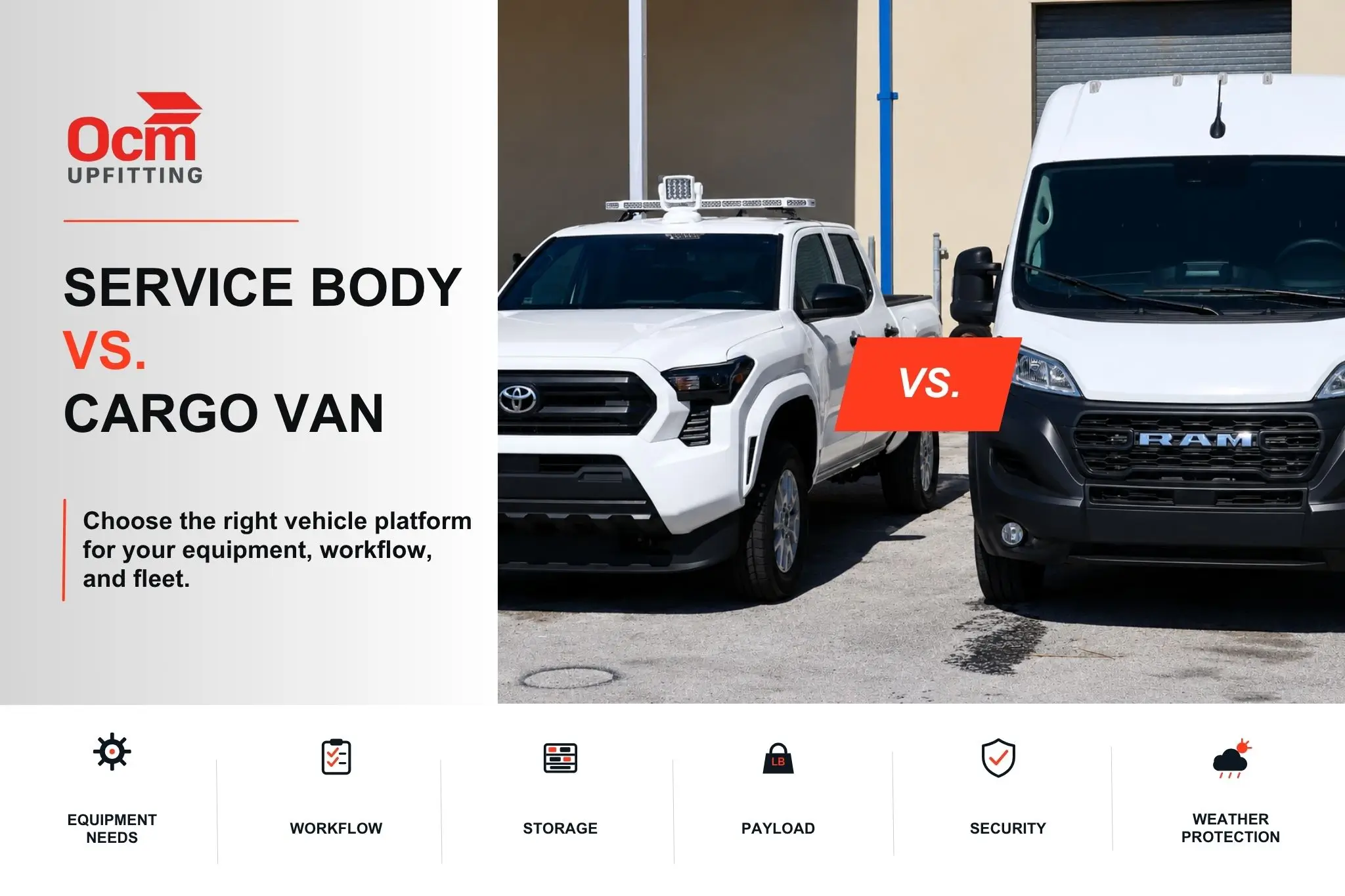
The Wrong Vehicle Platform Can Limit the Upfit Before It Starts
A technician can have the right tools and equipment and still lose efficiency if the vehicle makes those items difficult to reach, load, secure, or organize. That is why choosing service body vs. cargo van should happen before shelving, lighting, racks, cameras, or other upfit components are finalized.
For fleet managers, contractors, utilities, HVAC companies, plumbers, electricians, and facility-service teams, neither platform is automatically better. The right choice depends on equipment dimensions, how often crews access tools, payload requirements, weather exposure, security, parking environment, maintenance access, and whether the configuration needs to be repeated across a larger fleet. OCM Upfitting currently supports commercial and service fleet applications along with storage, fabrication, lighting, graphics, and other vehicle-integration needs.
Explore OCM Upfitting vehicle services
The goal is to choose the vehicle architecture that supports the job rather than forcing technicians to work around the vehicle.
Start With the Work Before Choosing the Body Style
A useful comparison begins with the vehicle mission.
NTEA’s commercial vehicle specification guidance recommends defining mission requirements, evaluating chassis and equipment needs, gathering stakeholder input, and aligning the vehicle specification with real operating conditions before procurement.
NTEA Vehicle Specification Process Guide
Document questions such as:
- What equipment travels every day?
- Which tools are accessed most frequently?
- What must stay protected from weather?
- What items require secure storage?
- Are ladders, pipe, conduit, or other long materials carried?
- Is heavy equipment loaded regularly?
- Where will the vehicle be parked?
- Does the crew work from inside or outside the vehicle?
- Will multiple vehicles use the same configuration?
Those answers are more useful than choosing a platform based only on what the fleet has purchased previously.
Where a Cargo Van May Fit Better
A cargo van provides an enclosed working and storage area, which can be useful when crews carry tools, inventory, diagnostic equipment, small parts, or materials that benefit from being organized inside the vehicle.
A van may deserve stronger consideration when the operation prioritizes:
- Enclosed tool and parts storage
- Interior shelving and drawers
- Weather protection for carried equipment
- A central aisle or interior working area
- Side and rear cargo access
- Large exterior surfaces for fleet graphics
- Trade-specific storage zones
OCM Upfitting’s current HVAC service van setup guide demonstrates why van layouts should be organized around technician role, frequency of tool use, bulky equipment, storage zones, electrical needs, and payload rather than simply filling every available space.
However, enclosed storage does not automatically make a van better. Technicians may need to step, crouch, or reach inside the cargo area depending on the layout.
OSHA notes that workers retrieving tools and materials from vans and trucks can encounter awkward reaching, crouching, kneeling, and climbing. That makes access and ergonomics part of the vehicle-selection decision, not just the shelving decision.
OSHA guidance on vehicular material handling
Where a Service Body May Fit Better
A pickup or chassis equipped with a service body can provide exterior compartment access that allows technicians to reach tools without entering an enclosed cargo area.
That configuration may deserve consideration when crews frequently need:
- Exterior tool access
- Separate lockable compartments
- Equipment organized by compartment
- Open or specialized space for bulky items
- Access to tools while working beside the vehicle
- Specialized mounting for job-specific equipment
- A truck-based platform for the required duty cycle
For utilities, field service teams, and contractors that repeatedly work beside the vehicle, exterior compartments can align well with the workflow.
But a service body should not be selected simply because the fleet carries heavy tools. Payload, axle ratings, body weight, equipment weight, and weight distribution still need to be reviewed for the exact chassis.
Do Not Assume One Platform Has More Usable Payload
One common mistake in the service body vs cargo van decision is assuming that one vehicle type automatically offers more useful carrying capacity.
The actual answer depends on the exact vehicle.
Fleet managers should review:
- GVWR
- Curb weight
- Available payload
- Axle ratings
- Body or upfit weight
- Tool and inventory weight
- Crew weight
- Weight distribution
GM’s current Body Builder Manuals contain vehicle-specific information such as frame dimensions, electrical schematics, and alteration guidance, illustrating why fleet decisions should be based on the actual chassis rather than a general assumption about vehicle category.
GM Upfitter Body Builder Manuals
Ford Pro likewise offers different upfitting pathways for vans, chassis, utility vehicles, and other commercial applications, reinforcing that the appropriate platform depends on the intended task and configuration.
Ford Pro commercial upfit resources
Compare Tool Access, Not Just Storage Volume
Storage capacity means little if the technician cannot efficiently reach the equipment.
Consider where employees normally stand when accessing:
- Hand tools
- Replacement parts
- Electrical components
- Diagnostic equipment
- Ladders
- Pipe or conduit
- Power tools
- Heavy equipment
A cargo van may work well when technicians benefit from organized interior zones.
A service body may work better when technicians repeatedly need exterior compartment access throughout the day.
Neither arrangement is universally more ergonomic. The correct layout depends on how the crew performs the job.
OCM Upfitting’s utility and service fleet upfitting guide also connects storage, equipment access, electrical systems, and workflow instead of treating them as separate decisions.
If your fleet is deciding between vans and service-body trucks, OCM Upfitting can review the vehicle roles, equipment inventory, access requirements, fleet quantity, and intended workflows before the configuration is finalized.
Think About Long Materials and Bulky Equipment Early
HVAC, electrical, plumbing, utility, and facility-service crews may carry ladders, pipe, conduit, compressors, diagnostic equipment, or other unusually shaped items.
Measure those items before choosing the platform.
Ask:
- Does the equipment fit inside the vehicle?
- Will exterior rack storage be required?
- Can heavy equipment be loaded without blocking frequently used tools?
- Does the load interfere with rear or side access?
- How will equipment be restrained?
- Will future equipment require additional space?
A vehicle that works well for a maintenance technician may be poorly suited to an installation crew carrying larger materials.
Compare Security and Weather Exposure Based on What You Carry
Do not assume that “enclosed van” automatically means secure enough or that “service body” automatically means equipment is exposed.
Security depends on the actual storage system, locks, partitions, equipment placement, operating environment, and procedures.
Weather considerations also vary.
A cargo van keeps much of its equipment inside an enclosed body. A service body can provide enclosed exterior compartments while leaving other cargo areas open depending on configuration.
Instead of choosing based on labels, inventory which tools and materials require:
- Enclosed storage
- Lockable storage
- Ventilation where applicable
- Weather protection
- Frequent exterior access
- Specialized restraint
Consider Parking, Visibility, and Daily Routes
Vehicle dimensions can affect real operations.
Review:
- Parking garages
- Height restrictions
- Tight service areas
- Residential driveways
- Urban parking
- Jobsites
- Loading zones
- Rear visibility
- Side visibility
- Ladder or rack height
Do not assume all vans or all service-body trucks have the same dimensional limitations. Roof height, wheelbase, body width, mirrors, racks, and installed equipment can change the finished vehicle profile.
A HVAC Fleet Comparison
Consider a HVAC company replacing 16 service vehicles.
Its maintenance technicians carry filters, fittings, diagnostic tools, small replacement parts, and refrigerant equipment. They frequently work from organized inventory throughout the day.
For that group, a cargo van with defined interior working zones may make sense.
The installation team carries more ladders, bulky tools, larger components, and materials that are frequently loaded and unloaded at jobsites. Depending on the equipment and operating environment, a truck with a service body may better support exterior access and larger items.
The fleet does not need to force both teams into one platform just for the sake of uniformity.
It can standardize within each job class.
OCM Upfitting’s fleet standardization guide recommends defining standard vehicle classes and repeatable upfit packages while still allowing controlled variations for different operational roles.
Compare Cost Drivers Without Relying on Generic Price Estimates
There is no responsible universal answer to which platform costs less after upfitting.
The quote can depend on:
- Base vehicle
- Service body or van configuration
- Storage equipment
- Racks
- Fabrication
- Lighting
- Cameras
- Electrical integration
- Graphics
- Vehicle quantity
- Installation complexity
- Standardization
A lower initial vehicle or equipment price does not necessarily mean a lower total project cost, but fleets should evaluate their own procurement and lifecycle requirements rather than rely on unsupported averages.
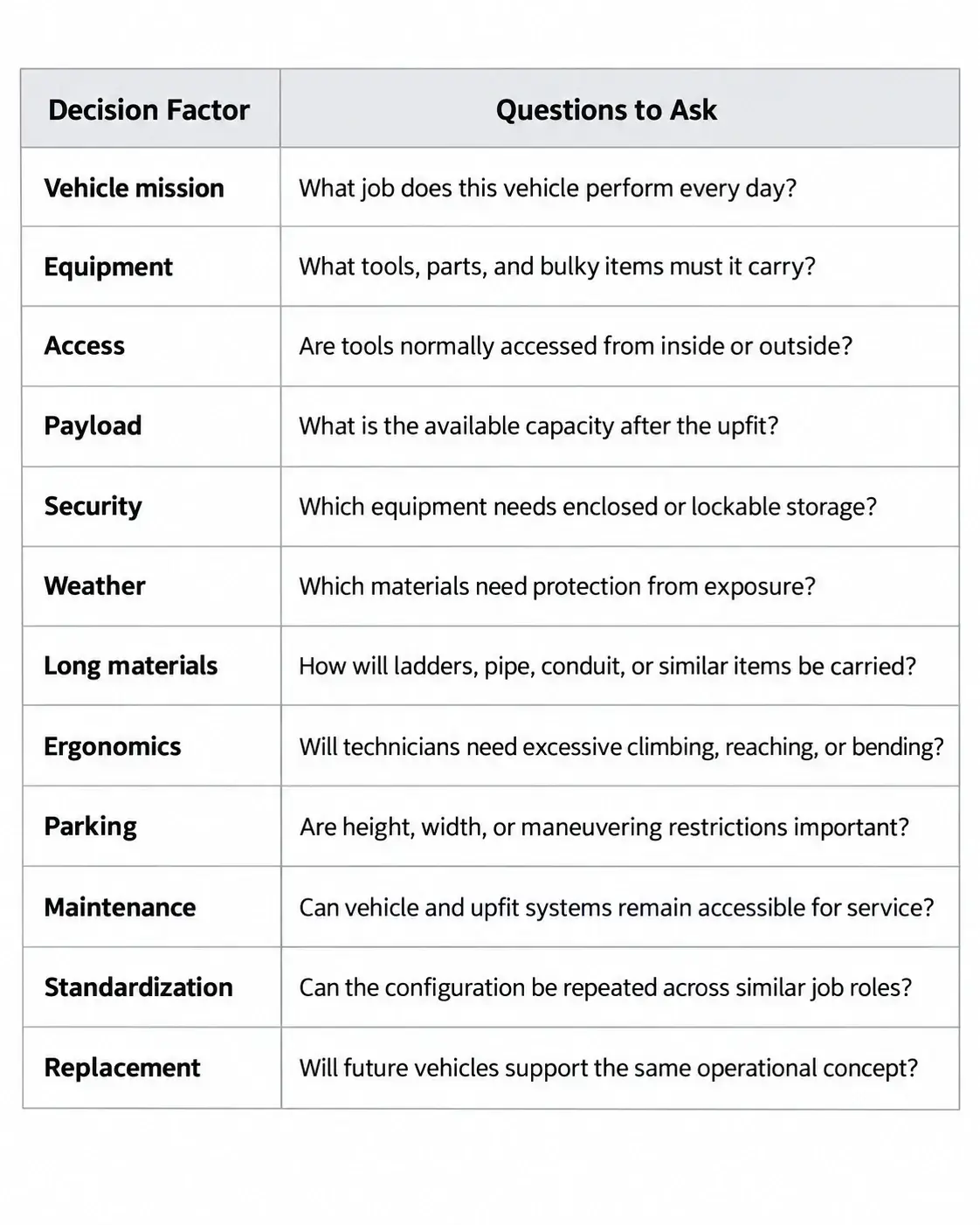
Service Body vs Cargo Van Decision Worksheet
Before selecting the platform, compare:
Choose the Platform Around the Job
The best service body vs cargo van decision is the one that matches the fleet’s work, equipment, employees, operating environment, payload requirements, and replacement strategy.
Fleet managers preparing a new service-vehicle purchase should gather the vehicle roles, fleet quantity, equipment list, equipment dimensions, workflow requirements, parking conditions, and existing fleet standards before finalizing the platform.
OCM Upfitting currently lists (954) 764-8117 as its primary contact number and supports commercial and service fleet vehicle projects.
Call (954) 764-8117 or use the OCM Upfitting project contact page to discuss your vehicle and upfit requirements before committing the fleet to one platform.
FAQs
Is a service body better than a cargo van for contractors?
Not universally. Service bodies can support exterior compartment access, while cargo vans can provide enclosed interior storage and organization. The better choice depends on equipment, workflow, payload, security, parking, and job requirements.
Which has more payload, a service truck or cargo van?
There is no universal answer. Available payload depends on the exact chassis, body, configuration, options, and installed equipment. Verify current OEM ratings for the specific vehicle under consideration.
Is a cargo van always more secure than a service body?
No. Security depends on the storage system, locks, equipment placement, partitions, vehicle configuration, and operating environment. Both platforms can incorporate secure storage when properly specified.
How should a fleet compare service body vs cargo van options?
Start with vehicle mission, tools, equipment dimensions, access frequency, payload, weather exposure, security, parking conditions, maintenance needs, and standardization requirements before selecting the platform.