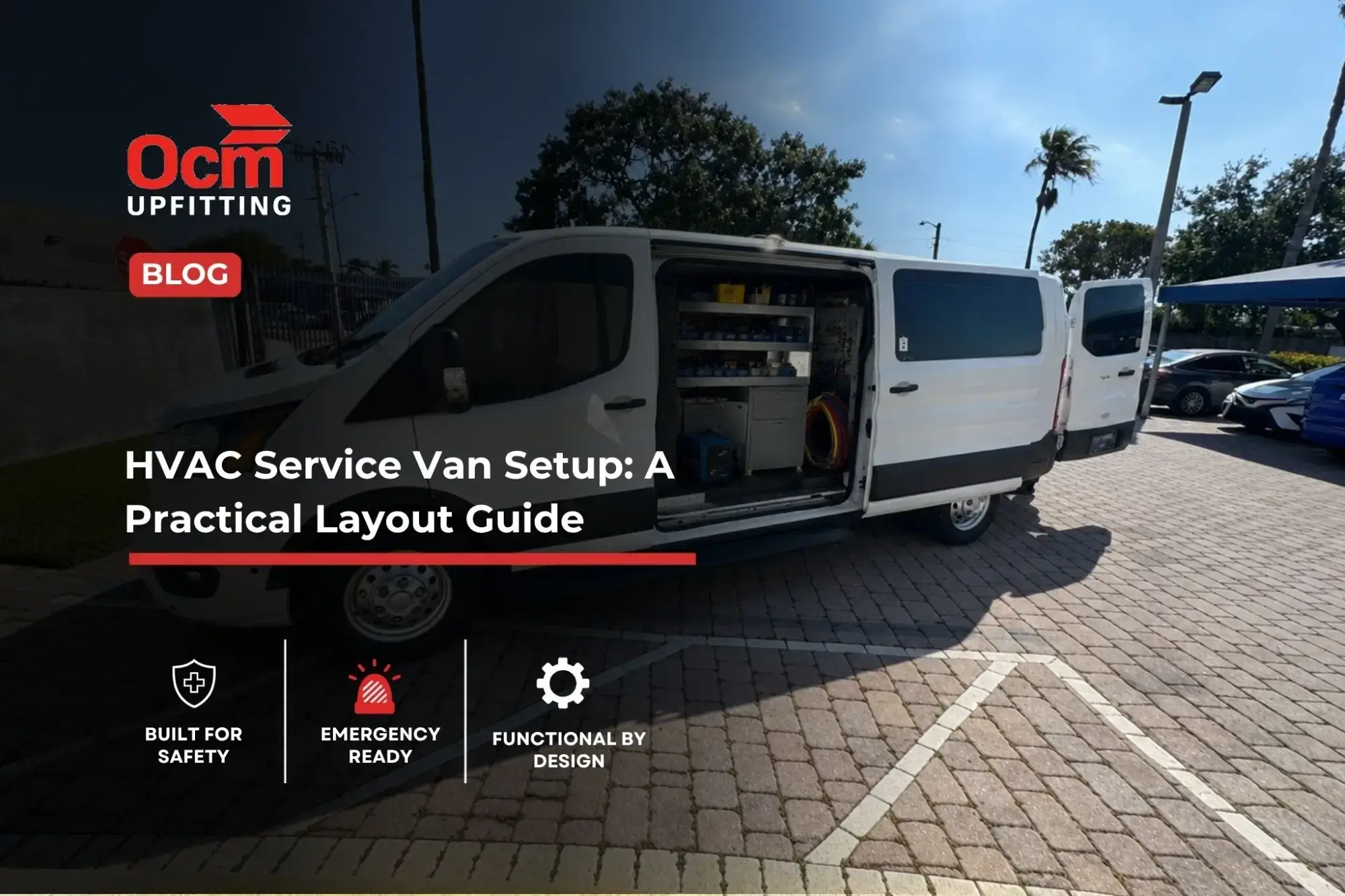
Build the Van Around the Technician’s Actual Work
An effective HVAC van setup should reduce unnecessary searching, rearranging, and difficult access to equipment during a technician’s workday. If filters block diagnostic tools or technicians regularly move heavy equipment to reach frequently used parts, the vehicle layout is working against the job.
For HVAC business owners, operations managers, and fleet leaders, the best design starts with workflow. OCM Upfitting provides vehicle upfitting for service and commercial fleets and currently positions its work for organizations operating across the United States.
Divide HVAC Van Organization Into Working Zones
Before selecting cabinets or shelves, map the cargo area by frequency and type of use. A practical HVAC service van layout can be divided into four zones:
- Daily-use tools and diagnostic equipment
- Replacement parts, filters, and replenishment stock
- Refrigerant cylinders and other pressurized materials
- Bulky tools, ladders, recovery equipment, and larger job materials
Frequently used items should generally be easier to reach than reserve stock. Heavy equipment placement also deserves attention. OSHA’s materials-handling guidance for heavy lifting recommends reducing awkward lifting and positioning manually handled materials in more favorable lifting zones where practical.
The goal of HVAC van organization is not to fill every available inch. It is to create predictable locations that support how technicians actually work.
Match HVAC Van Shelving to the Inventory
HVAC inventory ranges from small electrical components and fittings to filters, hoses, tools, and larger equipment. One shelf style rarely handles everything efficiently.
Effective HVAC van shelving may combine:
- Open shelves for larger parts and filters
- Divided bins for fittings and hardware
- Drawers for tools and sensitive equipment
- Dedicated spaces for frequently replenished inventory
- Secure locations for larger or heavier items
OCM Upfitting’s service van storage and shelving guide discusses adjustable shelving, drawers, tool mounting, partitions, and trade-specific layouts, including HVAC applications.
Fleet managers should inventory what technicians actually carry before ordering storage equipment. Filter sizes, common fittings, diagnostic tools, replacement motors, hoses, and seasonal stock can all influence shelf depth and placement.
Plan Refrigerant Cylinder Storage Before Installing Shelves
Refrigerant Tank Rack for Van Applications
A refrigerant tank rack for van should be treated as a restraint and transportation requirement, not simply another storage accessory.
Federal requirements depend on the material, packaging, quantity, and transportation operation. Current 49 CFR 177.840 requirements for Class 2 gases require covered cylinders to be appropriately restrained or otherwise secured to prevent shifting, overturning, or ejection under normal transportation conditions.
Before specifying the rack, determine:
- Which cylinders technicians will carry
- How many are normally transported
- Their dimensions and loaded weight
- Applicable restraint requirements
- How technicians will load and remove them
- What ventilation or other regulatory requirements apply to the materials carried
Ford’s current Transit trade upfit package information provides a useful industry example. Its HVAC package includes shelving, bins, refrigerant racks, restraints, and partition-related options, demonstrating how trade-specific vehicle packages combine several storage functions rather than treating them independently.
This does not mean the same package or layout works for every fleet. Vehicle dimensions, equipment, refrigerants, technician roles, and applicable requirements should drive the final design.
Put Small Parts and Diagnostic Tools Where Work Happens
Maintenance and diagnostic technicians often access meters, hand tools, electrical components, fittings, and charging equipment several times per day.
These items should not be buried behind replenishment stock.
Drawers and divided bins can create repeatable locations for smaller components. Charging stations may also be useful, but electrical equipment should be planned with appropriate power distribution, circuit protection, wiring, ventilation, and service access rather than added wherever space remains.
OCM Upfitting’s utility and service fleet upfitting guide emphasizes integrating storage, equipment access, electrical systems, and vehicle workflow as parts of the complete upfit.
If different technicians have created completely different storage systems over time, OCM Upfitting can review the inventory, technician roles, and vehicle platforms to help develop a more repeatable HVAC van upfit specification.
Use Partitions Without Ignoring Vehicle Safety Systems
A partition can separate the cab from the working cargo area and provide a defined starting point for shelves or equipment.
However, the partition needs to be compatible with the specific vehicle and surrounding safety systems. Vehicle modifications should not be approached as universal across every van platform.
NHTSA’s guidance concerning conversion of passenger vans illustrates why modifiers must consider Federal Motor Vehicle Safety Standards and avoid modifications that improperly make required safety equipment inoperative.
For fleet managers, this means checking current OEM body-builder or upfitter documentation before finalizing partition mounting, wiring routes, and other structural changes.
Use Cargo Lighting to Support the Storage Layout
Interior lighting should illuminate shelves, drawers, cylinder storage, and the central aisle.
That can matter during early morning calls, evening service work, parking-garage assignments, or any situation where technicians need to identify inventory without strong ambient lighting.
Lighting also competes for mounting space and electrical capacity. Plan fixture locations before shelves and racks eliminate access to appropriate mounting or wiring areas.
An HVAC service van layout should leave electrical protection and service points accessible. Technicians maintaining the vehicle should not need to dismantle unrelated shelving to reach a fuse, connector, or lighting component.
Check Payload and Weight Distribution
Every component added during an HVAC van upfit consumes some of the vehicle’s available payload.
That includes:
- Shelving
- Drawers
- Partitions
- Cylinder racks
- Ladders
- Tools
- Refrigerant cylinders
- Replacement parts
- Equipment
- Other cargo
Fleet managers should verify limits for the exact make, model, wheelbase, roof height, and configuration rather than applying a generic payload number to all vans.
Weight distribution matters as well. Placing every heavy component on one side simply because the shelving fits may create an undesirable configuration even if total vehicle weight remains within its overall limit.
Match the Layout to the Technician’s Role
A single design may not work equally well for every HVAC employee.
Installation Crews
Installation teams may carry ladders, larger tools, materials, and bulky equipment. They may benefit from more open cargo capacity and larger storage zones.
Maintenance Technicians
Maintenance vehicles may prioritize filters, replacement parts, consumables, hand tools, and frequently accessed inventory.
Diagnostic Specialists
Diagnostic technicians may need compact parts storage, meters, electronic equipment, charging locations, and secure drawers more than large open cargo areas.
An effective HVAC van setup can therefore use several controlled configurations instead of forcing every technician into one universal layout.
Standardize the Parts That Should Be Repeatable
Consider a hypothetical HVAC company with installation, maintenance, and diagnostic vans.
If every technician decides independently where tools, cylinders, filters, and parts belong, moving employees between vehicles becomes less predictable. Inventory replenishment and fleet replacement also become more complicated.
A better approach may be to create separate standardized templates for the three job types while keeping common elements consistent, such as:
- Cylinder restraint areas
- Common tool zones
- Lighting
- Electrical documentation
- Labeling
- Partition configuration
- Restocking locations
OCM Upfitting’s fleet standardization guide explains how repeatable specifications can coexist with mission-specific customization.
HVAC Van Layout Review Checklist
Before approving the build, review:
- Technician role
- Daily-use tools
- Filter and parts inventory
- Refrigerant cylinder requirements
- Bulky equipment dimensions
- Shelving and drawer access
- Ladder or long-material storage
- Charging requirements
- Cargo lighting
- Partition requirements
- Ventilation considerations
- Payload
- Weight distribution
- Electrical service access
- Restocking workflow
- Standardization across similar units
Build Your HVAC Fleet Around the Service Workflow
The best HVAC van setup is not necessarily the one with the most storage. It is the one that gives technicians predictable access to equipment, secures the materials they carry, respects vehicle limitations, and can be repeated where operational needs are similar.
OCM Upfitting works with service and commercial fleets on vehicle configurations designed around real operating requirements. Call (954) 764-8117 to discuss your vehicles, technician roles, equipment inventory, storage needs, and plans for a repeatable HVAC service-van specification. OCM Upfitting’s current website verifies the phone number and nationwide fleet positioning.
FAQs
What should be included in an HVAC van setup?
Typical requirements may include shelving, drawers, parts bins, cylinder restraint, lighting, charging equipment, partitions, ladder storage, and space for larger service equipment. The final layout should reflect the technician’s role and specific vehicle.
How should HVAC van organization be planned?
Inventory equipment by frequency of use. Keep daily-use tools accessible, separate reserve stock from bulky equipment, and plan dedicated restraint locations for cylinders and other materials with specific transportation requirements.
Should every HVAC technician use the same layout?
Not necessarily. Installation, maintenance, and diagnostic teams may need different capacities and access priorities. Fleets can standardize several role-based templates instead of using one layout for every vehicle.
How does an HVAC upfit affect van payload?
Shelving, racks, partitions, tools, cylinders, inventory, and other installed equipment all add weight. Verify the limits of the exact vehicle configuration using current OEM information before completing the specification.