The Wrong Upfitting Decision Can Affect an Entire Response Fleet
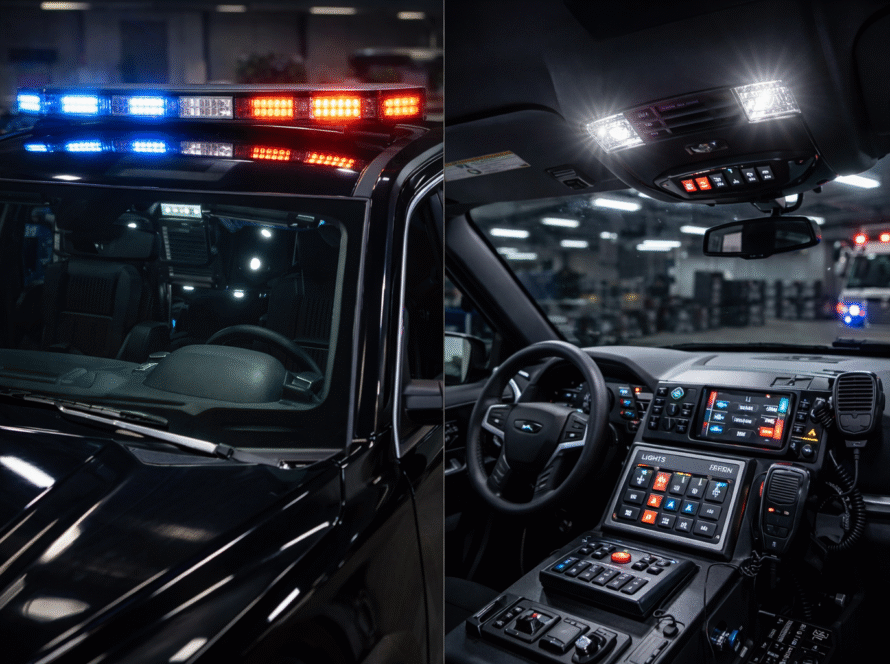
An emergency vehicle can have the specified lights, radios, cameras, and equipment yet still be poorly configured for the personnel expected to use it. Controls may be difficult to reach, equipment may interfere with another system, or the finished build may differ from the agency’s approved specification.
Choosing emergency vehicle upfitters requires evaluating more than installation capability. Public-safety fleet managers, procurement officers, and department administrators should compare how providers handle operational requirements, vehicle compatibility, electrical integration, agency approvals, testing, and long-term serviceability.
OCM Upfitting provides emergency lighting and public-safety equipment integration services for fleet applications involving warning lights, sirens, communications equipment, and related systems.
The goal is to select an upfitting partner that understands the complete vehicle configuration, not simply the individual products being installed.
1. Start With the Emergency Vehicle’s Mission
Before contacting an upfitter, define the vehicle’s operational role.
A patrol SUV, fire command vehicle, EMS support unit, and emergency-response truck can have significantly different equipment and workflow requirements.
Consider the following questions:
- What is the vehicle’s primary response function?
- Who operates the vehicle and its equipment?
- Which systems must be accessible from the driver’s or passenger’s position?
- What communications and warning equipment are required?
- Will personnel need specialized storage or mounted equipment?
- Does the vehicle require additional cameras, monitors, or control systems?
- What equipment needs to remain accessible during inspection or service?
For example, a police patrol SUV may prioritize driver-accessible controls, communications, and secure equipment storage. A fire command vehicle may require a different communications layout, work area, and storage arrangement.
The NTEA Vehicle Specification Process Guide emphasizes defining vehicle missions, involving relevant stakeholders, and developing clear specifications before procurement.
An effective upfitter should translate these operational requirements into an appropriate vehicle configuration.
2. Evaluate Experience With Public-Safety Equipment Integration
Not every company offering vehicle modifications has the same experience integrating emergency-response equipment.
Ask prospective emergency vehicle upfitters how they assess the interaction between multiple systems.
Emergency Lighting and Sirens
Public-safety warning systems may involve:
- Roof-mounted or low-profile light bars
- Grille, intersection, and rear warning lights
- Directional warning systems
- Sirens and public-address equipment
- Vehicle-specific control interfaces
The evaluation should cover warning visibility, approved operating modes, control placement, electrical integration, and maintenance access.
Emergency lighting requirements are not universal. Permitted colors, configurations, operating conditions, and vehicle authorizations vary by jurisdiction and application.
For example, Florida Statute 316.2397 establishes restrictions and exceptions for certain vehicle warning lights.
Agencies should identify applicable legal requirements and their own specifications before approving equipment.
Communications and Cameras
Communication systems require more than finding space for a radio.
An emergency vehicle equipment installation may involve radios, antennas, mobile data terminals, camera systems, monitors, charging equipment, and controllers.
Ask how the upfitter evaluates equipment locations, wiring routes, power requirements, operator access, and compatibility with the specific vehicle platform.
3. Ask How Vehicle Compatibility Is Verified
Equipment that fits one model year or vehicle platform should not automatically be considered compatible with another.
Before approval, the upfitter should review relevant vehicle information, including:
- Make, model, model year, and trim
- Chassis and wheelbase
- Available payload and axle ratings
- Equipment weight and distribution
- Electrical architecture and charging capacity
- Approved mounting locations
- Airbag and occupant-protection areas
- Driver visibility
- Access to vehicle service components
Vehicle weight ratings matter because an upfit adds equipment, occupants, and potentially other operational loads.
The GM Body Builder Manuals provide manufacturer-specific technical information, including electrical schematics and body dimensions. Ford Pro’s upfitter publications likewise provide resources for vehicle modifiers, including police-vehicle publications.
Ask which current manufacturer documents the upfitter will use for the proposed build.
Compatibility should be confirmed against the actual vehicles being ordered, rather than assumed from a previously completed installation.
4. Review Electrical Planning Before Installation
Emergency vehicles can operate multiple electrical systems simultaneously.
Warning lights, radios, cameras, computer equipment, chargers, and control modules may share the vehicle’s available electrical capacity.
An upfitter should be able to explain how the complete electrical system will be evaluated.
Important considerations include:
- Combined electrical demand
- Power distribution
- Circuit protection
- Grounding
- Ignition-controlled and constant-power functions
- Wiring protection
- Equipment interaction
- Service access
- Electrical documentation
A system functioning individually does not establish that every installed system will operate correctly together.
Qualified integration and vehicle-specific testing are important, especially when modifications interact with factory electrical and electronic systems.
Planning a public-safety fleet build? OCM Upfitting can discuss the vehicle platforms, intended equipment package, installation requirements, and fleet quantity before the proposed configuration is finalized.
5. Compare the Complete Procurement Scope
A lower initial proposal is not necessarily a better procurement decision if it excludes required equipment, integration work, testing, or documentation.
Before comparing prices, confirm that each provider is responding to the same approved specification.
OCM Upfitting’s fleet upfit RFP guide explains how a more complete scope of work helps reduce ambiguity during vendor evaluation.
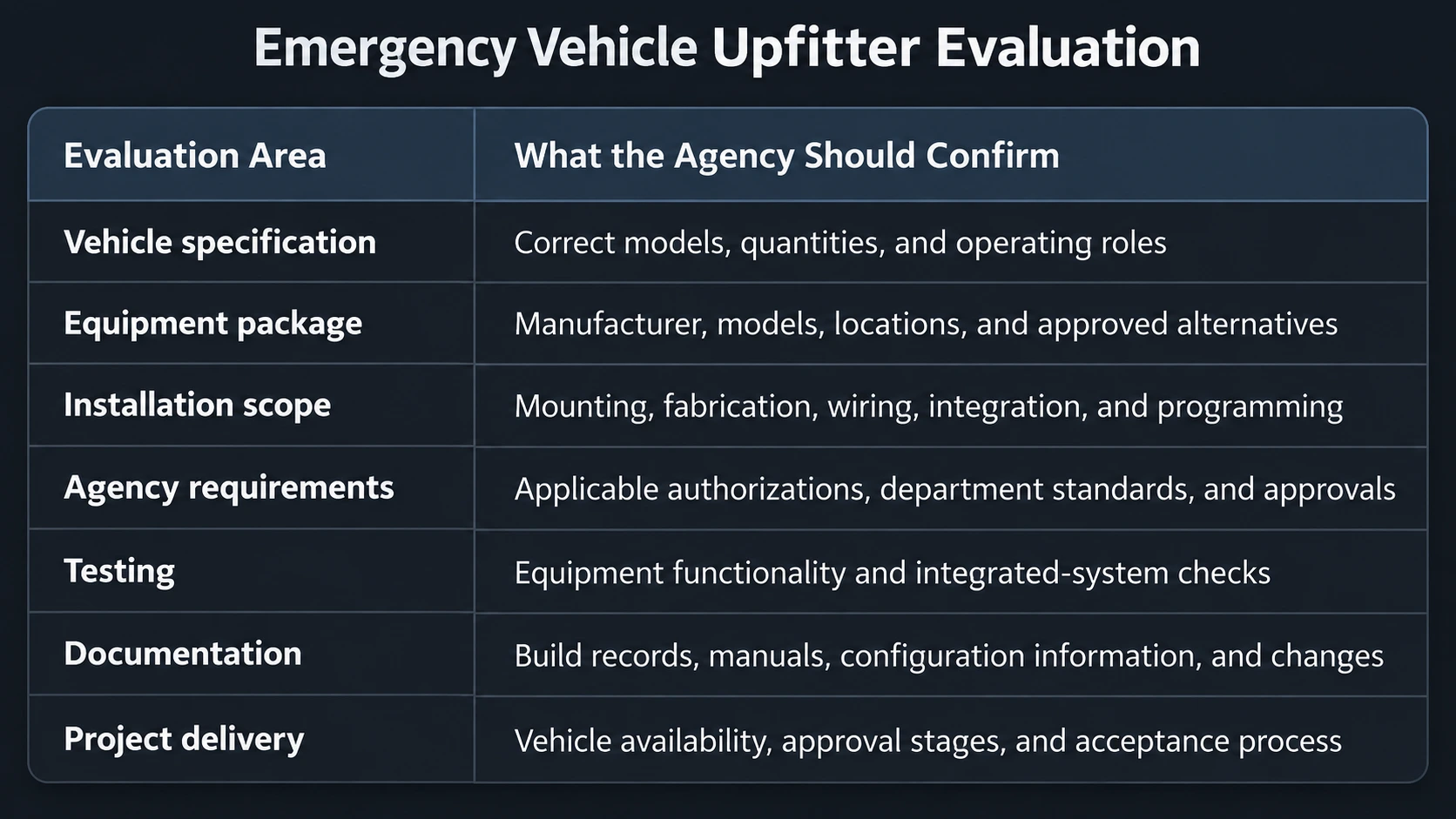
Ask bidders to identify exclusions, equipment substitutions, and assumptions separately.
This makes proposals easier to evaluate without assuming that the lowest total includes the same work.
6. Resolve Common Buyer Concerns Before Award
Can Existing Equipment Be Reused?
Possibly, but reuse depends on equipment condition, compatibility, vehicle interfaces, mounting requirements, and the agency’s approved specification.
Do not assume equipment from a retired vehicle can transfer directly into its replacement.
How Will Modifications Affect the Vehicle?
Ask how the upfitter reviews OEM modification guidance, occupant protection, electrical interfaces, weight limits, and applicable certification requirements.
Warranty responsibilities should also be clarified. An equipment manufacturer’s warranty, vehicle OEM warranty, and installation workmanship coverage are not necessarily the same.
What Happens if a Specified Product Becomes Unavailable?
Require written approval for material substitutions.
The review should address compatibility, function, pricing, scheduling, documentation, and testing before a revised component becomes part of the build.
Can the Same Configuration Be Repeated Across Several Vehicles?
Repeatability is valuable, but it depends on consistent vehicle platforms, approved equipment, documentation, and controlled exceptions.
The same design should not be imposed on different emergency-response roles when their requirements genuinely differ.
7. Require First-Vehicle Approval and Final Acceptance Testing
For a multi-vehicle emergency fleet, approving the first completed vehicle can identify problems before they are repeated.
The agency should compare that unit with the approved specification and involve the appropriate fleet, technical, and operational representatives.
A practical acceptance review may include:
- Confirming the installed equipment and locations
- Testing authorized warning-light and siren functions
- Checking radios, cameras, controls, and monitors
- Verifying electrical behavior under specified conditions
- Reviewing mounting and operator access
- Confirming approved substitutions
- Collecting build documentation
- Recording corrections before release
OCM Upfitting’s vehicle upfit acceptance checklist provides additional guidance for evaluating completed fleet vehicles.
Acceptance criteria should be established before the installation begins, rather than negotiated when the vehicle is ready for delivery.
8. Consider an Emergency Fleet Replacement
Consider a public-safety agency replacing 12 vehicles.
Eight are patrol SUVs, while four are supervisor and command-support vehicles.
All 12 vehicles require certain common communications and warning-system functions. However, the command-support vehicles also require a different equipment layout and additional work-related storage.
The agency could standardize shared equipment models, appropriate controls, documentation, and inspection requirements while approving separate layouts for the two operational roles.
The procurement process would include:
- Define the operating requirements for each vehicle group.
- Confirm the platforms and approved equipment.
- Review electrical and mounting requirements.
- Approve representative first builds.
- Document any necessary corrections.
- Apply the approved specifications to subsequent units.
- Complete individual vehicle acceptance checks.
This hypothetical example illustrates why public safety vehicle upfitting should balance consistency with mission-specific requirements.
Standardization is useful when the vehicles perform similar work. Controlled differences are appropriate when the work changes.
9. Prepare These Details Before Requesting a Proposal
Before discussing emergency fleet upfitting services, prepare a basic project summary.
Include:
- Agency or department
- Intended vehicle roles
- Vehicle make, model, model year, and quantity
- Required warning and communications equipment
- Camera, console, mounting, and storage requirements
- Existing equipment proposed for reuse
- Agency specifications and approval requirements
- Desired standardization
- Vehicle arrival and deployment considerations
- Testing and documentation expectations
- Any existing approved build specifications
A complete initial description helps the upfitter identify questions before estimating the work.
Discuss Your Emergency Fleet Upfit Requirements
Choosing the right emergency vehicle upfitter means finding a provider that can evaluate the entire vehicle around its intended mission, rather than treating every component as a separate installation.
OCM Upfitting works with public-safety and emergency-response fleet applications involving lighting, communications equipment, vehicle conversions, custom fabrication, storage, and integrated vehicle systems.
Fleet managers, police administrators, fire-rescue departments, and procurement teams preparing an upcoming project should have their vehicle models, fleet quantity, operating roles, required equipment, and agency specifications ready.
Call OCM Upfitting at (954) 764-8117 or use the OCM Upfitting project contact page to discuss the proposed vehicle configuration before the final build specification is approved.
FAQs
What should agencies look for in emergency vehicle upfitters?
Evaluate relevant vehicle experience, equipment integration capabilities, OEM technical review, emergency warning-system planning, electrical design, testing procedures, documentation, and agency-specific requirements. The provider should be able to explain how those factors affect the proposed vehicle configuration.
Do emergency vehicle upfitters install lighting, sirens, and radios?
Many emergency vehicle upfitting projects involve these systems, but capabilities differ by provider. Agencies should confirm the exact services, equipment compatibility, installation scope, and testing requirements before awarding a project.
How much does emergency vehicle upfitting cost?
Pricing depends on the vehicle platform, number of units, equipment package, wiring, fabrication, communications equipment, programming, testing, and documentation. A project-specific quotation is more useful than assuming a universal price range.
Should emergency fleet vehicles use identical upfit specifications?
Vehicles with similar roles may benefit from standardized equipment and layouts. Different vehicle platforms, operational assignments, and department requirements may justify controlled variations. Each approved configuration should be documented and tested appropriately.