A Finished-Looking Vehicle Is Not Necessarily Ready for Service
The worst time to discover a missing fuse label, loose equipment mount, incorrect radio programming, or inaccessible service point is after the vehicle has already been assigned to a driver.
That is why a vehicle upfit acceptance checklist should be part of the delivery process for commercial, government, municipal, public-safety, and service fleets. The inspection gives fleet managers a final opportunity to compare the completed vehicle against the approved specification before signing off, deploying it, and repeating the same build across additional units.
OCM Upfitting currently works with law-enforcement, emergency-response, security, service, and other fleets, with capabilities that include vehicle equipment integration, lighting, conversions, communications-related systems, fabrication, graphics, and fleet builds. Its own upfitting timeline identifies testing, inspection, documentation, and fleet acceptance as part of the final project stage.
Start the Fleet Vehicle Delivery Inspection With the Approved Specification
The first question is not whether the vehicle looks good. It is whether the fleet received what it approved.
Compare the completed vehicle against the purchase order, build sheet, equipment list, approved drawings, and any authorized change orders.
Your fleet vehicle delivery inspection should verify:
- Correct vehicle make, model, trim, and configuration
- Equipment manufacturer and model where specified
- Correct quantities
- Approved substitutions only
- Required mounting locations
- Storage or partition configuration
- Lighting and communications equipment
- Cameras, monitors, or recording equipment where specified
- Graphics and identification
- Required accessories
If a fleet is building several identical vehicles, resolve discrepancies on the first completed unit before treating that vehicle as the template for the rest of the rollout.
This connects directly to the planning principles in OCM Upfitting’s fleet vehicle upfitting timeline guide, which recommends defining testing and acceptance requirements before handoff rather than deciding what counts as “finished” at delivery.
Inspect Mounting Security, Placement, and Driver Visibility
Equipment should be checked not only for presence, but also for placement and usability.
An upfit inspection checklist should consider whether:
- Consoles and controls are securely mounted
- Radios and microphones remain accessible
- Cameras have the intended field of view
- Monitors do not create unnecessary sightline obstructions
- Storage equipment opens and closes correctly
- Frequently used equipment can be reached as intended
- Installed components do not interfere with normal vehicle controls
- Service panels remain accessible
Occupant-protection areas also matter. NHTSA explains that businesses modifying vehicles after first retail sale must not knowingly make inoperative safety equipment installed to meet applicable federal motor vehicle safety standards. For new vehicles altered before first retail sale, different alterer certification requirements may apply. Fleet teams should use the applicable OEM documentation and regulatory requirements when evaluating completed modifications. Review NHTSA guidance on vehicle alterations and safety equipment
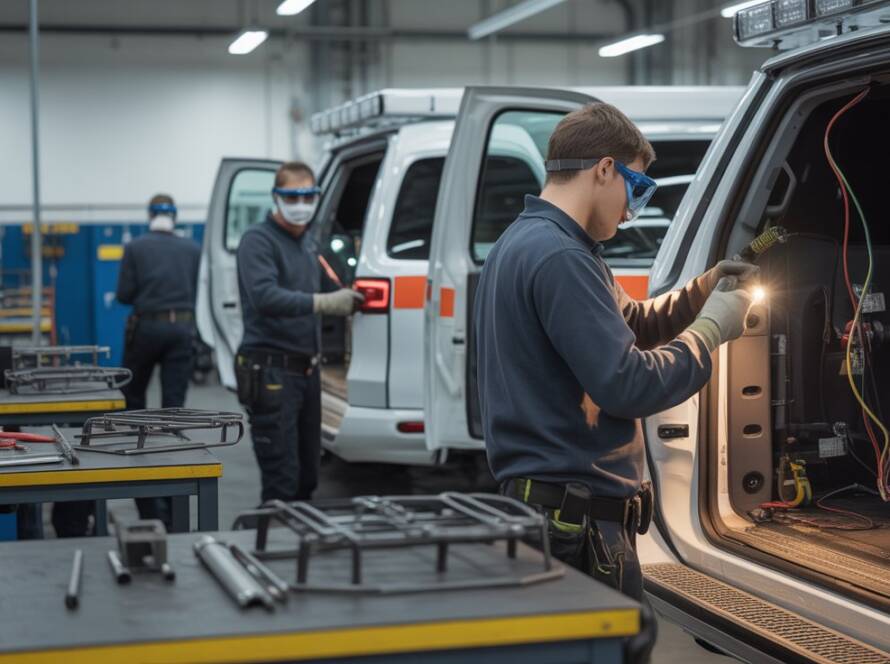
Inspect Wiring, Cable Protection, and Service Access
A clean dashboard does not tell you whether the electrical installation will be easy to maintain later.
Look at the accessible portions of the installation and confirm:
- Cables are appropriately protected
- Harnesses are supported and routed consistently
- Wiring is protected from obvious abrasion or pinch points
- Fuses and power-distribution components can be reached
- Circuits are labeled according to the agreed specification
- Connectors are secured
- Service technicians can identify installed systems
- Documentation corresponds to the completed build
GM’s official upfitter guidance emphasizes protecting wiring from damage and notes that proper routing is important to long-term electrical-system reliability. Its body-builder resources also contain vehicle-specific electrical schematics and technical information that demonstrate why the final installation should be evaluated against the actual vehicle platform. GM Upfitter Integration Best Practice Manuals GM Body Builder Manuals
Ford also maintains vehicle-specific upfitter publications and resources for modifiers. The applicable manufacturer’s current documentation should take priority over assumptions carried over from another vehicle model or model year.
Test Every System, Then Test Systems Together
A component powering on is only the first check.
The upfitted vehicle final inspection should verify each installed system individually and then confirm that major systems operate together as expected.
Depending on the vehicle specification, test:
- Work or warning lighting
- Siren and control equipment on authorized vehicles
- Radios and microphones
- Cameras and monitors
- DVR or recording equipment
- Auxiliary controls
- Charging equipment
- Interior lighting
- Scene or cargo lighting
- Other installed electronics
Programming should also match the approved specification.
For radio-equipped vehicles, OCM Upfitting’s two-way radio installation guide recommends checking communications performance, audio clarity, ignition behavior, equipment interaction, mounting security, and service access before release.
Camera-equipped fleets should perform a similar review. The company’s fleet camera system guide identifies camera locations, recording settings, monitor placement, inspection procedures, replacement considerations, and driver training as areas that can benefit from standardized specifications.
If your fleet is preparing to accept the first vehicle in a larger rollout, OCM Upfitting can review the specification and acceptance requirements so the approved first unit provides a clearer reference for subsequent builds.
Include Electrical-Load and Ignition-Behavior Checks
Modern upfits can combine lighting, communications equipment, cameras, chargers, controls, monitors, and other electronics.
The acceptance process should confirm that the vehicle behaves as specified under realistic operating conditions.
At a fleet-management level, check:
- Startup and shutdown behavior
- Ignition-controlled equipment
- Constant-power equipment where specified
- Simultaneous operation of major installed loads
- Unintended resets or interruptions
- Key-off behavior
- Access to circuit protection
- Abnormal warning indicators
Avoid applying a universal voltage, current, or parasitic-draw threshold to every vehicle. Test criteria should come from the specific OEM documentation, installed-equipment requirements, and approved build specification.
Give Public-Safety Vehicles a Mission-Specific Acceptance Test
A police vehicle acceptance inspection or other authorized emergency-vehicle inspection requires additional mission-specific checks.
Where included in the approved specification, confirm:
- Warning-light functions and control sequences
- Siren and speaker operation
- Radio operation
- Camera interaction
- Console controls
- Equipment accessibility
- Storage or partition operation
- Graphics and unit identification
- Programming
- Driver visibility
Acceptance testing should verify that the vehicle matches the agency-approved specification. It should not be treated as a substitute for the agency’s legal, regulatory, or policy review.
Verify Graphics, Labels, Keys, and Loose Accessories
Small delivery details are easy to miss because they are not part of the major equipment installation.
Check:
- Fleet graphics and decals
- Unit numbers
- Required reflective markings where specified
- Equipment labels
- Fuse or circuit identification
- Keys
- Remote controls
- Microphones
- Chargers
- Removable accessories
- Spare components included in the purchase
- Manuals supplied with equipment
The goal of fleet upfit quality control is to confirm that the fleet receives the complete vehicle package, not simply the permanently mounted components.
Collect Documentation Before Signing Off
Do not allow documentation to become a follow-up task after the vehicle has been deployed.
Depending on the project, the delivery package may include:
- Final equipment list
- Approved substitutions
- Wiring or circuit documentation
- Programming information appropriate for fleet records
- Equipment manuals
- Warranty information
- Serial numbers where relevant
- Keys and accessory inventory
- Final inspection record
- Outstanding-items list
- Authorized change orders
- Acceptance sign-off
For certain new vehicles altered before first retail sale, federal alterer certification requirements may also apply. NHTSA guidance explains that an applicable alterer must supplement the original certification label with an additional certification label for the altered vehicle. Fleet buyers should verify the applicable documentation and labeling for their particular vehicle and transaction rather than assuming every upfit falls into the same regulatory category.
Do Not Confuse Acceptance Inspection With Routine Maintenance
The vehicle upfit acceptance checklist is a pre-deployment process.
Its purpose is to establish that the fleet received the specified build and that the equipment is installed, configured, documented, and functioning as expected at handoff.
A monthly, quarterly, annual, or preventive-maintenance inspection serves a different purpose. After the vehicle enters service, recurring inspections may look for wear, damage, loose equipment, degraded wiring, failed lighting, camera problems, storage damage, or other changes caused by normal use.
In simple terms:
Acceptance inspection: Did we receive the vehicle we ordered?
Routine inspection: Is the vehicle and its equipment still operating and being maintained appropriately?
Both matter, but they should not be combined into one generic checklist.
Use the First Approved Vehicle as the Fleet Reference
Consider a public-works fleet receiving 15 similarly equipped vehicles.
If all 15 are delivered before anyone performs a detailed inspection, the fleet could discover that an inconvenient fuse location, inconsistent label, incorrect accessory location, or programming issue has been repeated across every vehicle.
A stronger process is to inspect and approve the first unit against the vehicle upfit acceptance checklist, document any corrections, and then use that approved configuration as the reference for subsequent vehicles.
This approach aligns with OCM Upfitting’s guidance on fleet standardization and repeatable vehicle specifications, which emphasizes documented equipment packages and inspection procedures while allowing specialized vehicles to differ where their mission requires it.
Vehicle Upfit Acceptance Checklist
Before signing the final acceptance, confirm:
- Vehicle matches the approved platform
- Equipment matches the specification
- Substitutions were authorized
- Quantities are correct
- Mounting is secure
- Driver visibility is acceptable
- Controls are accessible
- Fuses and power distribution are accessible
- Wiring is protected and documented
- Circuits are labeled as specified
- Lighting functions correctly
- Sirens operate correctly where applicable
- Radios transmit and receive as required
- Cameras and monitors operate as intended
- Systems function together
- Programming matches the approved configuration
- Ignition behavior has been tested
- Electrical-load testing is complete
- Graphics and identification are correct
- Keys and accessories are present
- Manuals and warranty information are supplied
- Outstanding issues are documented
- Fleet representative has completed sign-off
Make Acceptance Part of the Upfit Specification
A fleet should know how it will accept a vehicle before the installation begins.
OCM Upfitting’s current website positions the company for fleet work across the United States and identifies final inspection as part of its broader vehicle-upfitting process. Its current contact page lists (954) 764-8117 as the main phone number.
Call (954) 764-8117 to discuss your vehicle types, equipment specifications, fleet quantity, testing requirements, and acceptance process before your next vehicles move from the upfit shop into service. Contact OCM Upfitting about an upcoming fleet build
FAQs
What should be included in a vehicle upfit acceptance checklist?
The checklist should verify equipment against the approved specification, mounting, driver visibility, wiring protection, fuse access, system operation, programming, electrical behavior, graphics, documentation, warranties, accessories, and final sign-off.
Who should perform the fleet vehicle delivery inspection?
A fleet representative familiar with the approved specification should participate. Depending on the organization, that may include fleet management, operations, procurement, safety, IT or communications personnel, or the department that will use the vehicle.
What is the difference between an acceptance inspection and a maintenance inspection?
An acceptance inspection verifies the newly upfitted vehicle before deployment. Routine maintenance inspections evaluate the vehicle and installed equipment after they have been exposed to normal operating conditions, wear, service, and time.
Should the first vehicle in a fleet rollout receive a more detailed inspection?
Yes. When several vehicles share the same specification, thoroughly validating the first completed unit can establish the approved reference for the remaining builds. Mission-specific differences should still be inspected separately.