Before You Add Equipment, Define What the Vehicle Actually Does
A security vehicle can be fully equipped and still be poorly configured if the upfit does not match the officer’s actual assignment.
That is why private security vehicle upfitting should start with the mission rather than an equipment catalog. A campus patrol SUV, shopping-center security vehicle, mobile response unit, corporate security sedan, and general property-patrol vehicle may all need different visibility, communications, recording, storage, and power configurations.
For security directors, fleet managers, operations leaders, and procurement teams, the objective is a vehicle that supports daily patrol without unnecessarily copying a police configuration. OCM Upfitting currently lists Private Security among the industries it serves and positions its vehicle-upfitting work for security and other fleets across the United States.
Start the Checklist With the Security Assignment
Before selecting security patrol vehicle equipment, document how each vehicle will actually be used.
Campus and Facility Patrol
These vehicles may spend long periods moving around controlled properties. Priorities can include communications, cameras, equipment organization, identification, and lighting appropriate to the property and jurisdiction.
Property and General Patrol
Vehicles assigned to commercial properties, residential communities, or multiple client sites may need conspicuous branding, reliable communications, recording equipment, and organized storage.
Mobile Response
A response vehicle may place greater emphasis on communications, driver access to frequently used equipment, visibility, electrical capacity, and equipment that remains secure while the vehicle is moving.
Executive or Corporate Security
These vehicles may require a lower-profile approach. Equipment placement, antennas, communications hardware, cameras, and interior organization may need to preserve a less conspicuous exterior.
The goal is not one universal security fleet vehicle upfitting package. It is a small number of clearly defined configurations tied to actual roles.
Verify Patrol Vehicle Lighting Before Ordering It
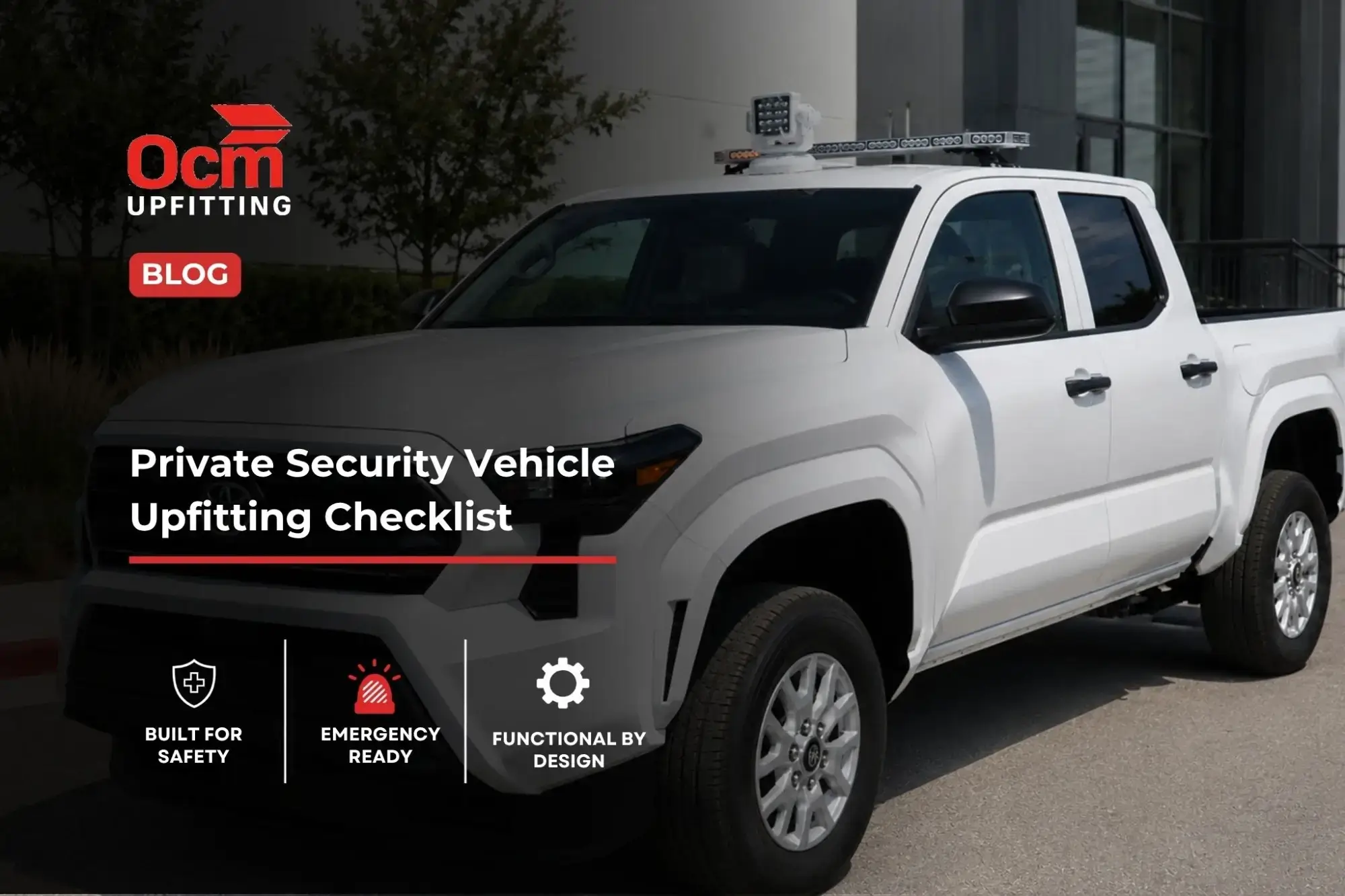
Patrol vehicle lighting should be selected according to the vehicle’s legal status, operating purpose, and applicable state or local rules.
Do not assume that a private security company can use the same colors or warning configuration as law enforcement. Regulations vary substantially by jurisdiction.
Florida provides a useful example. Current Florida law restricts certain red, red-and-white, and blue lighting and specifically limits blue lights to defined vehicle categories that include police vehicles. Private security operators in Florida should therefore verify the current statute and any other applicable requirements before choosing a warning-light package. Florida Statute 316.2397 on vehicle lighting
For broader equipment-selection considerations, OCM Upfitting’s emergency lighting system planning guide discusses roof, dash, deck, hideaway, intersection, and directional lighting. The legal authorization for any particular configuration still has to be verified for the security operation and jurisdiction.
Plan Security Vehicle Communications as a System
Reliable security vehicle communications are about more than attaching a radio to the dashboard.
A fleet specification may need to address:
- Radio-head location
- Microphone access
- Speaker placement
- Antenna position
- Mobile data terminal or tablet mounting
- Circuit protection
- Grounding
- Cable routing
- Equipment labeling
- Future programming and service access
OCM Upfitting’s dedicated radio, antenna, and MDT installation service includes vehicle mounting, antenna integration, power routing, and communications equipment, and specifically lists campus and facility security among common applications.
Radio authorization also matters. The FCC states that Private Land Mobile Radio systems support businesses and organizations with communications needs, while users operating on frequencies in the Industrial/Business Pool may be required to obtain the appropriate station license. Fleet teams should verify the radio system and licensing requirements rather than assuming hardware installation alone authorizes operation. FCC Private Land Mobile Radio Services FCC Industrial and Business licensing guidance
Add Cameras and DVRs Around a Defined Purpose
Cameras can support visibility, incident documentation, or monitoring, but the specification should begin with what the organization actually needs to see or record.
Questions for the private security fleet equipment checklist include:
- Is forward-facing recording required?
- Is rear or side visibility important?
- Is interior recording appropriate for the assignment?
- Will several cameras need centralized DVR recording?
- Where will a monitor be positioned?
- Who can access recorded footage?
- How will equipment be inspected and serviced?
OCM Upfitting’s Fleet Camera Systems buyer’s guide confirms its current camera-related capabilities include dash, rear-view and side cameras, DVRs, intercoms, and in-vehicle monitors. It also emphasizes camera placement, electrical integration, visibility, serviceability, and fleet standardization.
Privacy, retention, employee-monitoring, and recording rules should be reviewed for the organization’s specific jurisdiction and policies before deployment.
Protect Driver Visibility and Occupant Safety
Consoles, radios, monitors, cameras, tablets, switches, and storage can quickly crowd the interior.
Equipment should not obstruct the driver’s normal view or interfere with controls and occupant-protection systems.
NHTSA explains that manufacturers, distributors, dealers, and motor-vehicle repair businesses are generally prohibited from knowingly making inoperative safety equipment installed to satisfy applicable Federal Motor Vehicle Safety Standards. That makes OEM documentation and airbag zones important considerations when modifying vehicle interiors. NHTSA vehicle modification guidance
OEM upfitter documentation should also be reviewed for the specific make, model, and model year. Ford Pro upfitter publications are one example of manufacturer resources intended to support vehicle-specific modification planning.
Organize and Secure Equipment Around Frequency of Use
Poor storage creates unnecessary movement and clutter.
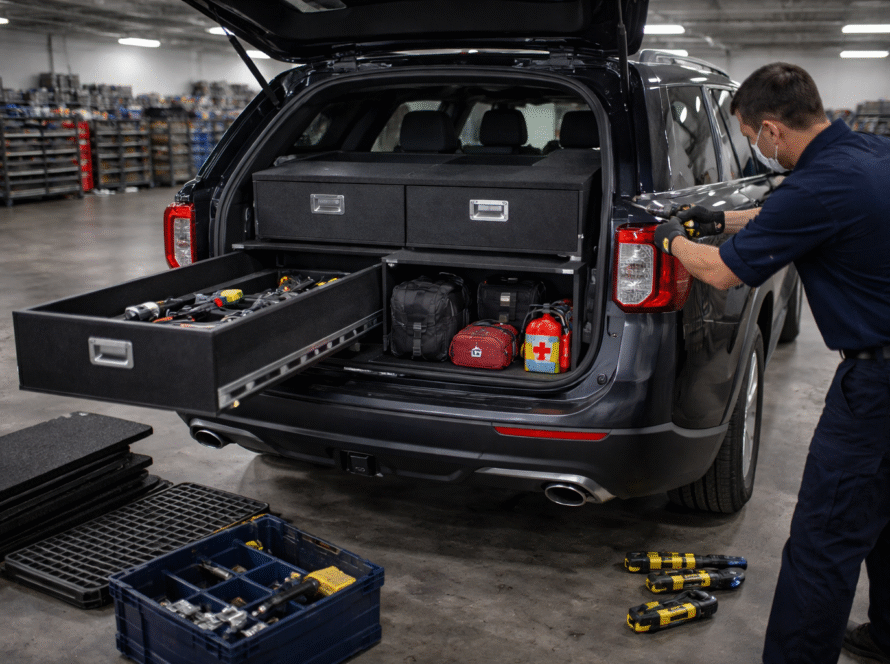
Frequently used items should have predictable locations that officers can access without unloading unrelated equipment. Less frequently used supplies can occupy secondary storage zones.
Consider:
- Lockable equipment storage where required
- Document and clipboard organization
- Flashlight and charger locations
- First-aid and safety-supply storage
- Cones or traffic-control equipment where appropriate
- Weather gear
- Spare batteries
- Site-specific equipment
The correct layout depends on assignment. A campus unit may carry different security patrol vehicle equipment from a mobile-response vehicle serving multiple properties.
If your fleet has accumulated different radios, camera positions, storage layouts, lighting controls, and vehicle graphics over time, OCM Upfitting can review the operational roles and help develop a more repeatable specification before the next vehicle order.
Plan the Electrical Load Before Systems Are Installed
Radios, cameras, DVRs, monitors, chargers, tablets, lighting, GPS hardware, and other electronics all add electrical demand.
Professional private security vehicle upfitting should address these systems together rather than installing them as unrelated accessories.
At the fleet-planning level, document:
- Required equipment
- Vehicle-specific power provisions
- Circuit protection
- Grounding
- Ignition-controlled and constant-power requirements
- Cable protection
- Heat around electronic components
- Fuse and service access
- Electrical documentation
The exact electrical design should follow OEM and equipment-manufacturer requirements for the specific vehicle.
Use Branding to Match the Security Mission
Some private-security operations benefit from clearly identifiable vehicles. Others intentionally use a lower-profile appearance.
Where visible identification is appropriate, consistent graphics can help distinguish company vehicles and reinforce a standardized fleet appearance.
OCM Upfitting’s graphics and vehicle branding service covers professional design and application of vehicle graphics.
Fleet managers should coordinate vehicle colors, logos, unit numbering, reflective materials where applicable, and client-specific identification requirements as part of the specification rather than treating graphics as an afterthought.
Standardize Similar Vehicles Without Forcing One Universal Build
A hypothetical regional security company might operate 18 vehicles across corporate campuses, residential communities, and mobile-response assignments.
Giving all 18 vehicles exactly the same private security fleet equipment could create unnecessary equipment on some units while leaving others underspecified.
A better approach could establish three templates:
- Campus and property patrol
- Mobile response
- Low-profile corporate security
Common elements such as radio mounting, camera controls, charging locations, equipment labeling, documentation, and inspection procedures could remain consistent.
OCM Upfitting’s guidance on fleet standardization and repeatable vehicle specifications discusses establishing common equipment and installation standards while retaining mission-specific customization where necessary.
Private Security Vehicle Upfitting Checklist
Before approving the final build, confirm:
- Vehicle role and operating environment
- Applicable warning-light authorization
- Required visibility equipment
- Radio and antenna requirements
- Communication-system licensing where applicable
- Camera coverage
- DVR or monitor requirements
- Privacy and recording policies
- Secure storage requirements
- Interior equipment organization
- Driver visibility
- Airbag and occupant-protection zones
- Electrical load planning
- Charging requirements
- GPS or communications hardware requirements
- Vehicle graphics and identification
- Service access
- Documentation
- Standardization across similar vehicles
Build Security Vehicles Around the Assignment
Successful private security vehicle upfitting starts by understanding the assignment, not by copying an emergency-service vehicle.
OCM Upfitting currently supports private-security fleets along with commercial and public-safety applications, with lighting, communications, graphics, vehicle electronics, storage-related solutions, and broader vehicle integration represented across its current site. Its published contact information lists (954) 764-8117.
Call (954) 764-8117 to discuss your patrol assignments, vehicle types, communications requirements, equipment, visibility needs, and plans for a repeatable security fleet specification.
FAQs
What equipment should a private security patrol vehicle have?
The correct security patrol vehicle equipment depends on the assignment. Common planning categories include lawful visibility equipment, radios, antennas, cameras, DVRs, monitors, GPS or communications hardware, secure storage, charging equipment, graphics, and organized interior equipment.
Can private security vehicles use emergency lights?
Authorization varies by jurisdiction, vehicle classification, color, and operating purpose. Security companies should verify current state and local requirements before selecting or installing patrol vehicle lighting. Police-style lighting should never be assumed to be authorized for private-security use.
What should be considered when installing security vehicle communications?
Plan radio placement, microphones, antennas, speakers, power, grounding, cable routing, programming, and future service access together. Depending on the system and frequencies used, FCC licensing requirements may also apply.
Should every private security vehicle have the same upfit?
Not necessarily. Security fleet vehicle upfitting can standardize common controls, communications, documentation, storage practices, and equipment locations while allowing campus, mobile-response, corporate, and general patrol vehicles to use different mission-specific configurations.