A Fleet Rollout Can Lose Control Before the First Vehicle Is Finished
A multi-vehicle project becomes difficult when vehicle arrivals, equipment deliveries, installation, graphics, programming, approvals, and fleet deployment are all moving on separate schedules. One delayed decision can affect more than one vehicle when the same configuration is being repeated.
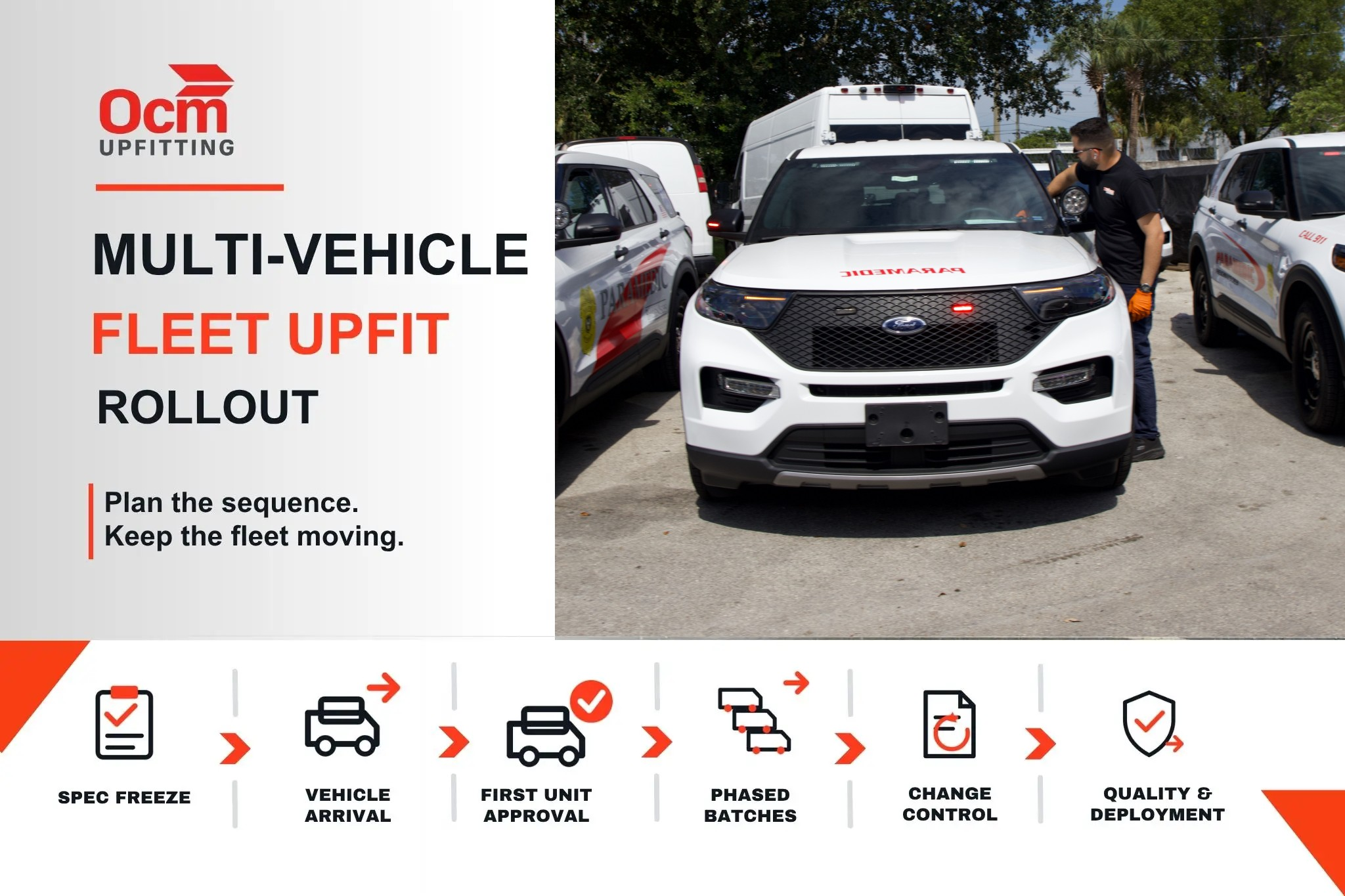
A successful fleet upfit rollout therefore needs more than an installation calendar. Fleet managers should establish the approved specification, identify what must happen before production begins, determine how vehicles will enter and leave the upfit process, and decide how the existing fleet will remain operational while replacement units are deployed.
OCM Upfitting currently supports projects ranging from individual vehicles to larger fleet applications, with capabilities that include vehicle conversions, lighting, storage, graphics, and in-house fabrication. Fleets preparing a larger project can review its vehicle and fleet upfitting services before defining the rollout plan.
Freeze the Specification Before Scaling the Build
The first vehicle should not become the place where every unresolved purchasing decision is discovered.
Before production begins, confirm the items that should remain consistent across the planned vehicle class:
- Vehicle make, model, trim, and configuration
- Equipment schedule
- Approved mounting locations
- Electrical requirements
- Storage or partition configuration
- Programming requirements
- Graphics
- Documentation requirements
- Testing procedure
- Acceptance criteria
- Approved substitution process
NTEA’s Vehicle Specification Process Guide emphasizes defining mission requirements, involving stakeholders, evaluating chassis and equipment needs, and preparing complete procurement-ready specifications. That structured work becomes especially important when one decision will be repeated across multiple vehicles.
Specification freeze does not mean changes are prohibited. It means the fleet establishes a controlled baseline before production starts.
Confirm Vehicle Arrivals Before Setting the Upfit Schedule
A planned fleet delivery date is not the same thing as having every vehicle physically available for installation.
Vehicle production, options, equipment, and delivery location can affect acquisition timing. GSA’s current vehicle-purchasing guidance, for example, notes that delivery time frames for federal vehicle orders vary based on vehicle type, equipment and color selections, and delivery location. It also recommends involving its engineering services during early planning for customized federal vehicles. U.S. General Services Administration
For any fleet, confirm:
- Which vehicles have actually arrived
- Whether they match the planned specification
- Which units are ready for release to the upfitter
- Whether multiple model years or configurations are involved
- Which vehicles have the highest operational priority
OCM Upfitting’s fleet vehicle upfitting timeline guide similarly identifies vehicle arrival, equipment availability, approvals, fabrication, and testing as schedule dependencies.
Approve the First Build Before Treating the Rest as Repeat Units
Not every project requires a formal pilot program, but the first completed vehicle deserves additional attention when several vehicles will share the same specification.
Use that first unit to verify:
- Equipment placement
- Driver and crew access
- Mounting
- Electrical-system behavior
- Controls and programming
- Camera views where applicable
- Graphics
- Service access
- Documentation
- Acceptance criteria
If a correction is needed, resolve it before repeating the same issue across the next batch.
OCM Upfitting’s vehicle upfit acceptance checklist specifically recommends resolving discrepancies on the first completed unit before using it as the reference configuration for subsequent vehicles.
Decide Whether the Fleet Should Move in Batches
Sending every available vehicle into production at once is not automatically the fastest operational strategy.
A phased approach may make more sense when the organization cannot remove too many active units from service simultaneously.
Batch planning should consider:
- Number of vehicles that can be released without affecting operations
- Upfitter installation capacity
- Equipment availability
- Vehicle priority
- Department or location needs
- Graphics and programming dependencies
- Inspection and acceptance capacity
- Space for completed vehicles awaiting deployment
There is no universal correct batch size.
A municipal fleet replacing field-service trucks may need a different sequence from a security organization replacing supervisor vehicles across several regions.
Planning a multi-vehicle build? OCM Upfitting can review your vehicle quantity, arrival sequence, equipment package, operational priorities, and planned in-service requirements before the rollout schedule is finalized.
Keep Enough of the Existing Fleet Operational
Replacement planning should include the vehicles that are leaving service, not only the new vehicles entering the upfit process.
Before each batch is released, decide:
- Which existing units must remain active?
- When can retiring units actually be removed?
- Are spare vehicles available?
- Can vehicle assignments be temporarily rearranged?
- Does the organization have access to temporary replacement transportation if needed?
For eligible federal fleets, GSA provides short-term rental options that can support seasonal work, surge requirements, and temporary replacements for vehicles or equipment that are out of service. Other organizations should use the coverage options available under their own fleet and procurement policies. U.S. General Services Administration
Do not retire a vehicle merely because its replacement has arrived. The replacement still needs to complete upfitting, testing, documentation, acceptance, and deployment.
Control Changes Across the Entire Rollout
A late change becomes more complicated when several vehicles are already at different stages of production.
For example, a revised camera, radio, storage component, graphic, or lighting requirement might affect:
- Units already completed
- Vehicles currently being installed
- Vehicles waiting for installation
- Equipment already purchased
- Programming
- Testing
- Documentation
- Acceptance requirements
Use one controlled specification and record which vehicles each revision affects.
OCM Upfitting’s fleet upfitting change-order guide recommends documenting the revision, vehicles affected, approval, pricing impact, schedule impact, and updated equipment or drawings rather than allowing informal changes to create different undocumented builds.
Do Not Assume Different Chassis Can Use the Same Build
A standardized fleet does not require every vehicle to be identical.
Different chassis, model years, wheelbases, departments, or regional operating requirements can require controlled variations.
The safer approach is:
Standardize the common core, then document approved exceptions.
Common standards may include equipment types, control philosophy, labeling, documentation, graphics, and acceptance procedures.
Vehicle-specific differences may involve mounting, payload, physical layout, wiring routes, electrical interfaces, or storage dimensions.
GM’s current Body Builder Manuals contain model-specific electrical schematics, body and frame dimensions, and alteration information, illustrating why an installation should be reviewed against the actual vehicle rather than copied from another chassis by assumption.
OCM Upfitting’s fleet standardization guidance likewise supports repeatable specifications while allowing specialized configurations where vehicle roles differ.
Use Quality-Control Checkpoints Between Batches
Do not wait until the final vehicle to decide whether the rollout is meeting the approved specification.
Useful checkpoints include:
Before installation:
Verify vehicle configuration, equipment availability, current specification revision, and authorized changes.
During installation:
Confirm the correct equipment package and identify conflicts before they are repeated.
Before release:
Complete testing, programming verification, graphics inspection, documentation, and acceptance.
After the first batch:
Review recurring issues and determine whether an authorized specification revision is necessary.
This creates a feedback loop without turning each vehicle into a new design exercise.
A Hypothetical 24-Vehicle Rollout
Consider a hypothetical organization replacing 24 similarly configured service vehicles.
Instead of releasing all 24 at once, the fleet confirms the specification and begins with one reference unit. After inspection and approval, the next group enters production while the existing vehicles assigned to later batches remain operational.
During the second batch, a mounting issue is discovered on vehicles with a different configuration.
Rather than modifying every vehicle informally, the fleet documents the exception, determines which units are affected, updates the applicable specification, and keeps the original standard for vehicles that do not need the change.
The result is not a perfectly identical fleet. It is a controlled rollout with documented differences.
Fleet Upfit Rollout Checklist
Before starting a fleet upfit rollout, confirm:
- Final vehicle specification
- Vehicle quantities and classes
- Arrival sequence
- Equipment availability
- First-unit approval process
- Planned batch sizes
- Existing-fleet coverage
- Installation dependencies
- Graphics approval
- Programming responsibilities
- Quality-control checkpoints
- Change-order authority
- Revision control
- Documentation requirements
- Acceptance criteria
- Delivery and deployment sequence
- Vehicle-specific exceptions
- Final fleet records
Stage the Build Around Fleet Operations
The objective of multi-vehicle upfitting is not simply to move the greatest number of vehicles through installation at once. A better rollout keeps specification control, installation capacity, fleet coverage, testing, acceptance, and deployment working together.
Fleet managers planning multiple vehicles can prepare the vehicle make and model, quantity, operating roles, equipment package, vehicle arrival information, desired deployment sequence, and standardization requirements before discussing the project.
OCM Upfitting’s current website lists (954) 764-8117 as its primary contact number and provides a project inquiry form for fleet customers. Call (954) 764-8117 or use the OCM Upfitting contact page to discuss an upcoming multi-vehicle rollout before the production sequence is finalized.
FAQs
Should every vehicle in a fleet rollout be upfitted at the same time?
Not necessarily. Phased fleet upfitting may be more practical when the organization needs to keep enough existing vehicles operational or when vehicle arrivals, equipment, installation capacity, and acceptance resources do not align at the same time.
How should the first vehicle in a multi-vehicle upfit be handled?
The first completed unit should be thoroughly compared with the approved specification. Resolve equipment, layout, programming, documentation, or acceptance issues before treating it as the reference for repeat builds.
Can different vehicle models be included in the same fleet rollout?
Yes, but do not assume one installation method fits every chassis. Fleets can standardize common equipment and operating requirements while documenting vehicle-specific mounting, electrical, payload, layout, or service-access differences.
What happens if the fleet specification changes during the rollout?
Use a controlled change process. Document what changed, who approved it, which vehicles are affected, and whether equipment, schedule, testing, documentation, or acceptance requirements must also be revised.