A Fully Equipped Work Truck Can Still Be Poorly Planned
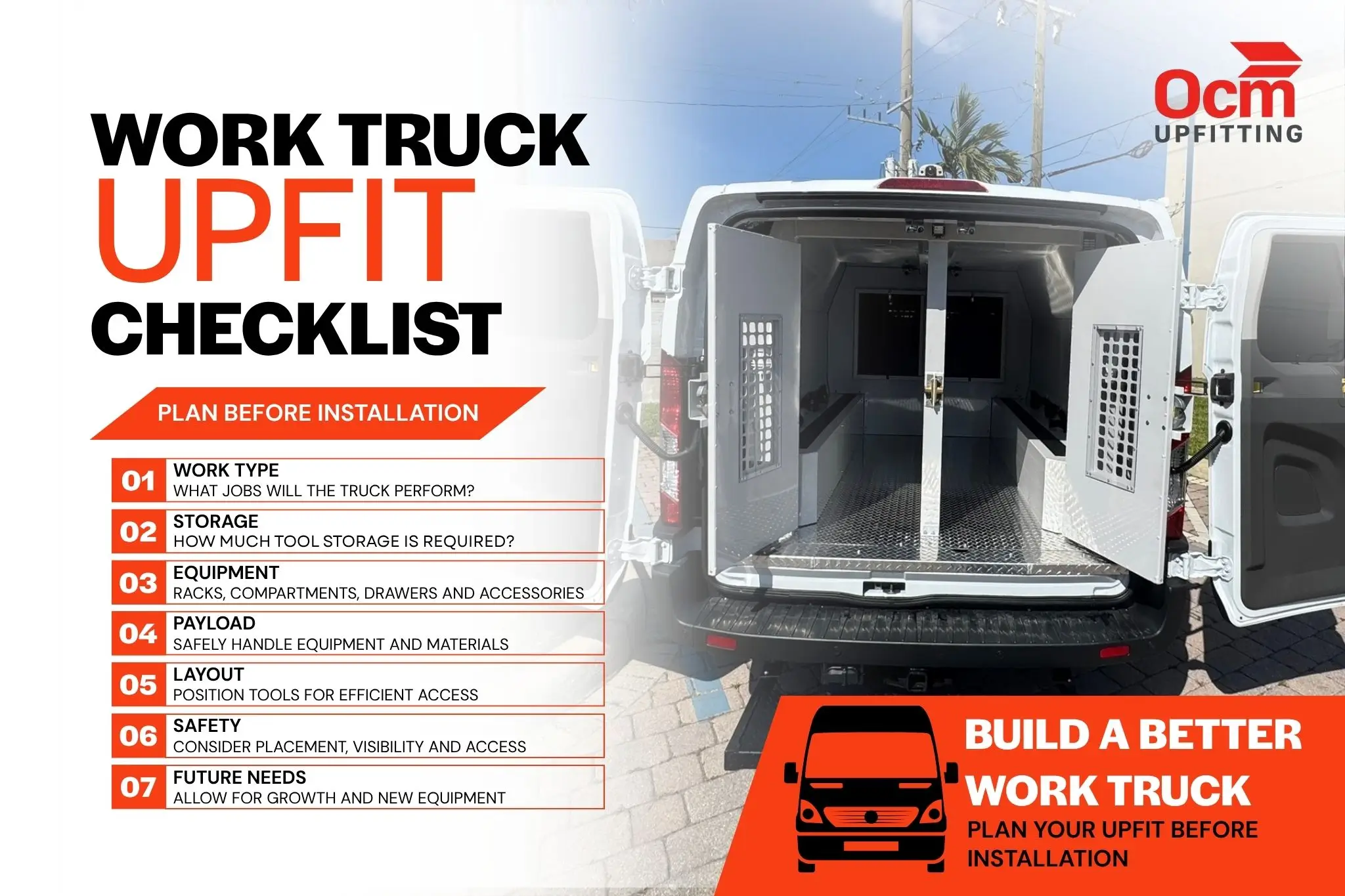
Buying the equipment first and figuring out where everything goes later can leave a work truck with blocked storage, difficult tool access, unnecessary reaching, electrical conflicts, or too little flexibility for future equipment. A useful work truck upfit checklist should begin with the job the vehicle performs, not with a catalog of accessories.
For fleet managers, contractors, utilities, and field-service operations, that means defining the vehicle mission, crew workflow, tools, equipment, storage needs, payload considerations, electrical requirements, and repeatable fleet standards before installation begins. OCM Upfitting currently positions its fleet vehicle upfitting services for service fleets and other fleet applications, with current capabilities that include storage solutions, custom fabrication, lighting, graphics, and integrated vehicle equipment. OCM Upfitting
The objective is simple: make the vehicle support the work instead of forcing the crew to adapt to a poorly planned layout.
1. Define Exactly What the Work Truck Must Do
Start by describing the vehicle’s actual role.
A truck used by an electrical contractor may carry very different tools and materials from one assigned to utility inspection, facilities maintenance, telecommunications, or mobile field service.
Before discussing equipment, document:
- Primary vehicle role
- Number and type of users
- Typical jobs performed
- Operating environment
- Frequently transported tools
- Bulky or heavy equipment
- Parts and consumables
- Roadside or nighttime work
- Security requirements
- Expected future equipment
NTEA’s Vehicle Specification Process Guide emphasizes defining vehicle mission requirements, obtaining stakeholder input, evaluating chassis and equipment needs, and building specifications around real operational requirements.
That same approach applies before any work truck equipment setup is approved.
2. Map the Crew’s Workflow Before Choosing Storage
Do not decide where shelves, drawers, bins, or equipment mounts belong until you know how frequently each item is used.
Separate equipment into practical categories:
- Used at nearly every job
- Used several times per week
- Replacement parts and replenishment inventory
- Large or heavy equipment
- Rarely used specialty tools
- Items requiring secure storage
Daily-use equipment should generally be easier to reach than backup stock.
This is also an ergonomics issue. OSHA guidance for contractors notes that workers retrieving tools and materials from vans and trucks may be exposed to awkward reaching, crouching, lifting, and climbing. OSHA specifically recommends positioning frequently used materials closer to doors or accessible storage areas when appropriate. OSHA
A good layout therefore asks not only, “Will everything fit?” but also, “How will the crew reach it throughout the day?”
3. Choose the Bed and Storage Configuration Around the Inventory
Once the equipment list and workflow are clear, evaluate the storage configuration.
Depending on the vehicle and job, that may involve:
- Bed-mounted storage
- Exterior compartments
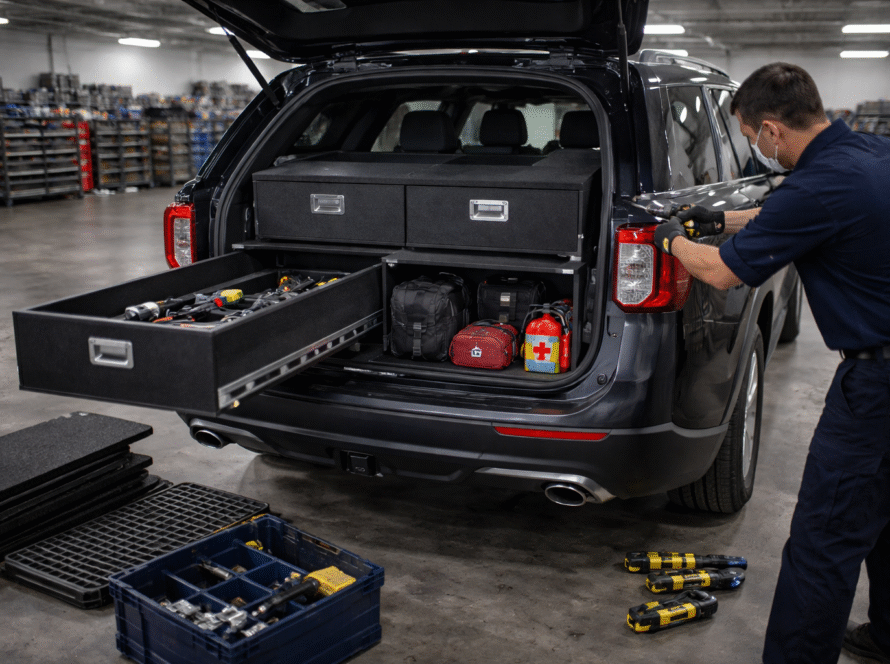
- Drawers
- Cabinets
- Secure tool storage
- Slide-out systems
- Equipment mounts
- Interior organization
- Custom-fabricated components
OCM’s existing guide to upfitting utility and service fleets discusses storage, electrical equipment, lighting, and workflow as connected parts of the vehicle rather than isolated add-ons.
Custom fabrication is not automatically better than an off-the-shelf component. If a standard system provides the required capacity, accessibility, mounting, and durability, there may be no operational reason to make it custom.
The better question is whether the chosen configuration supports the equipment and workflow of that specific vehicle.
4. Check Payload and Vehicle Limits Before Adding Equipment
Storage systems, tools, equipment, lighting, inventory, and fabricated components all add weight.
Fleet managers should verify the limits of the exact vehicle rather than relying on a general assumption about a truck model.
Review, where relevant:
- GVWR
- Available payload
- Axle ratings
- Equipment weight
- Cargo weight
- Weight distribution
- Body or mounting requirements
Do not confuse payload with towing capacity or GVWR.
OEM technical information matters here. GM’s current Body Builder Manuals provide vehicle-specific electrical, frame, body, dimensional, and modification information for light- and medium-duty commercial vehicles. GM Upfitter Ford also maintains upfitter publications and vehicle-integration resources for modifiers working with its platforms.
The upfit should be evaluated against the exact vehicle being ordered or modified.
5. Plan Equipment Mounting and Service Access Together
A component can fit physically and still be in the wrong location.
Before approving mounting positions, ask:
- Can the crew reach it easily?
- Does it interfere with doors or compartments?
- Will it block access to another system?
- Can technicians service it later?
- Does it affect driver visibility?
- Is surrounding vehicle equipment accessible?
- Could another planned component occupy the same space?
This is especially important for custom work truck upfits involving several systems at once.
Mounting a storage unit where technicians later need electrical or vehicle service access can create unnecessary disassembly. Likewise, installing one component without considering future accessories may restrict later modifications.
Planning new work trucks? OCM Upfitting can review your vehicle type, equipment inventory, crew workflow, fleet quantity, and configuration requirements before the layout is finalized.
6. Identify Electrical, Lighting, and Camera Requirements Early
Electrical accessories should not be treated as the last items added to an otherwise completed vehicle.
Depending on the truck’s role, the specification may need to consider:
- Work lighting
- Warning lighting
- Cameras
- Chargers
- Control systems
- Auxiliary equipment
- Other powered accessories
The planning discussion should include electrical load, circuit protection, grounding, wiring paths, controls, equipment placement, and future serviceability.
If the truck operates on roadsides, jobsites, or other visibility-sensitive environments, lighting should be selected around the actual operating condition. OCM Upfitting’s amber warning lights for work trucks guide explains why vehicle shape, racks, open compartments, viewing angles, electrical capacity, and applicable rules can all affect a warning-lighting plan.
Do not assume every work truck needs the same lighting or camera package.
7. Decide What Should Be Standardized Across the Fleet
Fleet standardization can be useful when several trucks perform similar jobs.
Potential standards include:
- Tool locations
- Storage configuration
- Lighting controls
- Camera placement
- Equipment labels
- Frequently used supplies
- Mounting locations
- Fleet graphics
- Safety equipment
OCM’s current guide to fleet standardization discusses creating repeatable specifications across similar vehicle classes while recognizing that specialized roles may still require different configurations.
That distinction matters.
Standardization should make similar vehicles easier to operate and replace. It should not force a specialized technician into a layout designed for another job.
A Service-Fleet Example
Consider a contractor preparing 12 pickup-based service trucks.
The company’s current vehicles have been equipped one at a time. Some trucks store daily-use power tools behind larger equipment. Others place replacement inventory closest to the tailgate while frequently used tools require technicians to climb farther into the bed.
Before ordering the next group, the fleet manager inventories the tools, separates daily-use items from reserve stock, documents heavy equipment, identifies electrical accessories, and maps the crew’s normal sequence of work.
The fleet can then develop a repeatable configuration for trucks performing the same job while maintaining a separate specification for specialized units.
The benefit is not simply “more storage.” It is a layout based on actual work.
What to Give Your Upfitter Before Requesting a Quote
Use this work truck upfit checklist before requesting a project quote:
- Vehicle make, model, model year, and configuration
- Fleet quantity
- Vehicle job or crew role
- Complete equipment inventory
- Tool and parts-storage requirements
- Heavy or bulky equipment
- Frequently used tools
- Secure-storage requirements
- Lighting requirements
- Camera requirements
- Other electrical accessories
- Preferred equipment locations
- Operating environment
- Fleet graphics requirements
- Existing fleet standard, if any
- Future equipment you may add
- Any role-specific differences between vehicles
The better the initial information, the easier it is to discuss the actual scope rather than relying on assumptions.
Plan the Work Truck Before Installation Starts
A strong work truck upfit checklist connects vehicle mission, employee workflow, equipment access, storage, payload, mounting, electrical systems, visibility, and fleet consistency before the vehicle reaches the installation stage.
Fleet managers and contractors planning new service or work trucks can contact OCM Upfitting with the vehicle make and model, fleet quantity, crew role, equipment inventory, operating environment, and preferred configuration. OCM’s current website lists (954) 764-8117 as its primary contact number. OCM Upfitting
Call (954) 764-8117 or use the OCM Upfitting project contact page to discuss your work truck requirements before the layout and equipment package are finalized.
FAQs
What should be included in a work truck upfit checklist?
Include the vehicle role, crew workflow, tools, storage needs, heavy equipment, payload considerations, mounting requirements, electrical accessories, lighting, cameras, service access, security, graphics, and fleet-standardization requirements.
What information should I give an upfitter before requesting a quote?
Provide the vehicle make and model, fleet quantity, vehicle role, equipment list, frequently used tools, operating environment, storage needs, electrical equipment, and any preferred or standardized layout requirements.
Should every work truck in a fleet use the same layout?
Not necessarily. Vehicles performing the same job may benefit from repeatable layouts, while specialized crews may need different equipment, storage, or access arrangements. Standardize where the operational requirements are genuinely similar.
How does a work truck upfit affect payload?
Installed storage, equipment, tools, cargo, and fabricated components all contribute weight. The available capacity should be evaluated for the exact vehicle configuration using current OEM specifications and applicable ratings.