A K9 Fleet Vehicle Has to Support the Dog and Handler
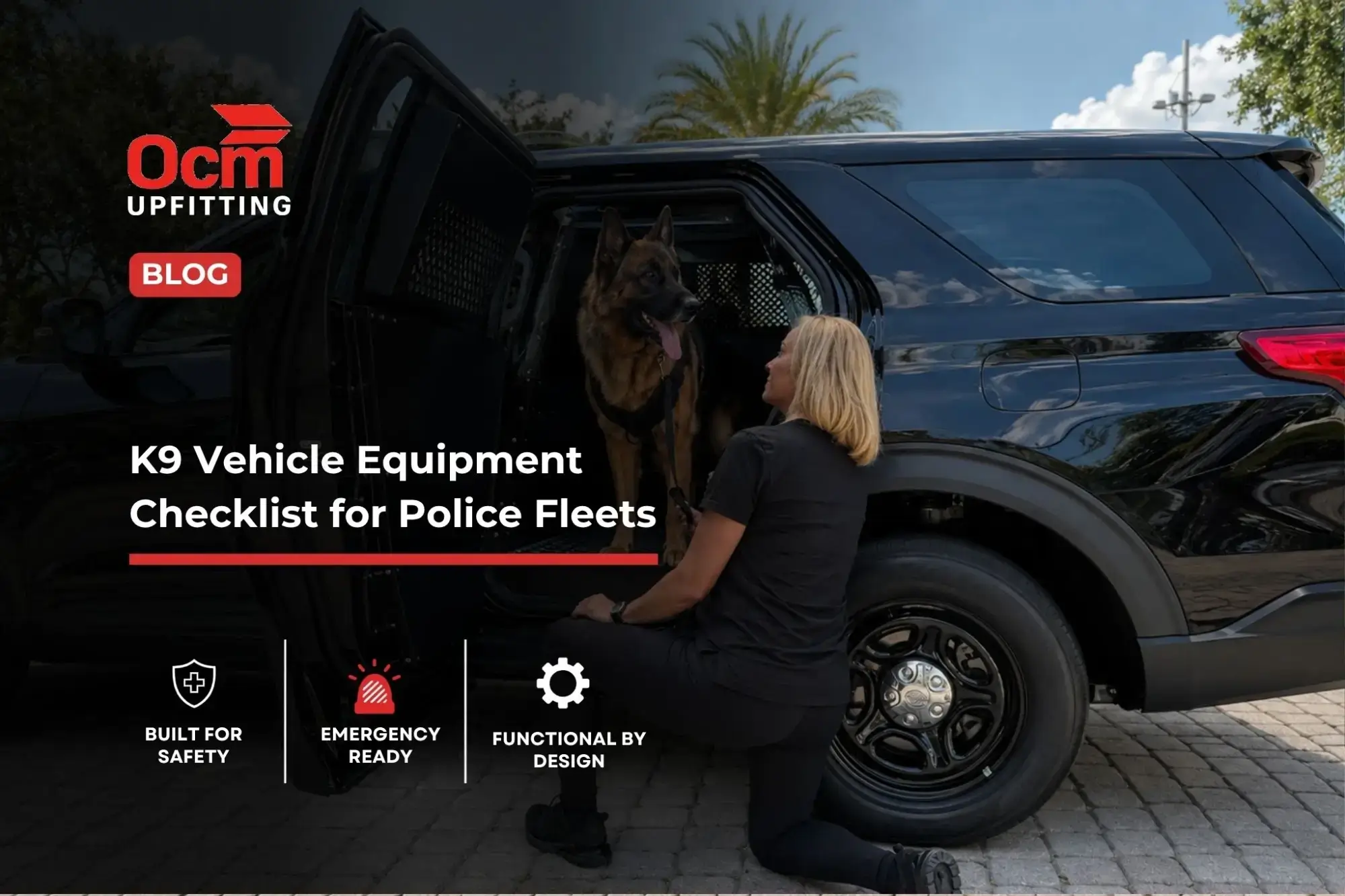
A police K9 vehicle is more than an SUV with a kennel installed in the cargo area. The vehicle may serve as transportation, a temporary working environment, equipment storage, a mobile command point, and a staging area during long patrol shifts. That makes K9 vehicle equipment planning an operational and animal-safety decision for fleet managers, K9 supervisors, procurement teams, and agency administrators.
A successful police K9 vehicle setup starts with the vehicle’s mission, the dog and handler, the expected duty cycle, climate, equipment load, and agency procedures. OCM Upfitting currently lists K9 transport modules, climate-controlled cages, window guards, vehicle electronics, storage, cameras, and public-safety fleet upfitting among its capabilities, with nationwide fleet positioning.
K9 Vehicle Equipment Checklist: Start With the Transport Area
1. Kennel or K9 Transport Module
The K9 transport system should be selected for the specific vehicle platform and operational requirement rather than treated as a universal insert.
Fleet planners should evaluate:
- Available interior dimensions
- Single-dog versus dual-dog requirements
- Entry and exit access
- Secure mounting
- Separation from loose equipment
- Ventilation openings
- Cleaning access
- Visibility
- Space remaining for handler equipment
OCM Upfitting already maintains a detailed comparison of single and dual K9 modules, making this checklist a broader procurement resource rather than a duplicate module-comparison article.
A compact SUV may require a very different configuration from a larger police utility vehicle. Fleet managers should confirm dimensions, mounting requirements, payload considerations, and upfitter provisions using documentation for the exact vehicle.
2. Climate Control, Ventilation, and Temperature Monitoring
Heat management should be treated as a system rather than as one accessory.
A climate-controlled K9 unit may combine vehicle HVAC integration, ventilation, temperature sensing, powered airflow, and monitoring equipment depending on the selected system and agency specification. OCM Upfitting’s existing climate-controlled K9 transport guide discusses climate control, sensors, airflow, and auxiliary power as integrated considerations.
Vehicle temperature deserves particular attention. The American Veterinary Medical Association warns that vehicle interiors can quickly reach temperatures that put dogs at risk of serious illness or death, even when outside conditions may not initially appear extreme. AVMA vehicle safety guidance reinforces why active climate planning and monitoring matter.
3. K9 Vehicle Heat Alarm
A K9 vehicle heat alarm should complement active temperature monitoring and agency procedures, not create a false assumption that the dog is automatically protected.
When evaluating systems, agencies should compare:
- Sensor location
- Driver or handler alert methods
- Power requirements
- System self-check procedures
- Failure notifications
- Compatibility with the vehicle
- Maintenance and testing requirements
If a selected product offers additional emergency functions, those functions should be verified against current manufacturer documentation and incorporated into agency procedures. Do not assume every alarm provides window control, remote alerts, fan activation, or other automated responses.
The U.S. military’s current K9 Heat Injury Clinical Practice Guideline underscores the seriousness of heat injury in working dogs and the need for prepared response procedures.
4. Window Guards, Interior Panels, and Flooring
Containment systems also have to withstand routine K9 movement while remaining practical to clean and inspect.
Consider:
- Secure window guards
- Protected interior door surfaces
- Smooth, durable edges
- Slip-resistant flooring
- Moisture-resistant surfaces
- Drainage or cleanup requirements where applicable
- Clear access to serviceable vehicle components
OCM Upfitting’s K9 window guard comparison provides a deeper look at material, weight, ventilation, and maintenance considerations.
5. Lighting, Cameras, and Handler Visibility
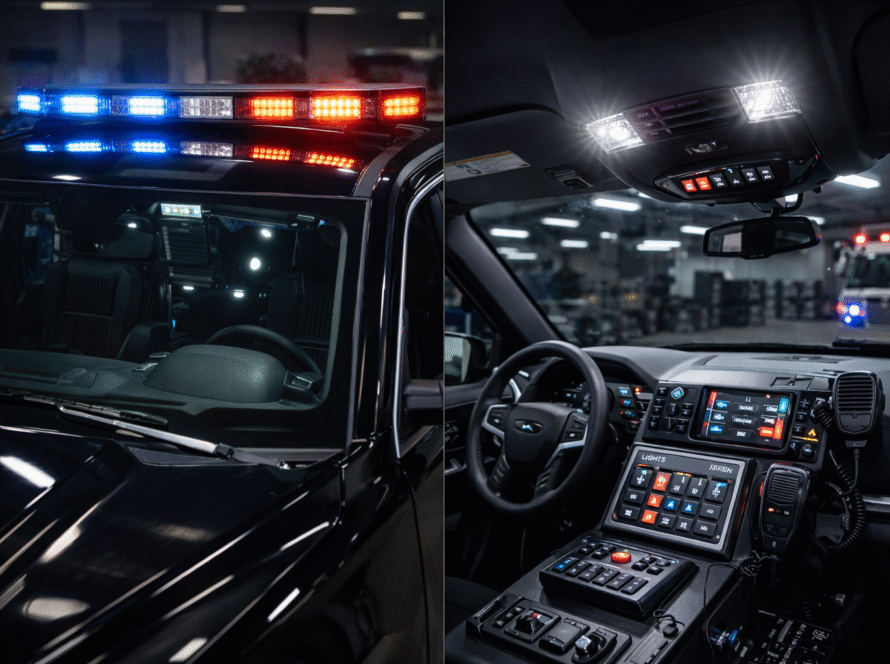
Interior lighting should help handlers inspect the kennel and retrieve equipment without creating unnecessary glare or interfering with vehicle operation.
Cameras may also be considered where agency policy and the selected equipment support monitoring or documentation. OCM Upfitting currently lists vehicle cameras, DVRs, monitors, and other technology installations among its services.
The camera location should not obstruct the driver’s view, interfere with airbags, or create unnecessary blind spots.
6. Storage for K9 and Handler Equipment
Police dog vehicle equipment can consume valuable cargo space quickly. Leashes, harnesses, training equipment, medical supplies, protective equipment, water, and other frequently used items need organized locations that do not interfere with the kennel.
Frequently accessed gear should be reachable without requiring the handler to unload unrelated equipment. Heavy items should be secured so they cannot move into the K9 area during normal driving or sudden vehicle movement.
If your agency is currently combining a kennel, climate system, electronics, cameras, and storage as separate purchases, OCM Upfitting can review the complete vehicle upfitting requirements and help develop an integrated specification before installation begins.
7. Water Access and Field Supplies
Handlers need a practical method for carrying water and accessing field supplies while keeping containers and equipment restrained during travel.
The layout should account for:
- Water storage
- Bowls or hydration equipment
- Cleaning supplies
- Towels
- First-aid equipment
- Leashes and harnesses
- Training or deployment gear
These items should not obstruct airflow, kennel doors, electrical equipment, or emergency access.
8. Auxiliary Power and Battery Protection
A K9 vehicle may carry more electrical equipment than a standard administrative vehicle. Climate equipment, powered ventilation, radios, lights, cameras, computers, chargers, and monitoring devices can all contribute to electrical demand.
Fleet managers should have the complete load evaluated rather than adding equipment one system at a time.
OEM documentation matters here. Ford Pro’s upfitter publications provide vehicle-specific resources for modifiers, while GM’s current police vehicle guidance cautions installers to protect factory wiring and components and remain mindful of applicable Federal Motor Vehicle Safety Standards when installing aftermarket equipment.
Electrical planning should address circuit protection, grounding, wiring quality, service access, battery capacity, and the operating conditions under which equipment must function.
9. Emergency Access and Daily System Checks
A K9 vehicle heat alarm, climate system, and containment module are most useful when handlers know their condition before the vehicle begins a shift.
Agencies should establish procedures for checking equipment such as:
- Climate and ventilation operation
- Temperature-monitoring status
- Kennel doors and latches
- Interior lighting
- Electrical warning indicators
- Cameras where installed
- Emergency access equipment
- Water and field supplies
Emergency-release procedures should be agency-approved, documented, and practiced without relying on improvised roadside solutions.
Standardize the Police K9 Vehicle Setup Without Ignoring the Mission
Consider a hypothetical agency replacing several K9 SUVs. One unit carries a single patrol dog and substantial handler equipment, while another supports a different mission requiring two separated canine spaces.
Giving every vehicle an identical module may not make operational sense.
The agency could instead standardize common elements such as temperature monitoring, control placement, wiring documentation, storage labeling, maintenance access, and inspection procedures while selecting different kennel configurations where the mission requires them.
That approach creates a repeatable police K9 vehicle setup without assuming every team works the same way.
Plan the Complete K9 Build Before Installation Begins
The best K9 vehicle equipment specification connects the transport module, climate system, monitoring, storage, electronics, flooring, window protection, power requirements, and handler workflow into one vehicle plan.
OCM Upfitting currently offers K9 vehicle conversions with climate-controlled cages and window guards as part of its public-safety vehicle services and positions its fleet work for agencies across the United States.
Build Your Next K9 Unit Around the Mission
OCM Upfitting can help agencies evaluate vehicle layout, police dog vehicle equipment, K9 containment, climate requirements, electrical integration, storage, and fleet-standardization needs before the next build.
Call (954) 764-8117 to discuss your vehicles, K9 program requirements, duty environment, and upcoming fleet specifications. The current number is verified on OCM Upfitting’s contact page.
FAQs
What equipment should be included in a police K9 vehicle?
A typical K9 build may include a secure kennel or K9 transport system, climate control, ventilation, temperature monitoring, window guards, protective interior surfaces, lighting, cameras where required, organized equipment storage, water supplies, and properly planned electrical systems. The final configuration should match the specific vehicle, dog, handler, climate, and agency procedures.
Does every police K9 vehicle need the same kennel configuration?
No. Vehicle dimensions, dog size, single- versus dual-dog operation, available storage, duty cycle, and agency mission can all affect the appropriate configuration. OCM Upfitting’s existing single-versus-dual module guide discusses these differences in greater depth.
What should agencies look for in a climate-controlled K9 unit?
Consider airflow, vehicle HVAC integration, temperature sensing, monitoring, power requirements, serviceability, and the equipment manufacturer’s documented capabilities. A climate system or alarm should never be treated as a substitute for handler monitoring and established agency procedures.
How often should K9 vehicle equipment be inspected?
Inspection frequency should follow agency policy, equipment manufacturer instructions, vehicle maintenance requirements, and the operating environment. Systems that affect containment, temperature monitoring, climate control, and electrical reliability should be incorporated into documented pre-use and preventive-maintenance procedures.