Build a Warning System Around Real Operating Risk
Amber warning lights for work trucks help drivers identify slow-moving, stopped, or actively working vehicles near road shoulders, construction zones, utility projects, loading areas, and roadside service calls. A coordinated system can reduce blind spots and prevent inconsistent fleet setups.
Effective work truck warning lights require more than a bright beacon. Fleet managers must consider vehicle shape, equipment, viewing angles, weather, electrical capacity, and applicable rules. OCM Upfitting designs systems for Fort Lauderdale, South Florida, and nationwide fleets around how each vehicle operates.
Why Amber Warning Lighting Matters for Commercial Fleets
Amber lighting warns that a vehicle may be stopped, moving slowly, entering traffic, or creating an unusual operating condition. The CDC and NIOSH highway work-zone safety guidance recognizes that work zones create risks for workers and motorists.
Lighting supports, but does not replace, cones, reflective graphics, training, and traffic-control procedures. Fleets should verify permitted colors, mounting positions, flash patterns, and use conditions because requirements vary by location, agency, contract, and vehicle purpose.
Types of Amber Warning Lights for Work Trucks
Effective work truck warning lights combine devices because one location rarely covers every direction.
Amber Beacons and Mini Light Bars
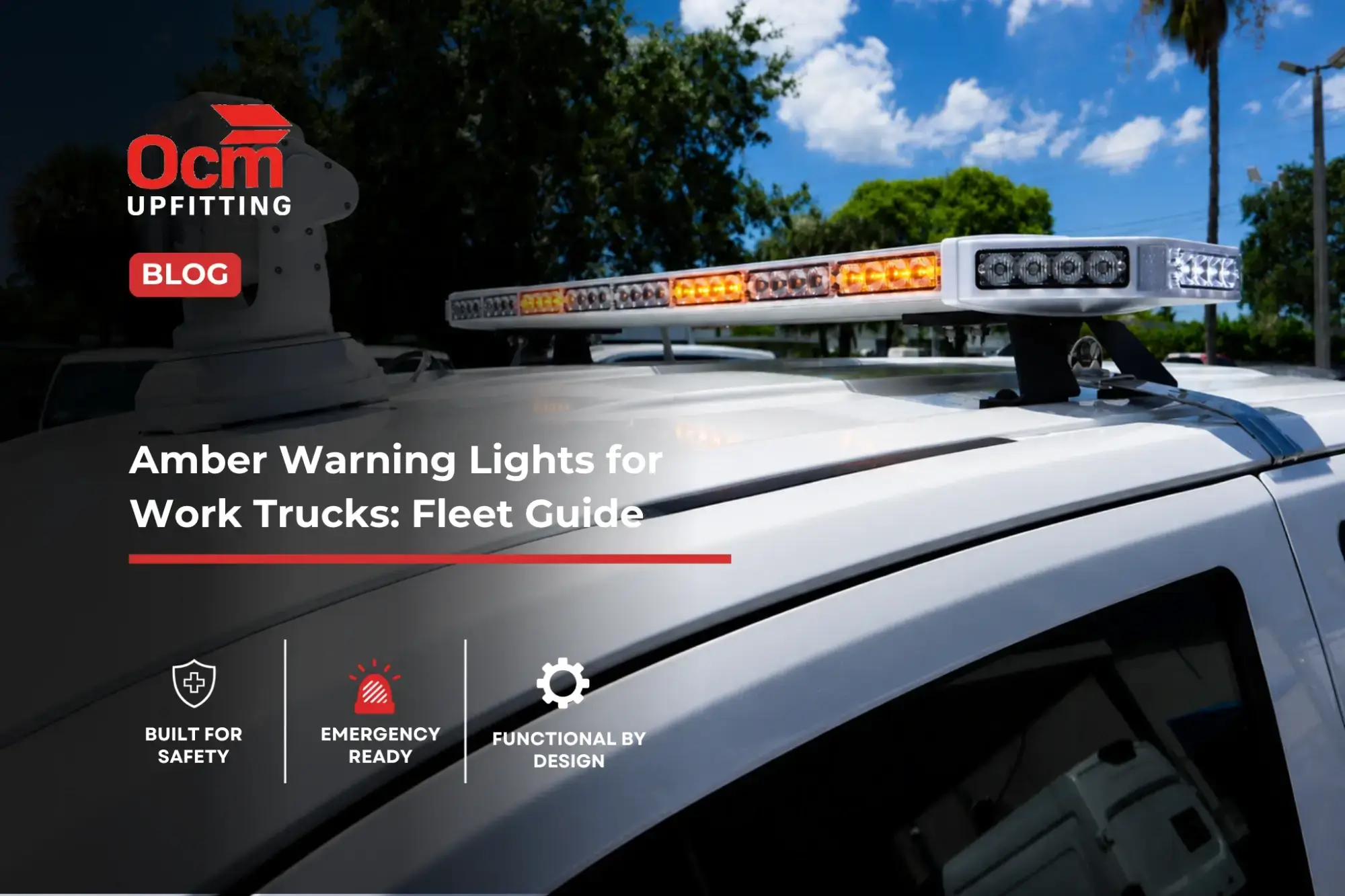
Beacons provide elevated coverage for maintenance, landscaping, and utility vehicles. Mini bars provide wider roof coverage for pickups, service trucks, and municipal units. Racks, booms, cargo, and open compartments can obstruct either option.
Grille and Surface-Mount Lights
Grille lights improve forward visibility when roof lighting is difficult to see from a low angle. Surface-mounted LED warning lights for trucks can be placed on bumpers, mirrors, push bars, rear bodies, or side panels. Mounting height and aiming should be planned together.
Hideaway Strobes and Perimeter Lighting
Amber strobe lights for trucks may be installed inside compatible lamp housings or around the body perimeter. Hideaways preserve a clean exterior, while side lights improve corner coverage. Housing design, heat, sealing, and light dispersion require professional review. Compare the options in OCM Upfitting’s guide to light bars versus hideaway lights.
Traffic Advisors
Rear traffic advisors show left, right, or center-out patterns. They suit towing, public works, utility, and roadside operations. A traffic advisor communicates direction, while flashing lights communicate caution. See the traffic advisor and directional warning lighting guide.
How to Design an Effective Warning-Light System
Start With Vehicle Type and Operating Risk
Identify whether the unit is a pickup, van, service body, tow truck, dump truck, or aerial vehicle. Consider roof height, trailers, racks, liftgates, parking position, and viewing distance. Utility truck warning lights must remain visible when compartments are open and crews are beside the vehicle.
Plan for 360-Degree Coverage
Brightness does not guarantee coverage. Evaluate the front, rear, sides, and corners while the vehicle is loaded for work. The SAE J845 guidance for 360-degree warning devices provides performance guidance for single-color, 360-degree warning devices.
Consider a South Florida utility truck whose aerial boom blocks an elevated beacon. Grille lights, rear directional lighting, and side perimeter lights create a clearer warning envelope. It shows why utility truck warning lights should be tested in the normal working position.
Evaluate Daytime Output and Flash Patterns
Sunlight, glare, rain, fog, and busy backgrounds reduce perceived output. Buyers should consider intensity, lens design, viewing angle, and tested performance, not LED count alone. The SAE J595 warning-light standard covers directional, single-color flashing warning devices.
Alternating, synchronized, directional, and slower patterns communicate differently. Faster flashing is not automatically better. Coordinated construction vehicle warning lights are easier to interpret than devices flashing independently.
Check Durability and Electrical Capacity
LED warning lights for trucks should withstand water, dust, vibration, heat, corrosion, washing, road salt, mud, and chemicals. Coastal conditions around Fort Lauderdale and South Florida make sealed connectors important.
The electrical plan should account for alternator output, battery reserve, wire gauge, relays, fuses, grounds, controller capacity, and duty cycle. Central controls and low-voltage protection can reduce operator error and battery depletion.
Review Rules Before Installation
Warning equipment should not obscure required headlights, brake lights, turn signals, marker lamps, or reflectors. Review state law, agency specifications, customer requirements, and the current MUTCD temporary traffic-control guidance for roadway work zones. FHWA lists the 11th Edition with Revision 1, dated December 2025, as the current edition.
Need a system designed around your fleet? OCM Upfitting can assess viewing angles, equipment conflicts, electrical load, and operating risk before recommending emergency lighting products and professional installation.
Recommended Work Truck Warning Lights by Fleet Type
Utility Fleets
Use a mini bar or beacon, grille lights, rear traffic advisor, and side perimeter lights. Utility truck warning lights should remain visible around aerial equipment and open compartments.
Construction Vehicle Warning Lights
Use roof-level coverage, grille lights, rear amber strobe lights for trucks, and corner lighting. Construction vehicle warning lights should tolerate dust, vibration, uneven terrain, and strong daylight.
Towing and Roadside Service Fleets
Combine an elevated bar, rear traffic advisor, grille lights, and side coverage. Prioritize the traffic-facing side.
Municipal and Public Works Fleets
Standardize mounting, controllers, and patterns across departments. Consistency reduces training time and simplifies troubleshooting. OCM Upfitting’s municipal fleet vehicle upfitting services support lighting, storage, service bodies, and related equipment.
Landscaping Fleets
Use a beacon or mini bar, rear surface lights, and trailer-aware perimeter coverage. LED warning lights for trucks should not be hidden by racks, mowers, trailers, or material.
Mobile Service Fleets
A low-profile mini bar, grille lights, rear lights, and work-area lighting can preserve garage clearance. Amber strobe lights for trucks should warn road users without creating excessive glare for technicians.
Why Professional Installation Protects Fleet Value
Professional installation supports secure mounting, weatherproof wiring, correct wire sizing, grounding, circuit protection, controller programming, and synchronized patterns. It reduces the risk of battery failures, electrical faults, water intrusion, and interference with factory systems.
Repeatable specifications improve purchasing, training, maintenance, and replacement planning. OCM Upfitting evaluates the vehicle, equipment, hazards, and power demand before finalizing each design for Fort Lauderdale, South Florida, and national operations.
Frequently Asked Questions
Are amber warning lights legal on work trucks?
They may be permitted for specific vehicles and uses, but rules vary. Verify state and local law, agency policy, and contract requirements.
Where should amber lights be mounted?
Cover the front, rear, sides, and corners without obstruction from racks, doors, cargo, or trailers.
Is one beacon enough for 360-degree visibility?
Sometimes. Vehicle height, body shape, equipment, cargo, and working position can block a single beacon.
Is a Beacon or Mini Light Bar Better?
A beacon is simple and economical. A mini bar generally offers wider roof-level coverage and more configuration options.
Build a Safer, More Consistent Fleet Lighting Standard
The best amber warning lights for work trucks form a coordinated system based on vehicle type, visibility zones, environmental exposure, electrical capacity, operating risk, and applicable rules. OCM Upfitting can design and install one vehicle or an entire fleet to improve visibility, consistency, and reliability.
Do not leave fleet safety to a one-size-fits-all kit. Request a custom warning-lighting consultation or call +1 954-764-8117 to discuss your vehicles and installation requirements.