Climate controlled K9 cages are no longer a “nice to have” in emergency vehicle builds—they are a critical safety system. Modern police and first-responder K9 units must maintain stable interior temperatures, proper ventilation, fail-safe power, and rugged structural integrity to keep working dogs safe in high-stress environments.
When agencies deploy K9 vehicles across the U.S., the equipment inside those vehicles has to survive far more than daily travel. It has to handle running engines, cooling systems, heavy electrical loads, sudden stops, temperature extremes, and constant field use. A proper K9 transport build treats the cage and its support systems as a complete engineered environment, not just a metal box sitting in the rear of an SUV.
In the world of security vehicle upfitting, building for K9 transport demands even more attention to safety, comfort, and durability than standard cargo or prisoner modules. A K9 vehicle is a workspace, transport unit, safety shelter, and climate-controlled environment wrapped into one. The core purpose is to protect a partner who cannot speak up when conditions become unsafe.
Building a K9 Cage that Works in the Real World
The foundation of any proper K9 transport build is the cage itself. Agencies typically choose aluminum or stainless steel for their strength-to-weight benefits, corrosion resistance, and long-term durability. Aluminum is popular because it avoids unnecessary weight on the rear axle, which helps preserve vehicle handling and reduces suspension wear over time. Stainless steel is often used in key security and mounting areas because it offers even higher impact durability in components like door frames, lock hardware, and mounting points.
But metal choice is just the beginning. What separates a professionally built K9 cage from a generic insert is the engineering behind airflow, mounting, sound dampening, and internal component placement. The cage needs to stay secure without rattling, remain rigid without turning into a vibration amplifier, and provide airflow without compromising safety.
Ventilation & Airflow: More Than Just a Fan
A true climate-controlled system begins with ventilation planning. Even with AC running, a poorly ventilated cage will trap warm spots. A proper K9 transport module uses multi-path airflow design. That means pulling in cool air from outside the cage, moving it across the space evenly, and exhausting warmer air without allowing backflow. The best designs pull air from the vehicle’s HVAC system into the kennel area while supplementing it with independent multi-speed fans that prevent temperature stratification.
Intake vents are positioned low or mid-height, while exhaust systems are routed higher when possible, mimicking natural heat flow. Vent openings must be reinforced, shield-blocked, and arrays-inserted so they cannot be used as pry points, cannot pinch paws, and do not create sharp edges or airflow noise extremes that can distress animals.
Airflow has to function while stationary too. In many U.S. states, parked patrol or agency vehicles can become dangerously hot within minutes. A proper system is designed to circulate air even when the engine is idle and includes automatic cycling for temperature stabilization.
Climate Control and Temperature Monitoring Systems
The most important ingredient in a K9 transport build is temperature stability. Because these vehicles often operate in Florida, Texas, Arizona, and other southern states where external temps can exceed 95°F+ for long stretches, interior temp monitoring is critical.
A proper K9 upfit includes:
-
Primary HVAC integration from the vehicle’s AC system to supply cooled air toward the rear kennel zone
-
Independent temperature sensors inside the cage, not just in the cargo area
-
Digital readouts or alert modules mounted in the driver cabin for constant monitoring
-
Audible and visual alarms triggered if temperatures leave a defined safe zone
-
Auto-window drop systems in some builds for emergency venting if temps spike when parked
These systems must be calibrated and stress-tested to ensure sensors don’t read the cargo area temp instead of the actual cage temp—a dangerous oversight common in cheap cage modules.
Redundancy is key. Climate systems must continue functioning even if one power source fails.
Power Management & Electrical Safety
You’re powering multiple mission-critical systems in a K9 vehicle: light bars, radios, computers, cameras, sirens, and now a climate control system. That means energy planning isn’t optional.
Proper K9 builds use:
-
Dedicated auxiliary battery systems to prevent draining the vehicle’s main power supply
-
Auto-cutoff safety circuits that prevent overheating or electrical runaway
-
Independent fuses per device so a single failure doesn’t kill the entire kennel system
-
Inverter or low-draw electrical pathways carefully spec’d for idle operation
Electrical control hardware is mounted away from paws, bites, or accidental contact and housed in tamper-proof cabinets when needed.
Mounting, Impact Framing & Noise Control
A K9 cage fork-mounted without reinforcement may technically “fit,” but it isn’t safe. Professional fabricators weld or bolt cages to:
-
Vehicle frame rails
-
Reinforced flooring plates
-
Rear structural mounts engineered in-house
Cages must be crash-resistant and test-fit for high-impact braking and collision scenarios. Mounting brackets use vibration-dampening inserts to avoid cage buzz, which can hurt dog hearing over months of patrol use.
Noise control is a health feature too. Rushing road wind, rattles, or metal echo chambers stress animals. Proper cages include:
-
Sound-dampening pads
-
No-rattle gasket systems
-
Insulated panels that reduce echo
This is especially important when tactical light bars or sirens are mounted directly overhead.
Visibility & Working Dog Comfort
Visibility features are an extension of climate control. Dark, enclosed, vibration-heavy spaces stress working dogs and can worsen heat retention. That’s why proper cages include:
-
UV-shielded windows
-
Cage-integrated lighting
-
Reflective or compliant vent spacing for ambient light
Flooring surfaces inside the cages must remain slip-safe, temperature-neutral, non-cutting, and resistant to water, scratching, and rapid sanitation chemicals.
Rear Storage and Functional Officer Access
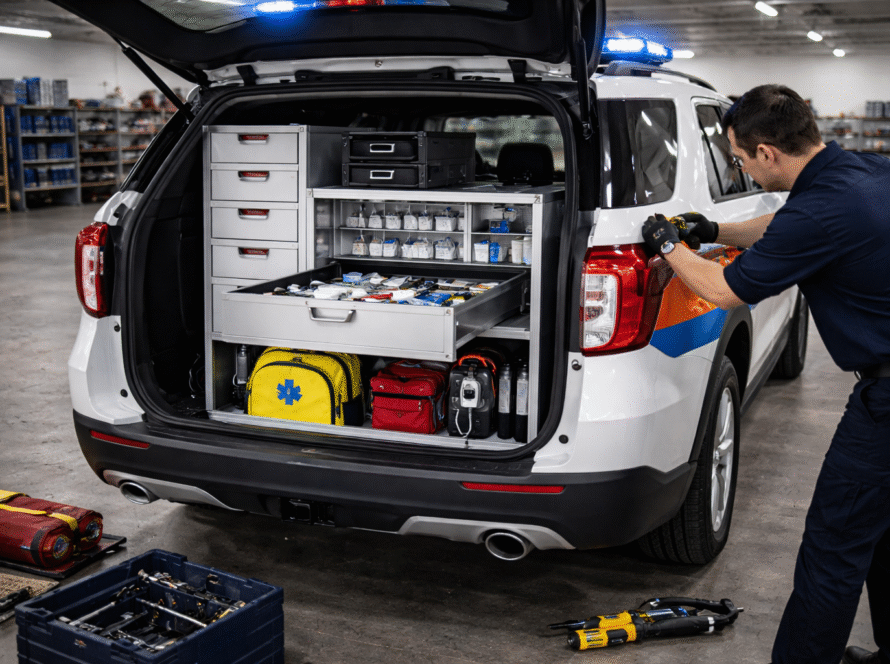
K9 builds should serve both ends of the vehicle. Officers need fast, organized access to:
-
Leashes and harnesses
-
Medical kits
-
Training aids
-
Weapon locking cabinets
-
Monitoring control panels
This is where in-house fabrication shines because storage units are sized around department gear, not guesswork.
Finishing and Decal Integration
A professional K9 vehicle must look compliant, clear, and agency-approved. In-house wrap and decal installs ensure:
-
Unit numbers and agency symbols remain regulation compliant
-
Vent routing stays unobstructed
-
Doors, windows, and airflow ports remain fully functional
-
UV fade doesn’t compromise visibility
Why Proper Cage Design Protects Agencies and Working Dogs
A poorly built cage can put working dogs at risk, lead to vehicle downtime, create compliance issues, drain batteries, damage dog hearing, or cause injury during braking events.
A proper climate-controlled cage protects:
✔ Dog health
✔ Officer safety
✔ Vehicle handling
✔ Electrical reliability
✔ Equipment lifespan
✔ Agency compliance
If you’re planning a K9 fleet vehicle build, you deserve equipment that works for the long haul. OCM Upfitting specializes in climate-controlled cages, airflow engineering, auxiliary power protection, and reinforced module fabrication for police and tactical fleets across the U.S.
Don’t leave K9 safety to aftermarket guesswork. Work with a team that builds every module with real field conditions in mind. Book your appointment today or Schedule your K9 upfitting consultation to speak with our team.