A Window Guard Must Work With the Complete K9 Vehicle
A police K9 vehicle may have a properly selected transport module and still require changes if its window protection interferes with ventilation, visibility, cleaning access, or the vehicle’s interior configuration.
That is why K9 window guards should be evaluated as part of the complete police K9 vehicle upfit rather than purchased as an isolated accessory.
For K9 supervisors, fleet managers, and law enforcement procurement teams, selecting the appropriate guard means confirming its fit, construction, mounting requirements, airflow characteristics, compatibility with other equipment, and daily maintenance needs.
OCM Upfitting provides K9 vehicle conversions with climate-controlled cages and window guards for police and other working-dog fleet applications.
The objective is straightforward: select window protection that supports secure containment, practical handler access, and the intended K9 transport environment without compromising other vehicle requirements.
What Is the Purpose of K9 Window Guards?
K9 window guards are protective barriers installed in designated vehicle window areas as part of a canine transport configuration.
Depending on their design, they may help prevent the dog from contacting window glass or reaching through an open window while maintaining appropriate visibility and airflow openings.
However, a guard is only one part of the containment system.
The complete K9 vehicle configuration may also include:
- A vehicle-specific K9 transport module
- Protective interior door panels
- Appropriate containment doors and latches
- Climate-control equipment
- Ventilation systems
- Temperature monitoring
- Handler-access provisions
- Secure equipment storage
A window guard should not be treated as a substitute for the transport module, climate system, or agency-approved operating procedures.
Before selecting a product, determine what the guard must accomplish within the specific vehicle.
1. Confirm Vehicle Compatibility Before Selecting a Guard
Window dimensions, door-panel designs, interior trim, and mounting locations vary between vehicle platforms.
A guard suitable for one patrol SUV may not fit another model or model year.
Before approving the equipment, review:
- Vehicle make, model, and model year
- Rear passenger-door design
- Window dimensions and available clearance
- Existing K9 module configuration
- Interior panels and trim
- Window operation and available travel
- Approved mounting locations
- Vehicle-specific installation restrictions
The Ford Pro upfitter publications provide technical resources for commercial and police vehicles. The GM Body Builder Manuals also provide vehicle-specific information used when planning modifications.
These documents help qualified upfitters evaluate vehicle architecture and applicable modification requirements.
Do not assume that a guard from the previous patrol vehicle will fit the replacement vehicle.
Even when the window opening appears similar, trim, mounting arrangements, occupant-protection systems, and adjacent equipment may differ.
2. Evaluate Ventilation Alongside Window Protection
Airflow is an important consideration in police K9 vehicle upfitting.
Depending on the selected window-guard design, openings may allow air movement when windows are appropriately positioned and a compatible ventilation system is operating.
However, the amount and direction of airflow depend on the guard, window position, vehicle configuration, and installed ventilation equipment.
Before selecting a guard, ask:
- Does the guard interfere with planned ventilation openings?
- Will an auxiliary fan be installed?
- Does the selected guard support the proposed fan arrangement?
- Can the window operate as required by the approved configuration?
- Will the guard obstruct existing HVAC outlets or ventilation paths?
- How will the completed system be evaluated?
Window ventilation alone cannot establish that the K9 compartment will remain at a safe temperature.
The American Veterinary Medical Association’s warm-weather safety guidance warns that vehicle interiors can become dangerously hot even when windows are partially open.
For working-dog vehicles, climate-control equipment, temperature monitoring, system maintenance, and agency procedures must be evaluated together.
No window guard, fan, or temperature-monitoring component should be described as guaranteeing canine safety.
3. Compare Construction Materials and Guard Designs
Different K9 vehicle window guards may use metal bars, perforated or slotted panels, or other protective materials.
The appropriate design depends on the vehicle, containment requirements, ventilation arrangements, and agency specifications.
Aluminum Window Guards
Aluminum components may be considered when an agency is evaluating weight, corrosion resistance, and integration with an aluminum K9 transport module.
However, suitability depends on the actual material grade, design, construction, and mounting arrangement.
Steel Window Guards
Steel designs may be considered for particular structural and durability requirements.
Their suitability also depends on component design, protective finish, weight, and compatibility with the selected vehicle.
Slotted or Panel-Based Designs
Some protective panels provide a different balance of visibility, ventilation openings, cleaning access, and physical separation.
Agencies should evaluate the complete product specification rather than assuming one material or opening pattern is universally preferable.
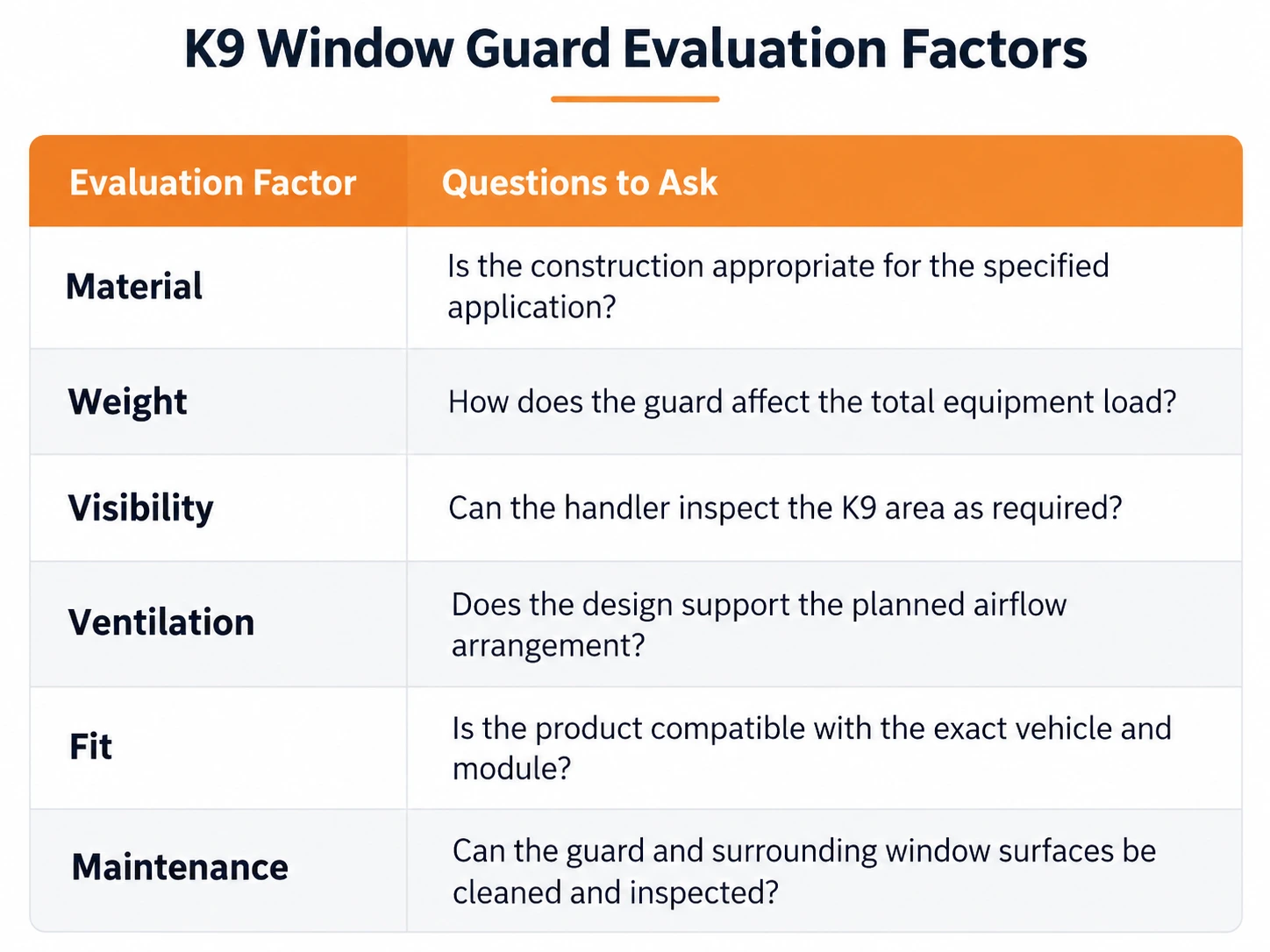
The strongest purchasing decision is based on the complete installed configuration, not material choice alone.
4. Consider Visibility and Handler Workflow
A K9 handler may need to inspect the transport area during routine checks, loading, unloading, and equipment assessment.
Window protection should be evaluated for how it affects these activities.
Consider:
- Visibility into the canine compartment
- Lighting and reflections
- Inspection access
- Window functionality
- Interaction with interior door panels
- Accessibility during routine maintenance
Guard placement should also avoid creating unnecessary obstructions to driver visibility or other required vehicle functions.
Where cameras or monitoring equipment are planned, evaluate their locations alongside the K9 module and window protection.
OCM Upfitting’s K9 vehicle equipment checklist discusses how window guards, climate systems, interior panels, lighting, and storage fit into broader police K9 vehicle planning.
The goal is not maximum visibility at the expense of containment. It is an appropriate balance based on the operational requirements.
5. Review Mounting and Interior Safety Considerations
The mounting arrangement is just as important as the visible guard.
A professional installation should account for the selected vehicle’s construction, applicable manufacturer instructions, and nearby systems.
Important considerations include:
- Secure mounting
- Smooth and protected edges
- Appropriate fastener placement
- Interior panel compatibility
- Protection against rattling and vibration
- Access to components requiring inspection
- Relevant airbag deployment areas
- Applicable OEM modification requirements
Vehicle modifications must not improperly interfere with occupant-protection systems.
The National Highway Traffic Safety Administration’s airbag guidance explains the role of frontal and side airbags, reinforcing why surrounding vehicle equipment must be evaluated carefully.
Guard mounting should be reviewed by a qualified upfitter using the relevant manufacturer guidance.
Planning a new K9 patrol vehicle configuration? OCM Upfitting can discuss window protection, transport modules, vehicle fit, ventilation requirements, and handler access before the complete layout is approved.
6. Make Cleaning and Maintenance Access Part of the Specification
A K9 vehicle interior must accommodate routine cleaning, inspection, and equipment maintenance.
Window guards should not make these activities unnecessarily difficult.
Depending on the approved design, removable or hinged configurations may provide access to surrounding glass and interior surfaces.
Before purchasing, determine:
- How will both sides of the window be cleaned?
- Can dirt and moisture be removed from surrounding areas?
- Are edges and mounting points accessible for inspection?
- Can the guard be serviced without unnecessary interior disassembly?
- Are hinges, fasteners, and other components replaceable as applicable?
- What maintenance instructions will be supplied?
A guard that provides appropriate protection but makes routine inspection difficult may create an avoidable fleet-maintenance concern.
Cleaning access should therefore be addressed before the installation method is finalized.
7. Coordinate Window Guards With the Entire K9 Compartment
Police dog vehicle equipment must function as an integrated configuration.
Window protection can affect surrounding components, especially when a vehicle includes a specialized kennel, ventilation equipment, interior panels, and additional storage.
Before approving the installation, evaluate how the guard interacts with:
- K9 transport module dimensions
- Containment partitions
- Interior door protection
- Climate-control outlets
- Auxiliary ventilation equipment
- Temperature-monitoring components
- Window operation
- Electrical accessories
- Handler equipment access
OCM Upfitting’s climate-controlled K9 transport guide examines the relationship between containment, climate management, electrical planning, and operational requirements.
For procurement teams, the important question is whether the window guard supports the complete vehicle design.
It is not enough to verify that the product can be mounted.
8. Address Common K9 Fleet Procurement Questions
Can Existing Window Guards Be Reused?
Possibly, but reuse should depend on the equipment’s condition, vehicle compatibility, mounting requirements, and manufacturer instructions.
A guard in acceptable condition may still be unsuitable for a replacement vehicle.
Will the Guards Affect Vehicle Payload?
Any additional equipment contributes to the installed vehicle’s total weight.
The impact depends on the guard design, mounting hardware, transport module, other installed equipment, occupants, and operational load.
The completed upfit should be evaluated against the applicable vehicle and axle weight ratings.
Should Every K9 Vehicle Use the Same Guard?
Standardization can simplify inspections, replacement planning, documentation, and equipment familiarity.
However, vehicles with different window dimensions, K9 modules, or operational requirements may need approved variations.
The fleet should standardize appropriate requirements without assuming universal physical compatibility.
What Determines the Installation Quote?
Relevant factors may include the vehicle platform, selected guard design, mounting requirements, interior modifications, integration with other K9 systems, fleet quantity, and testing or documentation requirements.
An accurate quote should reflect the actual project scope.
9. A Police K9 Fleet Example
Consider a police department replacing eight K9 SUVs.
Six vehicles are assigned to standard patrol K9 teams. Two vehicles support specialized operations and use a different containment-module configuration.
The agency wants common inspection procedures and window-protection requirements across the fleet.
However, the two vehicle groups may have different interior layouts.
Instead of assuming identical guards are appropriate for every unit, the department could:
- Confirm the vehicle platforms and K9 module designs.
- Establish common requirements for containment, visibility, cleaning, and inspection.
- Evaluate compatible guards for each configuration.
- Review ventilation and window functionality.
- Approve representative completed installations.
- Document vehicle-specific differences.
The result is a repeatable procurement approach that still respects the actual vehicle configurations.
10. K9 Window Guard Planning Checklist
Before approving K9 window guards for police vehicles, confirm the following:
- Vehicle make, model, and model year
- K9 transport-module configuration
- Window-guard material and design
- Vehicle-specific product compatibility
- Mounting and installation requirements
- Interior trim and door-panel clearances
- Ventilation and window functionality
- Auxiliary fan compatibility, if applicable
- Handler visibility
- Cleaning and maintenance access
- Appropriate edge and surface finishes
- Equipment weight considerations
- OEM modification guidance
- Agency specifications
- Final inspection and acceptance requirements
The agency should also establish who will approve the installation and how any changes will be documented.
Review Your Police K9 Vehicle Configuration Before Installation
Selecting K9 window guards is ultimately a vehicle-planning decision.
The guard must fit the platform, support the approved containment design, preserve appropriate ventilation and access, and work with the other equipment installed in the vehicle.
For police K9 supervisors, fleet managers, and procurement teams preparing new vehicles or replacing existing units, reviewing these requirements before installation can help identify compatibility and specification questions earlier.
OCM Upfitting provides K9 vehicle conversions involving window guards, containment systems, climate-control equipment, and related vehicle integration.
Planning a K9 patrol vehicle upfit? Prepare your vehicle make and model, fleet quantity, K9 module requirements, preferred window-guard configuration, ventilation needs, and department specifications.
Call (954) 764-8117 or use the OCM Upfitting contact page to discuss your proposed K9 vehicle configuration before the installation specification is finalized.
FAQs
What are K9 window guards used for in police vehicles?
K9 window guards are protective barriers installed in designated vehicle window areas. Depending on the design, they can help provide separation between the dog and window openings while supporting specified visibility and ventilation requirements. They should be evaluated as part of the complete K9 containment system.
Do K9 window guards provide enough ventilation for a police dog?
Not by themselves. Window guards may allow airflow through appropriately designed openings, but they do not replace climate control, temperature monitoring, or agency procedures. Ventilation performance depends on the complete installed system.
Can K9 window guards fit any police SUV?
No universal compatibility should be assumed. Fit depends on the vehicle make, model, model year, interior configuration, window dimensions, mounting requirements, and selected K9 transport equipment.
Should police departments choose aluminum or steel K9 window guards?
Neither material is automatically suitable for every application. Agencies should compare the actual product design, construction, weight, corrosion protection, fit, ventilation characteristics, maintenance access, and installation requirements before selecting a guard.