Why Storm-Response Fleets Need Specialized Vehicle Equipment
A utility truck may be ready for everyday service calls but poorly equipped for a nighttime storm response. Limited warning visibility, unsecured equipment, and difficult access to communication systems can complicate work when crews arrive at unfamiliar locations.
For utility fleet managers, utility fleet vehicle upfitting begins with understanding the assignments each vehicle must support.
OCM Upfitting provides emergency and warning light installations for utility and service vehicles, along with fleet graphics and equipment integration.
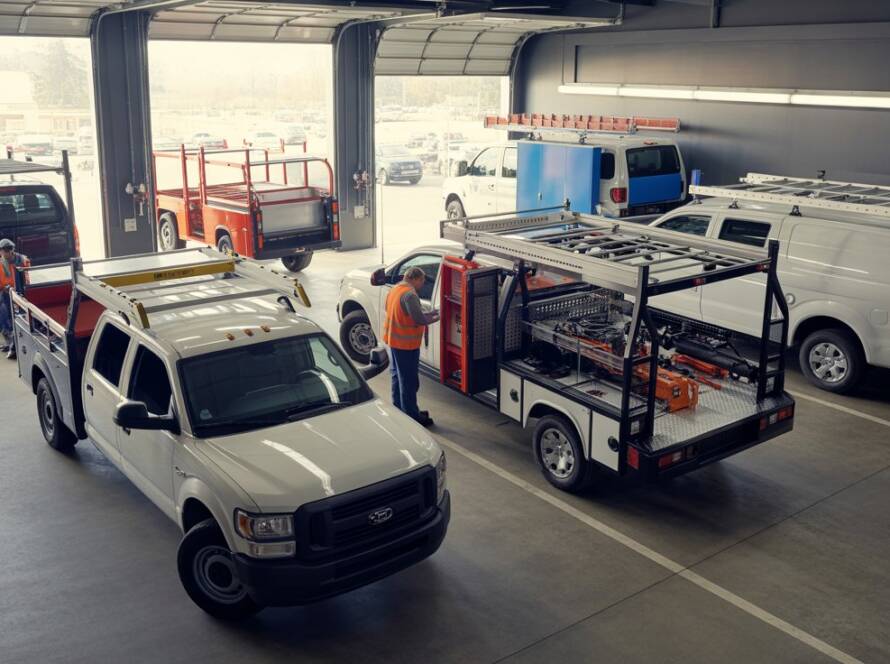
A practical storm-response configuration may include warning lights, worksite illumination, communication equipment, organized storage, and clear vehicle identification.
The objective is not to add every available accessory. It is to equip each vehicle for its assigned work while maintaining accessibility, electrical compatibility, and consistent fleet specifications.
Will Your Utility Fleet Be Ready for the Next Storm Callout?
Before severe weather arrives, review warning lights, worksite illumination, and equipment accessibility across your service vehicles.
Plan Warning Light Bars and Worksite Lighting
Utility crews may stop near active roadways, work after dark, or operate in locations with limited existing lighting.
These conditions make lighting a critical part of utility storm response vehicle upfitting.
However, warning lights and worksite lights have different purposes.
Warning Lights Alert Approaching Motorists
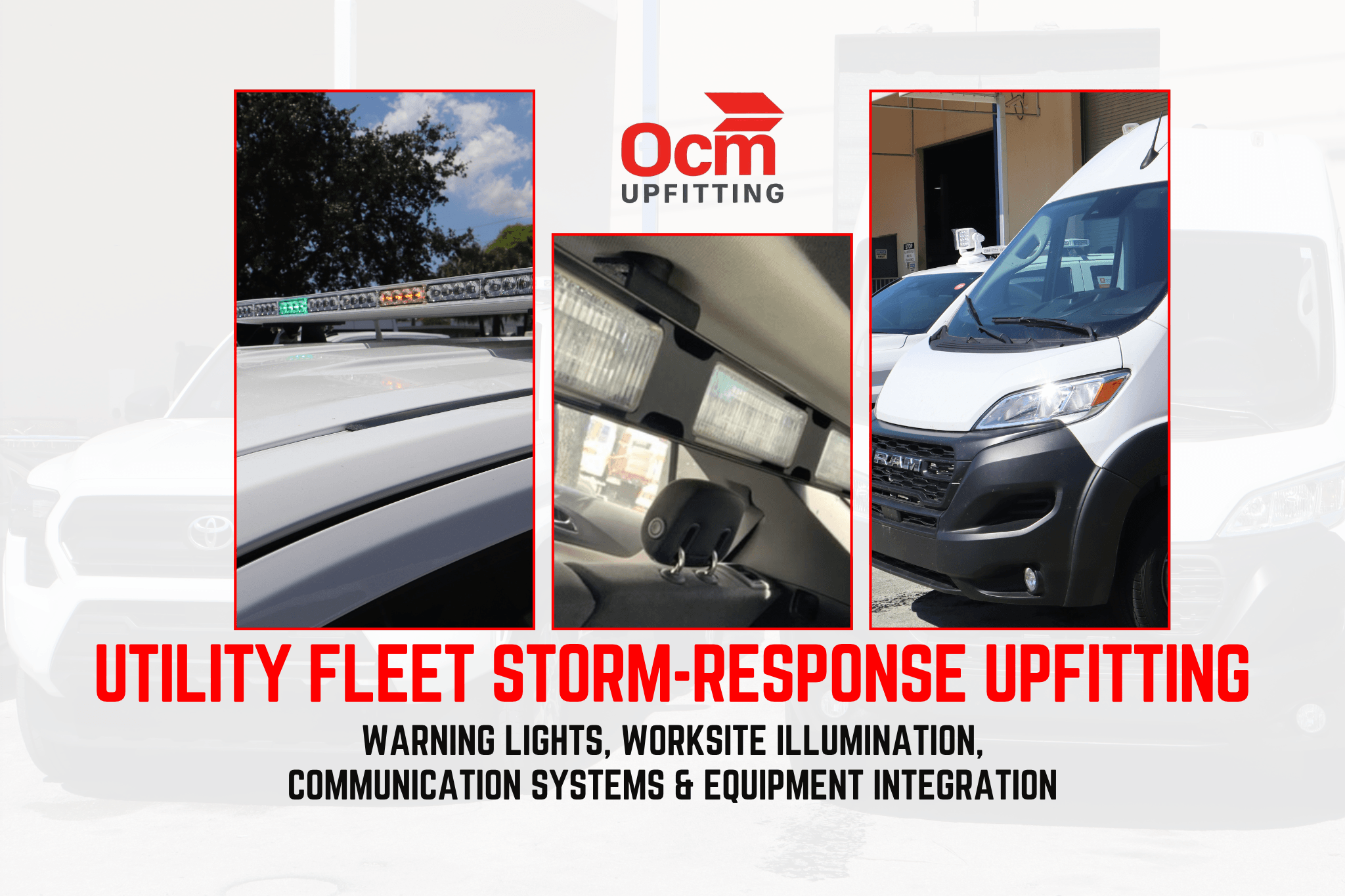
Storm service truck warning lights help approaching motorists recognize a stopped, slow-moving, or working vehicle.
Depending on the vehicle and operating conditions, an appropriate system may include:
- Roof-mounted amber light bars or beacons
- Grille and perimeter warning lights
- Rear directional warning systems
- Additional lights for obstructed viewing angles
Mounting positions should account for ladders, racks, service bodies, and other equipment that could block warning visibility.
Fleet managers can review OCM Upfitting’s traffic advisor and directional warning lighting services when evaluating roadside warning configurations.
Worksite Lights Illuminate the Task
Worksite lighting serves a different function.
Floodlights and task lights may help crews see tools, vehicle compartments, equipment, and nearby work areas.
They should be positioned to illuminate the intended activity while minimizing unnecessary glare toward approaching traffic, nearby workers, and vehicle operators.
Warning lights should not be treated as substitutes for work-area illumination.
Likewise, work lights should not replace traffic warning systems when those systems are required.
Review Applicable Roadside Work Requirements
The Federal Highway Administration’s current Manual on Uniform Traffic Control Devices provides standards for traffic-control devices, including temporary traffic control.
The current federal edition is the 11th Edition with Revision 1, dated December 2025.
OSHA’s highway work zone guidance also identifies hazards involving passing vehicles, equipment, and workers.
Fleet managers should verify applicable state requirements, permitted warning light colors, vehicle classifications, and the traffic-control procedures required for each assignment.
Warning lighting supports visibility but does not replace appropriate signs, barriers, traffic-control procedures, or worker training.
Coordinate Communication Equipment and Secure Storage
Storm-response crews may need to coordinate with dispatchers, supervisors, other contractors, and utility operations personnel.
A useful utility emergency response fleet equipment specification should address communication access and tool organization before installation.
Communication Equipment Integration
Depending on operational requirements, vehicles may need:
- Two-way radios
- Antennas
- Mobile communication terminals
- Approved charging connections
- Accessible equipment controls
These systems must be evaluated against the vehicle’s electrical capacity, existing equipment, and available mounting locations.
The GM Upfitter Body Builder Manuals provide vehicle-specific electrical and dimensional information that helps guide modification planning.
Professional installation should also account for circuit protection, wiring routes, grounding, and future maintenance access.
Secure Storage for Field Equipment
Storm-support vehicles may carry tools, testing equipment, protective gear, cables, and other supplies.
Poorly organized equipment can complicate unloading and create unnecessary movement inside the vehicle.
Fleet managers should evaluate storage based on:
- Equipment size and weight
- Frequency of use
- Secure mounting requirements
- Access from exterior compartments
- Available vehicle payload
- Crew loading and unloading procedures
Heavy equipment should be positioned and secured according to the vehicle’s specifications and the storage-system manufacturer’s requirements.
A consistent storage arrangement can also make it easier for crews to locate equipment when moving between similarly configured trucks.
Planning Several Storm-Response Vehicles?
OCM Upfitting can discuss warning lighting, communication equipment, storage, and vehicle-specific integration requirements before your fleet specifications are finalized.
Outfitting Multiple Storm-Response Trucks?
Different vehicle models and crew assignments need carefully planned equipment configurations. Discuss warning lighting, storage, communications, and fleet consistency with OCM Upfitting before finalizing your specifications.
Use Vehicle Graphics for Fleet and Contractor Identification
Storm-response operations may involve utility employees, outside contractors, and support vehicles working in the same area.
Clear vehicle identification can help distinguish organizations and assigned equipment during coordinated field operations.
For businesses planning utility contractor vehicle wraps, branding should remain readable while accommodating the vehicle’s actual configuration.
Important considerations include:
- Company logos and approved colors
- Contractor or utility identification
- Fleet unit numbers
- Vehicle-specific graphic layouts
- Door and compartment clearances
- Existing required markings
- Lighting and reflector visibility
OCM Upfitting offers vehicle wraps, decals, and fleet branding services for commercial vehicles.
The 3M fleet graphics guide identifies full wraps, partial wraps, decals, and spot graphics as available branding options.
For utility service bodies with multiple compartments, strategically placed lettering or partial graphics may be more practical than a full wrap.
Fleet identification should not be confused with authorization to access restricted worksites. Contractors must still follow the relevant utility’s identification and access procedures.
Match Equipment Specifications to Crew Assignments
Not every storm-response vehicle needs the same equipment package.
A field assessment pickup, utility service truck, and contractor support vehicle may perform different tasks.
Fleet managers should first define each vehicle’s intended role, then determine which equipment should be standardized.
Preparing 12 Utility Service Trucks
Consider a hypothetical utility contractor preparing twelve vehicles for seasonal storm-response assignments.
The fleet includes:
- Four field assessment pickups
- Six utility service trucks
- Two equipment support vehicles
The company establishes a common standard for approved warning lighting, vehicle identification, and communication requirements.
It then develops role-specific configurations.
Assessment pickups receive equipment appropriate for mobile inspections and reporting. Service trucks prioritize accessible tools and work-area illumination. Support vehicles are organized around carrying and securing assigned equipment.
Each vehicle type receives a compatibility review before installation.
The contractor approves a reference build for each configuration and documents any necessary variations.
This approach can help coordinate purchasing, installation, and future vehicle replacement without assuming every truck must be identical.
What Affects Storm-Response Fleet Upfitting Costs?
The scope of a utility response truck lighting installation depends on more than the number of lights ordered.
Fleet quotes may vary based on vehicle models, mounting locations, electrical requirements, auxiliary lighting, controllers, storage systems, graphics, and installation complexity.
Additional considerations include existing vehicle modifications, equipment availability, and whether different vehicle types require separate specifications.
For multi-vehicle projects, fleet managers should request a clearly defined equipment and installation scope so proposals can be compared consistently.
Utility Storm-Response Upfitting Checklist
Before approving a storm-response vehicle build, confirm:
- Vehicle makes, models, and quantities are documented.
- Crew assignments and operating conditions are defined.
- Warning light configurations are approved.
- Worksite lighting requirements are identified.
- Lighting colors and operating patterns meet applicable requirements.
- Electrical capacity and integration are reviewed.
- Communication equipment locations are finalized.
- Storage and equipment mounting are appropriate.
- Payload and axle ratings are respected.
- Company graphics and identification are approved.
- Lighting and required vehicle markings remain unobstructed.
- Final equipment testing and inspection are included.
FAQs
What equipment should utility storm-response trucks have?
Equipment depends on vehicle assignments but may include authorized warning lights, worksite illumination, communication equipment, secure storage, and vehicle identification.
Are amber warning lights required on utility storm-response vehicles?
Requirements vary by state, vehicle role, roadway activity, and applicable work-zone rules. Fleet managers should confirm the authorized lighting configuration before installation.
Can the same lighting setup work on every utility truck?
Not necessarily. Roof configurations, equipment obstructions, electrical capacity, and operating assignments can require different mounting arrangements.
Can utility vehicle wraps and warning lights be installed during the same project?
Yes. Coordinating graphics and lighting requirements before installation can help avoid conflicts involving mounting locations, wiring, and vehicle identification.
Request a Utility Storm-Response Upfitting Quote
Preparing new utility service trucks or upgrading an existing fleet? Share your vehicle models, fleet quantity, lighting requirements, and equipment needs with OCM Upfitting.
Request Your Fleet Upfitting Quote
Prefer to speak with our team?
Call (954) 764-8117
Visit OCM Upfitting in Fort Lauderdale
Planning utility fleet vehicle upfitting?
Contact our Fort Lauderdale headquarters to discuss your fleet requirements.
OCM Upfitting Headquarters
730 NW 7th St
Fort Lauderdale, FL 33311