A Delivery Van Built for One Load May Work Poorly for 40 Stops
A delivery vehicle can hold every package assigned to the route and still be poorly configured if the driver repeatedly moves cargo, searches for the next stop, climbs around obstacles, or loses access to frequently handled items.
That is why delivery vehicle upfitting should begin with the route and driver workflow, not with shelving alone. Fleet managers should define package dimensions, loading methods, stop frequency, cargo sensitivity, security exposure, route environment, and access patterns before selecting storage, partitions, cameras, lighting, or other equipment.
OCM Upfitting works with commercial fleet applications and vehicle configurations involving storage, cameras, graphics, fabrication, and integrated equipment. Fleets preparing delivery vehicles can begin by reviewing OCM Upfitting vehicle services.
The objective is straightforward: configure the vehicle around how cargo moves through the route.
Start With the Number and Type of Stops
A vehicle making one large delivery does not operate like a van completing dozens of stops.
Before designing the interior, answer questions such as:
- How often will the driver access the cargo area?
- Are packages loaded in route order?
- Do package sizes vary significantly?
- Will returns or pickups be added during the route?
- Are side doors, rear doors, or both used regularly?
- Does the route involve loading docks, residential streets, garages, alleys, or dense urban areas?
Those answers influence aisle space, storage zones, access points, and how flexible the layout should remain.
A multi-stop delivery van layout should reduce unnecessary handling between stops rather than simply maximize storage capacity.
Organize Cargo Around Route Sequence
Interior organization should support the order in which cargo leaves the vehicle.
Depending on the operation, useful zones may include:
- Early-route deliveries
- Mid-route deliveries
- Late-route deliveries
- Returns or pickups
- High-value cargo
- Fragile or sensitive items
- Driver equipment and paperwork
The exact configuration depends on cargo dimensions and the loading process.
Fixed shelving may work well when package dimensions are relatively consistent. Adjustable shelving, open areas, or modular storage may be more practical when loads change frequently.
The key question is whether the driver can identify and retrieve the next delivery without moving unrelated cargo first.
The NIOSH ergonomics guidance identifies repetitive movement, lifting, bending, twisting, and awkward posture as workplace risk factors. For frequent-stop delivery work, that makes access and placement important planning considerations.
Keep Frequently Used Equipment Within Practical Reach
The largest storage compartment is not always the most valuable one.
Think about what drivers repeatedly access throughout the route:
- Packages for upcoming stops
- Scanner or mobile device
- Delivery documentation
- Returns
- Hand truck or cart
- Safety equipment
- PPE where required
- Charging equipment
Frequently used items should not be buried behind bulk cargo.
The same workflow-first principle applies to other service vehicles. OCM Upfitting’s HVAC service van setup guide shows how vehicle storage can be organized around frequency of use rather than filling every available space.
Plan Cargo Restraint Before Finalizing Storage
Shelving and organization do not replace cargo restraint.
Packages, totes, carts, tools, and other items need to remain controlled during normal vehicle movement, braking, and turning. Depending on the vehicle and operation, this may involve partitions, appropriate containers, tiedowns, racks, barriers, or other restraint systems.
For commercial vehicles subject to federal cargo-securement requirements, fleets should review the applicable FMCSA cargo securement rules along with relevant state and company requirements.
The storage plan and the restraint plan should work together.
Evaluate Payload and Load Distribution
Delivery vehicles may begin the day near their heaviest operating condition and gradually become lighter as deliveries are completed.
Before approving the delivery van upfit, review:
- Vehicle curb weight
- Available payload
- Shelving and partition weight
- Driver and passenger weight
- Camera and electrical equipment
- Package or product weight
- Carts and handling equipment
- Weight distribution
Payload should not be confused with GVWR, towing capacity, or axle ratings.
Vehicle-specific information matters. Current GM Body Builder Manuals and Ford Pro upfitter publications are examples of manufacturer resources that can help qualified upfitters evaluate vehicle-specific dimensions and integration requirements.
Decide Whether a Partition Fits the Workflow
A partition may be appropriate when the cargo area needs separation from the cab, but it should not be selected automatically.
Consider:
- Whether the driver needs passage between cab and cargo area
- Cargo type
- Security requirements
- Vehicle architecture
- Visibility
- Equipment mounting
- Driver workflow
- Service access
The configuration should support the actual route instead of creating unnecessary movement.
If your fleet is developing a new delivery configuration, OCM Upfitting can review the vehicle platform, fleet quantity, package profile, route workflow, storage requirements, and equipment before the interior layout is finalized.
Match Security to the Route
A delivery vehicle making repeated stops may face different exposure than one traveling directly between secured facilities.
Ask:
- Is the vehicle left unattended during deliveries?
- Can cargo be seen from outside?
- Are high-value items carried?
- How frequently do side and rear doors open?
- Is overnight parking involved?
- Are returns mixed with outbound cargo?
Security planning may involve controlled storage, interior organization, partitions where appropriate, cameras, or operating procedures.
OCM Upfitting’s cargo van security guide provides additional considerations for matching vehicle security to access patterns, parking conditions, and what the vehicle carries.
Plan Cameras Around the Visibility Problem
Delivery vehicles may operate in loading zones, residential streets, alleys, warehouses, parking lots, and other areas where visibility requirements differ.
Before choosing cameras, identify the problem you are trying to solve:
- Is rear visibility the main concern?
- Are side views important?
- Is incident recording required?
- Where should monitors be positioned?
- How will equipment remain serviceable?
- Should every vehicle use the same camera configuration?
OCM Upfitting’s fleet vehicle camera guide can help fleet managers think through camera placement and equipment integration around actual operating conditions.
Keep Lighting and Serviceability in the Design
Interior lighting may be valuable when drivers retrieve or sort cargo in low-light environments.
Cameras, lighting, chargers, and other electrical equipment should be planned as part of the vehicle’s electrical integration rather than added wherever unused space remains.
The finished configuration should also preserve access to:
- Electrical components
- Vehicle service points
- Replaceable equipment
- Wiring and distribution areas where appropriate
- Components requiring inspection or future removal
A layout that works well on delivery day but requires major disassembly for service can create another operational problem later.
Standardize Without Ignoring Different Routes
Fleet standardization can make training, inspections, vehicle swaps, documentation, and replacement planning easier.
Possible standards include:
- Storage-zone logic
- Labels
- Camera locations
- Driver equipment
- Charging locations
- Lighting controls
- Partition configurations
- Inspection points
- Documentation
However, different route profiles may justify controlled variations.
A dense urban parcel route may need a different interior from a regional route carrying fewer but larger products.
Standardization should create repeatability without forcing every operational role into an identical vehicle.
A Delivery Fleet Example
Consider a company replacing 20 delivery vans.
Twelve vehicles handle dense local routes with many small packages and frequent stops. Eight vehicles serve longer routes with fewer stops and larger products.
Using exactly the same shelving configuration across all 20 vehicles might simplify purchasing, but it may not support both workflows equally well.
The fleet could instead standardize shared features such as labeling, driver equipment, camera placement, lighting, cargo restraint points, and documentation while maintaining two approved interior layouts based on route type.
The fleet remains standardized, but the standard reflects the work.
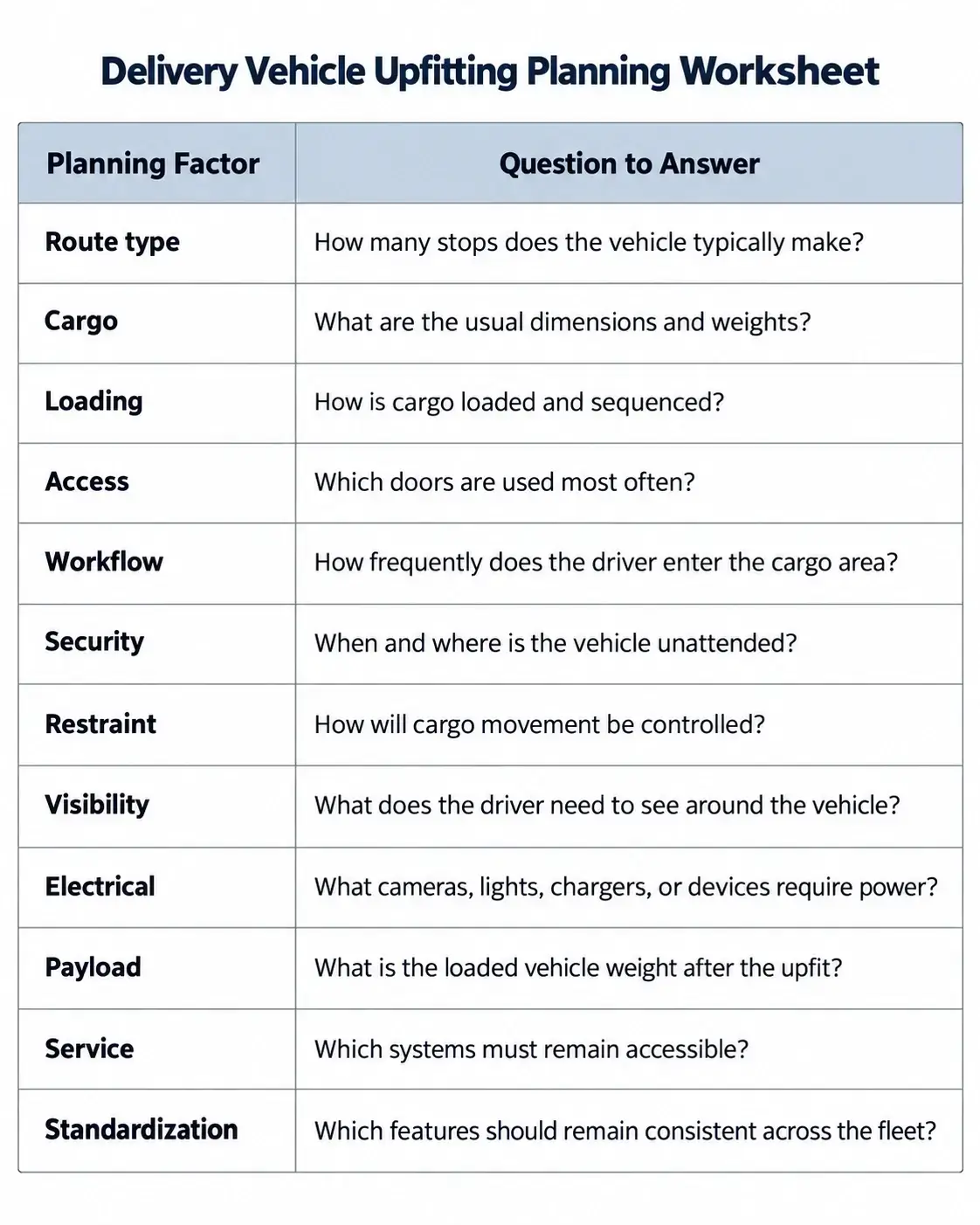
Delivery Vehicle Upfitting Planning Worksheet
Build the Vehicle Around the Route
Effective delivery vehicle upfitting starts with understanding the route, cargo, driver workflow, vehicle platform, and operating environment before storage and equipment are selected.
Fleet managers planning new delivery vehicles should prepare the vehicle make and model, fleet quantity, package dimensions, expected cargo weight, typical stop count, loading method, route environment, security requirements, camera needs, and desired fleet standards.
Planning a delivery fleet configuration? Call (954) 764-8117 or use the OCM Upfitting contact page to discuss the vehicle and equipment requirements before the final layout is approved.
FAQs
What should be included in a delivery van upfit?
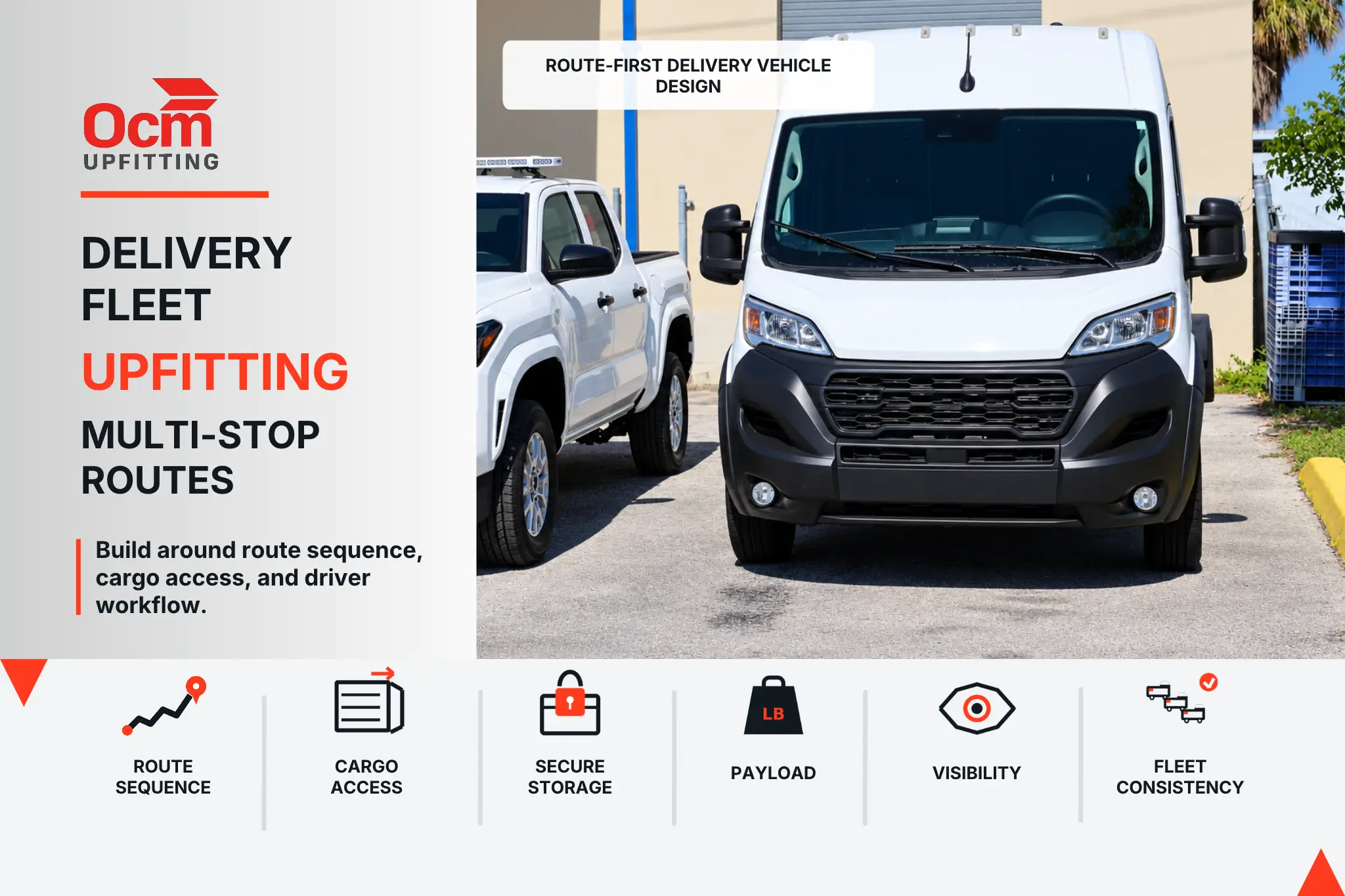
A delivery van upfit should be planned around cargo dimensions, route sequence, driver access, secure storage, cargo restraint, visibility, lighting, payload, service access, and fleet consistency.
How should a multi-stop delivery van be organized?
Organize the vehicle around route sequence and frequency of access. Frequently handled deliveries should be easier to reach, while later-route cargo, returns, and special items can use separate defined areas when appropriate.
Should every delivery vehicle use the same layout?
Not necessarily. Vehicles serving similar routes may benefit from repeatable layouts, while different cargo profiles or operating environments may justify controlled variations within the fleet standard.
What information should a fleet provide before requesting an upfit quote?
Provide the vehicle make and model, fleet quantity, route type, cargo dimensions and weight, stop frequency, loading method, door-access preferences, security requirements, camera needs, electrical accessories, and desired standardization.