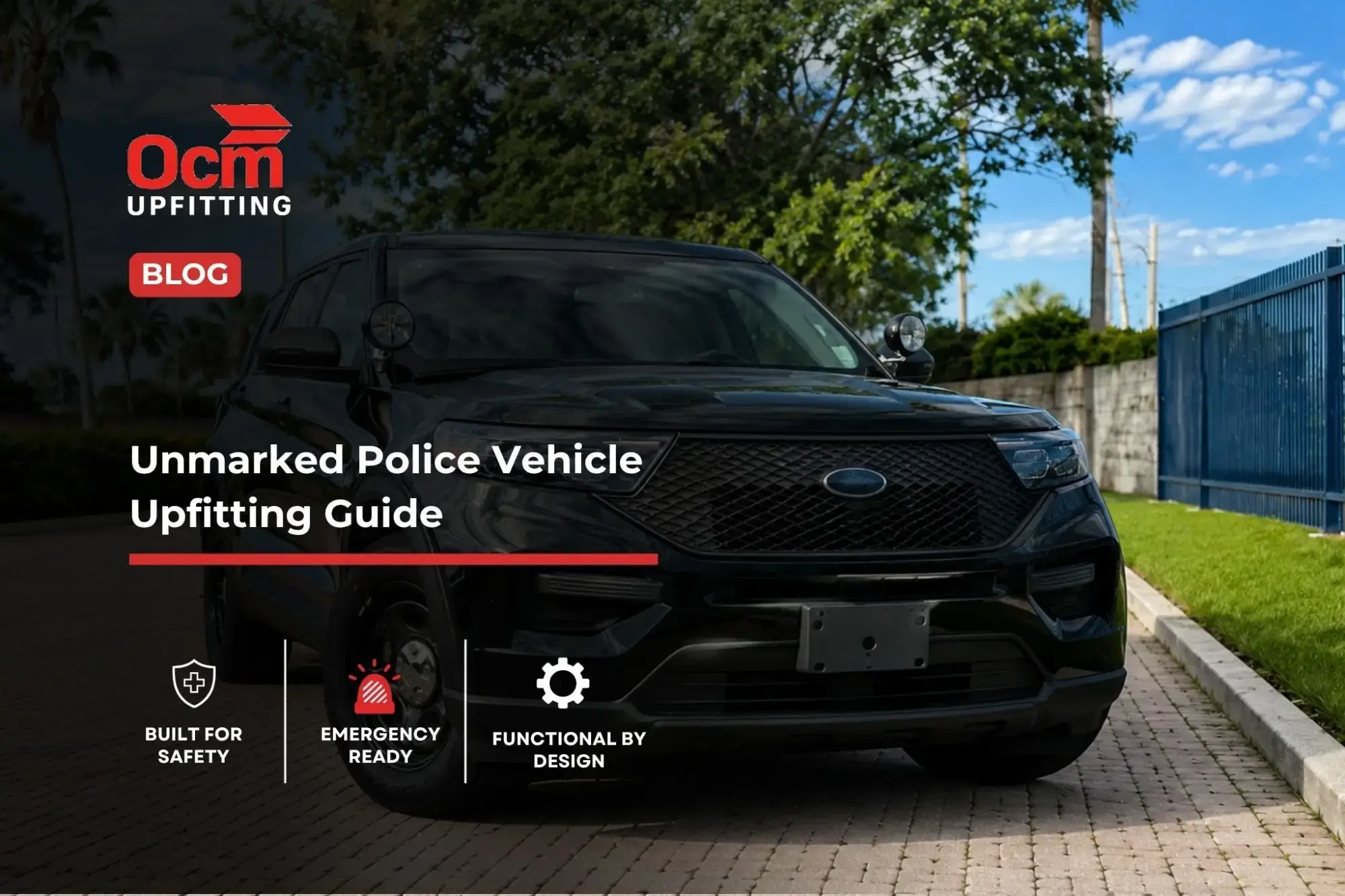
Designing an Unmarked Police Vehicle Around the Assignment
Unmarked vehicles have to balance two requirements that can compete with each other: maintaining a low-profile exterior while still giving officers dependable access to warning, communications, camera, control, and safety systems. For fleet managers and law-enforcement procurement teams, choosing unmarked police car equipment should start with the vehicle’s actual assignment, not with a list of accessories.
A detective unit, traffic-enforcement vehicle, command SUV, and specialized response vehicle may all need different layouts. OCM Upfitting supports law-enforcement and public-safety vehicle upfitting for agencies nationwide, so the planning discussion should begin with vehicle platform, duty cycle, officer workflow, equipment requirements, and agency specifications.
What Unmarked Police Car Equipment Actually Needs to Do
The goal is not simply to hide equipment. The goal is to preserve the vehicle’s intended appearance while keeping essential systems usable, secure, maintainable, and appropriate for authorized police operations.
A fleet specification may need to address:
- Emergency warning visibility when the system is activated
- Siren and control access without creating driver distraction
- Radio, camera, and other in-car electronics
- Secure equipment or weapon storage
- Driver sightlines and mirror visibility
- Airbag and occupant-protection zones
- Electrical load and circuit protection
- Heat around electronics and control modules
- Service access for future diagnosis or replacement
That makes detective vehicle equipment a layout problem as much as an equipment-selection problem. OCM Upfitting’s current site identifies law-enforcement vehicle upfitting, emergency and tactical lighting, in-car electronics, camera systems, custom fabrication, and secure storage among its public-safety capabilities.
Plan Covert Emergency Lighting as a Complete Warning System
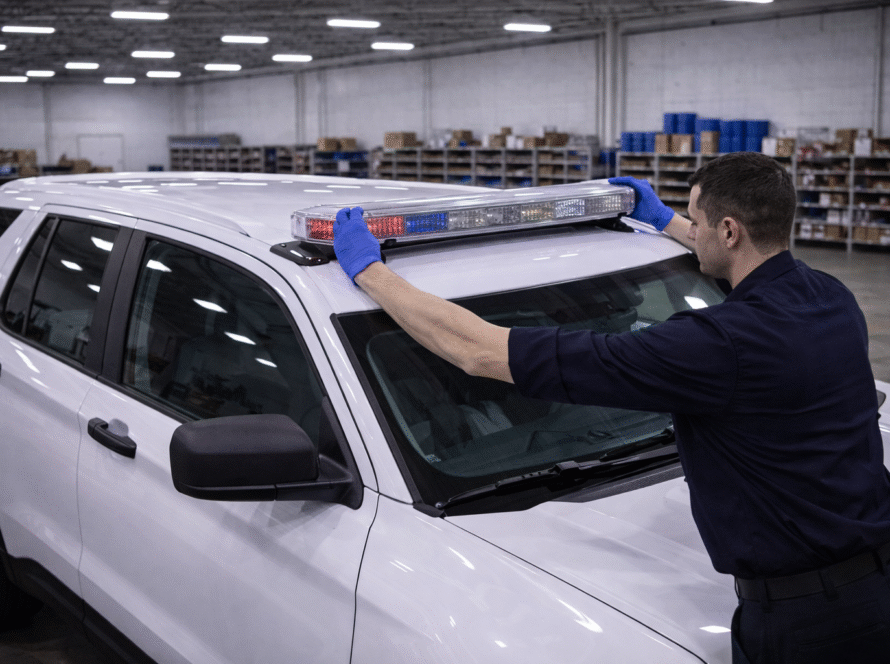
A slick-top police vehicle does not use a conventional full-length roof light bar, so warning coverage must be planned through lower-profile locations. Depending on the agency specification and vehicle platform, covert emergency lighting may involve interior visor or deck lighting, grille-mounted units, intersection lighting, or other concealed or low-profile warning lights. OCM’s current lighting content specifically discusses dash, deck, hideaway, and intersection lighting as fleet options.
The important question is not how many hidden police lights can be added. Fleet managers should ask whether the activated system provides the required visibility for the vehicle’s mission while preserving driver visibility, serviceability, and the desired civilian appearance when the system is off.
OCM Upfitting’s emergency lighting system guide provides additional context on matching lighting types to operating needs.
Integrate Sirens, Controls, Radios, Cameras, and Antennas Together
An unmarked build can become crowded quickly. A console may need to accommodate lighting and siren controls, radio equipment, charging, camera interfaces, and other electronics without blocking normal vehicle controls or creating an awkward reach.
Planning should also account for electrical demand, cable routing, grounding, component ventilation, antenna placement, and the possibility of interference between communications equipment and other electronics. Radio and electronic equipment should be integrated according to current vehicle and equipment-manufacturer guidance rather than treated as independent add-ons.
Resources such as Ford Pro upfitter publications and GM Upfitter body-builder manuals provide vehicle-specific technical information that can affect electrical integration, mounting, dimensions, and other modification decisions.
If your agency is developing a new detective, traffic, command, or specialized vehicle package, OCM Upfitting can review the mission and help turn those requirements into a more repeatable fleet upfitting specification.
Protect Airbag Zones, Visibility, and Future Service Access
Low-profile should never mean buried without a service plan. Equipment mounted around the instrument panel, seats, pillars, headliner, or center console has to be evaluated against the vehicle’s occupant-protection systems and OEM restrictions.
NHTSA guidance on the federal make-inoperative provision explains that covered businesses modifying vehicles may not knowingly make inoperative a device or element of design installed to comply with an applicable Federal Motor Vehicle Safety Standard. That is one reason fleet specifications should require installers to check current OEM documentation before selecting mounting locations or altering areas around safety systems.
Serviceability matters too. If a control module, fuse, camera interface, or radio component eventually needs diagnosis, the technician should be able to reach it without dismantling unrelated equipment. Good unmarked police car equipment planning considers the next service visit before the first installation is completed.
Secure Storage Without Advertising the Vehicle’s Mission
Unmarked and detective vehicles may need secure storage for weapons, evidence-related equipment, protective gear, or specialized tools. Storage should be selected around authorized access, security, available cargo space, vehicle structure, and officer workflow.
A large exposed enclosure can work against the purpose of a low-profile vehicle, while poorly located storage can interfere with seating, cargo access, or other equipment. OCM Upfitting’s article on vehicle weapon storage planning discusses integrating secure storage with vehicle interiors, consoles, power systems, and other public-safety equipment.
Florida Rules Still Apply to Unmarked Police Car Lights
Vehicle appearance does not replace legal authorization. Under the currently published Florida Statute 316.2397, blue lights are restricted to specified vehicles that include police vehicles. The statute also provides that authorized emergency vehicles may operate emergency lights and sirens in an emergency.
Agencies should therefore review the current law and their own policies when specifying unmarked police car lights, flash patterns, colors, and operating controls. For the primary legal source, review Florida Statute 316.2397. OCM Upfitting also maintains a practical overview of Florida emergency vehicle lighting requirements.
Because authorization, vehicle classification, operating purpose, and agency specifications can matter, a lighting package should not be treated as universally compliant simply because a particular color or product is commonly used.
Standardize the Build Without Making Every Unit Identical
Consider a hypothetical department replacing several vehicles used by detectives and specialized units. One group needs primarily detective vehicle equipment for interviews, communications, cameras, and secure storage. Another group uses a slick-top police vehicle for traffic enforcement and needs a more robust activated warning package.
The department can still standardize control logic, labeling, documentation, preferred service access, electrical protection, and common equipment where practical. The mission-specific pieces can then vary by assignment. This approach can make training, maintenance, and future replacement planning more consistent without forcing every vehicle into the same configuration.
What Fleet Managers Should Specify Before the Build
Before vehicles enter the shop, define the decisions that affect the entire upfit:
- Vehicle make, model, trim, and intended assignment
- Required covert emergency lighting and warning coverage
- Siren and control requirements for authorized vehicles
- Radio, camera, antenna, and other electronic equipment
- Secure storage and access requirements
- Driver visibility and airbag clearance
- Electrical load and power-management needs
- Heat and ventilation considerations for installed electronics
- Service access and documentation expectations
- Which elements should be standardized across the fleet
- Whether any equipment may be considered for future transfer
This keeps hidden police lights, radios, cameras, consoles, and storage from being planned as separate projects that compete for the same space or electrical capacity.
Build the Vehicle Around the Assignment
The strongest unmarked build is one that remains discreet when appropriate, becomes clearly functional when authorized warning systems are activated, and stays practical to operate and service over its fleet life. That requires planning the entire vehicle as a system.
OCM Upfitting works with law-enforcement and public-safety fleets nationwide on vehicle configurations built around mission requirements, equipment integration, safety, and fleet specifications. Call (954) 764-8117 to discuss your vehicles, operational requirements, and upcoming unmarked police car equipment needs. The phone number and nationwide law-enforcement positioning were verified against the current OCM Upfitting website.
FAQs
What equipment is commonly included in an unmarked police vehicle?
Typical unmarked police car equipment can include low-profile emergency lighting, authorized siren and control equipment, radios, cameras, antennas, consoles, charging equipment, and secure storage. The final package should depend on the assignment, vehicle platform, agency specification, electrical capacity, and safety requirements.
What is a slick-top police vehicle?
A slick-top police vehicle generally refers to a police vehicle without a traditional roof-mounted full-length light bar. Warning lighting may instead be integrated into lower-profile locations according to the vehicle, agency requirements, and applicable law.
Are blue lights legal on unmarked police vehicles in Florida?
Florida Statute 316.2397 lists police vehicles among the vehicles permitted to display blue lights. The provision does not distinguish between marked and unmarked police vehicles, but the vehicle must still be legitimately authorized and operated according to applicable law and agency policy.
How should agencies choose covert emergency lighting?
Start with the vehicle’s assignment, required activated warning coverage, driver visibility, vehicle platform, electrical capacity, service access, agency specifications, and applicable state law. Lighting placement should be planned as part of the complete vehicle rather than as an isolated installation.