Choose Camera Coverage Around the Fleet’s Actual Risk
A fleet vehicle camera system should solve a defined operational problem. A contractor may need better visibility while reversing at crowded job sites. A service fleet may want front-facing incident documentation. A public-safety agency may need several camera views, recording, monitors, and other vehicle systems working together. The right configuration depends on where the vehicle operates, what the driver needs to see, what must be recorded, and how the footage will be managed.
OCM Upfitting currently works with law enforcement, emergency-response, security, service, and other fleet applications. Its dedicated camera service includes high-definition dash cameras, rear-view cameras, side cameras, DVRs, intercoms, and in-vehicle monitors. That makes camera planning part of the larger upfit, where mounting, electrical integration, driver visibility, communications, and other equipment must work together.
Start by Choosing the Right Camera Type
Not every fleet needs the same coverage. Before comparing specifications, determine what information drivers and managers actually need.
Front-Facing and Dual-Facing Cameras
A fleet dash camera system typically begins with a forward-facing view that documents activity in front of the vehicle. Depending on the equipment selected, fleets may also evaluate dual-facing configurations that capture both the road and vehicle interior.
Interior recording creates additional privacy and policy considerations. Fleet managers should establish why interior recording is required, who may access footage, and how data will be handled before deployment.
Rear and Side Camera Systems
Rear cameras can support visibility during backing and maneuvering, while side-mounted cameras can provide additional views around larger vans, trucks, and specialty vehicles.
Federal requirements also matter when an upfit affects original rear-visibility equipment. NHTSA’s FMVSS No. 111 rear-visibility resources address rear-visibility performance requirements for applicable vehicles. An added camera should not be treated as a substitute for required OEM equipment or applicable vehicle requirements.
Is a 360 Vehicle Camera System Necessary?
A 360 vehicle camera system can be useful when an operating environment requires broader coverage around the vehicle. Fleet managers should compare the actual camera views, monitor presentation, recording coverage, image quality, and blind areas instead of assuming every system provides identical visibility.
OCM Upfitting’s current service page specifically lists dash, rear, and side cameras, DVRs, intercoms, and monitors, but does not publish a universal 360-degree platform specification. If 360-degree coverage is required, confirm compatibility and functionality for the equipment being considered.
Compare More Than Camera Resolution
Resolution matters, but it should not determine the purchase by itself. A commercial vehicle camera system must remain useful under the fleet’s actual operating conditions.
Fleet managers should evaluate:
- Camera position and field of view
- Daytime and low-light image usability
- Ability to identify useful details in recorded footage
- Exposure to vibration, weather, dirt, and physical damage
- Monitor placement and driver visibility
- Recording duration and storage capacity
- How footage is retrieved and exported
- Access permissions and administrative controls
- Serviceability and replacement requirements
- Compatibility across planned vehicle classes
A high-resolution camera positioned poorly may provide less useful information than a properly placed system designed around the vehicle’s blind areas and working environment.
DVR, Mobile Recording, and Cloud Access
A mobile DVR for vehicles provides centralized recording for one or more cameras, depending on the system design. Fleet managers should understand how footage is stored, what happens when storage fills, how recordings are retrieved, and how access is controlled.
Cloud-connected platforms may add remote access or centralized fleet management depending on the product. Those capabilities should never be assumed. If remote footage access is an operational requirement, include it in the specification and verify exactly what the selected platform supports.
Remote connectivity also turns camera selection into an information-security decision. The NIST Cybersecurity Framework 2.0 provides organizations with a framework for managing cybersecurity risk. Fleet IT teams should be involved when cameras, DVRs, or management platforms connect to organizational networks or remotely accessible services.
If your fleet is comparing cameras, DVRs, monitors, and other electronic systems, OCM Upfitting can review how the vehicles operate and help plan the camera installation as part of the overall upfit rather than treating it as an isolated accessory.
Build Privacy Policies Before the Cameras Go Into Service
Video creates information that needs to be managed. Before deploying a fleet vehicle camera system, organizations should decide what gets recorded, why recording is necessary, who has access, how long footage is retained, and how footage is handled when an incident occurs.
The NIST Privacy Framework provides a voluntary framework for identifying and managing privacy risk. It can help organizations think systematically about data governance rather than waiting until recorded information creates a policy question.
Audio, employee monitoring, public recording, disclosure, and retention requirements may vary depending on jurisdiction and fleet use. Organizations should have applicable policies and legal requirements reviewed for their specific operation rather than relying on a generic camera policy.
Installation Quality Is Part of Camera Performance
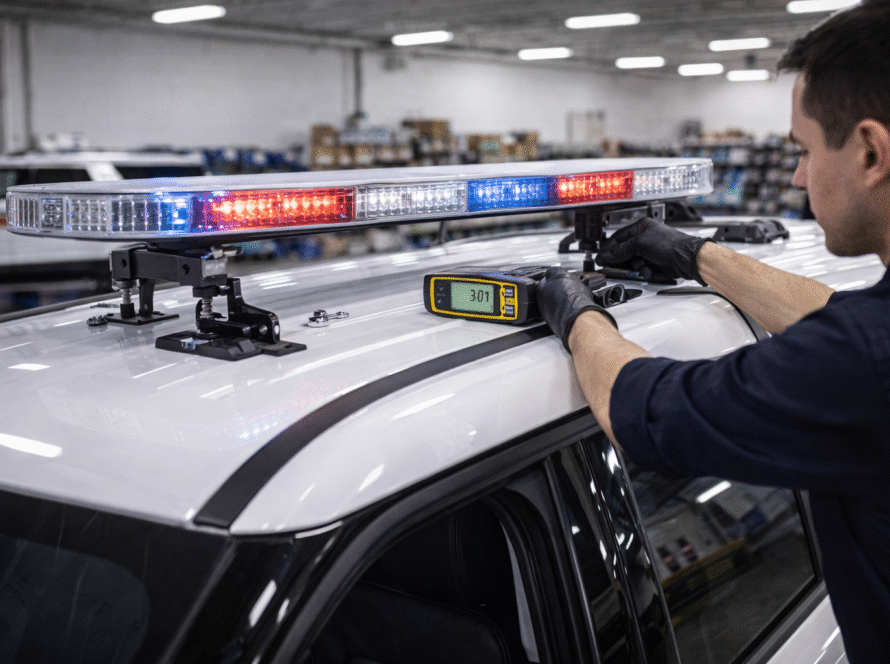
Professional in-vehicle camera installation involves more than attaching a camera to the windshield. Equipment location must consider driver visibility, existing controls, airbags and occupant areas, wiring routes, mounting integrity, maintenance access, and the rest of the vehicle’s electrical equipment.
Electrical demand also needs to be viewed across the complete upfit. A vehicle may already have warning lighting, radios, charging equipment, auxiliary lighting, controllers, and other electronics. OCM Upfitting’s guide to power distribution planning for multi-system vehicles explains why electrical planning becomes more important as systems are combined.
Fleet teams should also use the correct OEM documentation when planning modifications. GM Upfitter body-builder manuals include vehicle-specific electrical schematics and body information that demonstrate why electrical integration cannot be treated as universal across different vehicles.
Standardize Camera Specifications Across Similar Vehicles
A fleet with ten different camera configurations can create unnecessary complexity for drivers, managers, technicians, and procurement teams.
Where vehicle missions are similar, standardizing the commercial vehicle camera system can establish consistent expectations for:
- Camera locations
- Recording settings
- Monitor placement
- Footage retrieval
- User access
- Inspection procedures
- Replacement equipment
- Driver training
OCM Upfitting’s broader guidance on fleet upfitting standards discusses the operational value of repeatable equipment and installation specifications while allowing mission-specific vehicles to remain customized where necessary.
Hypothetical Fleet Scenario
Consider a hypothetical field-service company operating 30 vans. Some vehicles have rear cameras, others have standalone dash cameras, and several have different recording systems purchased at different times.
Instead of simply buying another fleet dash camera system, the fleet manager could review recurring operating conditions first. If technicians frequently reverse in tight commercial properties, rear visibility may be a priority. If incident documentation is important, forward recording may be required. If several views need to be stored together, a mobile DVR for vehicles may make more sense than separate recording devices.
The resulting specification could then be repeated across similar vans while specialized vehicles receive different configurations. No particular configuration guarantees fewer incidents, but consistency can make equipment use, training, maintenance, and future procurement easier to manage.
OCM Upfitting’s fleet safety equipment guide can also help fleet managers evaluate cameras alongside warning equipment, visibility systems, and other vehicle safety considerations. Cameras are already covered there as one element of a broader safety strategy, while this buyer’s guide focuses specifically on selecting and integrating camera systems.
Plan the Camera System as Part of the Complete Upfit
Choosing a fleet vehicle camera system requires decisions about coverage, recording, storage, privacy, electrical integration, driver visibility, serviceability, and fleet standardization. Camera hardware should support the vehicle’s mission instead of creating another disconnected system that has to be managed later.
OCM Upfitting provides vehicle cameras, DVRs, intercoms, monitors, and broader fleet-upfitting capabilities that allow camera planning to be coordinated with the vehicle’s other equipment. Call (954) 764-8117 to discuss your vehicles, operating environment, camera requirements, and in-vehicle camera installation needs before developing the final specification. The phone number remains the current number published by OCM Upfitting.
FAQs
What should fleet managers look for in a vehicle camera system?
Start with the operational problem, then compare coverage, image usability, night performance, storage, footage retrieval, access controls, durability, electrical requirements, installation, and scalability across the fleet.
Is a 360 vehicle camera system better than separate cameras?
Not automatically. A 360 vehicle camera system may suit fleets that need broader surrounding visibility, while other vehicles may only need front, rear, or side coverage. The correct configuration depends on the vehicle and operating environment.
What is the difference between a dash camera and a mobile DVR?
A dash camera generally captures a specific view and may include its own recording capability. A mobile DVR can serve as a centralized recorder for multiple cameras, depending on the selected equipment.
Can fleet cameras be integrated with other vehicle equipment?
They can be part of a coordinated upfit, but compatibility depends on the vehicle and equipment. OCM Upfitting currently installs cameras, DVRs, monitors, intercoms, and other vehicle electronics, making system-level planning important.