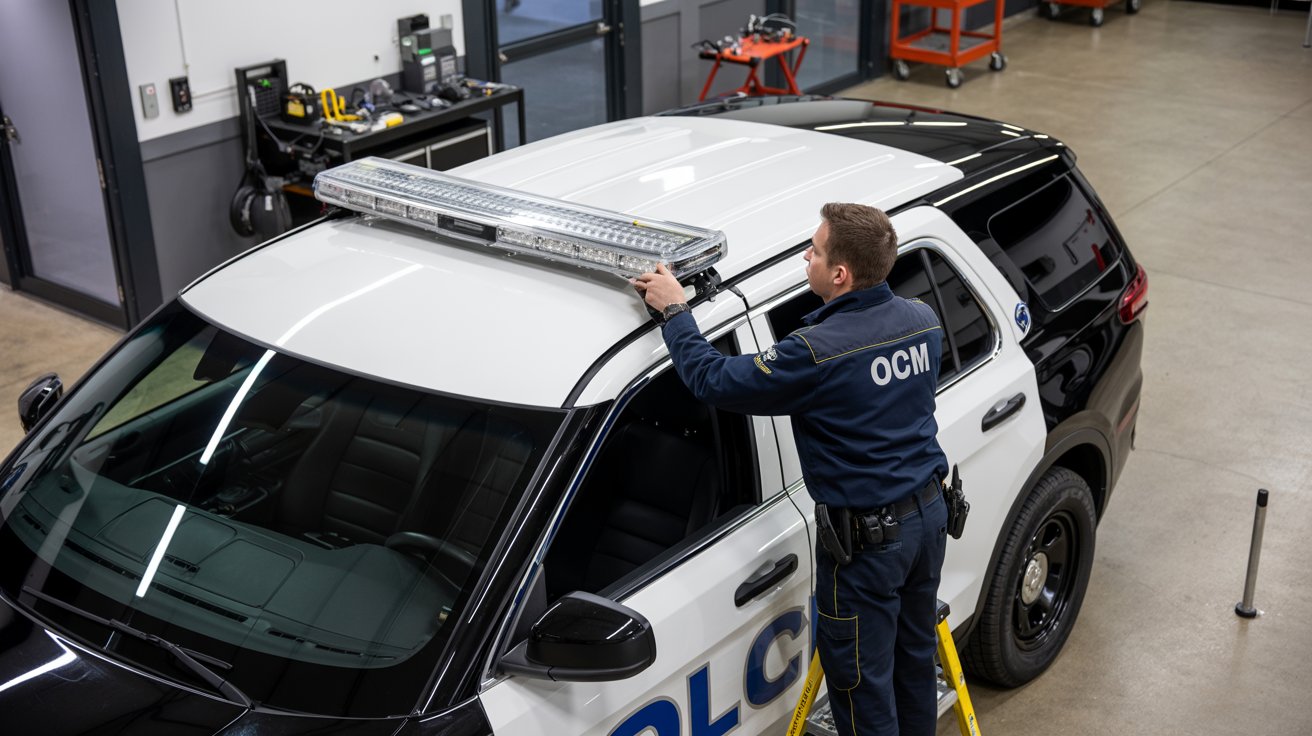
Roof-mounted full-length light bars continue to dominate pursuit fleet builds thanks to their proven visibility, reliability, and road authority. For emergency and law enforcement fleets, roof-mounted full-length systems remain the most recognizable and effective rooftop warning solution in the industry. These light bars are more than a lighting accessory they’re a core safety system engineered to perform in the most demanding response environments.
Early in the upfitting process, fleet managers evaluate brightness, durability, controller integration, and compliance requirements. The conversation often starts and ends in the same place: roof-mounted full-length light bars offer the strongest blend of perception, performance, and practicality for pursuit operations across the United States.
OCM Upfitting has delivered custom fleet upfitting solutions since 1991, building vehicles for law enforcement, fire rescue, EMS, K9, and tactical divisions. Every lighting system, hardware mount, partition, cage, and storage module reflects real field needs and end-user safety requirements. That same real-world understanding drives why full-length roof bars continue to be a top request in modern pursuit vehicle builds, especially when rapid recognition and aggressive environmental performance are non-negotiable.
Visibility That Commands the Road
One of the biggest reasons roof-mounted full-length light bars remain the standard is simple — drivers notice them faster and from farther away than any other lighting format. Human reaction time is driven by visual recognition, color contrast, pattern motion, and perceived urgency. Full-length light bars create a wider signal footprint, increasing light dispersion at eye level for surrounding traffic.
From elevated highways to dense urban intersections, full-length roof bars generate a 360-degree warning zone that cuts through blind spots, median obstructions, large commercial vehicles, guard rails, overgrowth, and low ambient light. The significant width also increases off-axis visibility, meaning drivers who aren’t directly behind or in front still catch the signal early.
Law enforcement agencies have relied on roof light bars for decades because of their unmatched recognition distance. LED modules project high-intensity light that remains visible even in direct sunlight — a requirement for daytime pursuit and roadside scene management. Unlike low-profile interior-mounted lights, roof bars are positioned in the highest visual plane on the vehicle, giving them a natural advantage in visibility competitions.
Tactical Authority and Public Response Psychology
Emergency lighting is heavily influenced by perception. When motorists see red and blue flashing signals projected across a full-length roof bar, their brain processes it as a legitimate emergency alert requiring compliance. Studies around emergency vehicle driver behavior repeatedly show that motorists yield faster when lighting appears full-sized, centralized, and roof-dominant.
Full-length roof bars also reduce hesitation in high-stress situations by creating clear signaling hierarchy. In multi-vehicle responses, full roof systems establish leadership on road scenes and prevent the ambiguity that smaller or scattered systems can create.
For tactical teams, roof bars provide instant identification at night without revealing interior operator positions — delivering both visibility and concealment when required. Undercover builds may reduce exterior lighting, but pursuit fleets prioritize authority signaling, and full-length roof bars fulfill this role better than any micro-system configuration.
Durability, Heat Management, and Structural Integrity
Roof-mounted full-length light bars are engineered with weather-sealed circuitry, rugged housings, and impact-tolerant lenses. These vehicles run harder, brake faster, accelerate aggressively, shoulder curbs, navigate debris zones, and operate for long hours in extreme heat, rainstorms, humidity, and salt-air environments.
Common construction advantages include:
-
Aluminum extruded housings for structural stiffness and rust resistance
-
UV-stable polycarbonate lenses that resist cracking, fogging, fading, and yellowing
-
Internal heat-sink channels that pull temperature away from LED boards
-
Vibration-tested mounting brackets that prevent module fatigue, loosening, or hardware fracture
In states like Florida, Texas, Arizona, Nevada, and California — where rooftop systems sit under direct sun for hours — heat management determines long-term light bar survival. Modern full-length systems incorporate thermal channeling that stabilizes LED junction temperatures, preserving brightness consistency and module life.
OCM’s In-House Custom Fabrication unit also builds vehicle-specific roof mounts, consoles, and wiring paths to enhance durability and eliminate installation stress points. Custom mounts protect your light bar investment from long-term vibration damage that can be caused by generic or ill-fitting brackets.
Compliance Advantages Across U.S. Jurisdictions
Lighting compliance standards vary from state to state, but full-length roof bars historically fit regulatory frameworks better because they meet:
-
Minimum brightness thresholds
-
Pattern clarity and separation requirements
-
Color visibility dominance laws
-
Directional traffic advisor integration standards
-
Off-axis recognition and angle minimums
Many jurisdictions now promote amber integration for scene guidance. Full-length roof bars easily accommodate built-in traffic advisor modules, take-down lights, alley flood modules, and multi-color pattern scripting — all within a single roof system to maintain compliance without adding separate hardware.
By offering consolidated lighting architecture, full roof bars also reduce aftermarket wiring complexity, electrical overload risk, and failure points.
Power Management and Reduced Battery Strain
Full-length roof bars today use low-draw LED circuits that consume less power than legacy strobe or halogen bars while delivering more output. These systems support modern multi-load electrical architecture, often sharing power lines with radios, MDTs, surveillance cameras, and auxiliary vehicle systems.
Benefits include:
-
Lower amperage demand on vehicle alternator
-
Reduced parasitic battery drain during idle use
-
Ability to integrate with smart vehicle controllers
-
Fewer fuses and reduced wiring congestion
-
Stable voltage control during simultaneous system activation
OCM Upfitting also performs power distribution planning, battery upgrades, and load protection wiring, ensuring emergency lighting works alongside communication and surveillance systems without overloading the vehicle.
Optical Engineering That Scales with Road Environments
Unlike smaller dash or intersection lights that compete for space, full-roof light bar optics are scalable. A typical full-length bar can support:
-
Front and rear flood lighting
-
Red/blue driver compliance signaling
-
Amber traffic advisor sequencing
-
White take-down spot modules
-
Side alley illumination zones
-
Pursuit pattern domination modes
-
Cruise brightness optimization
This modular flexibility allows one lighting system to perform multiple mission roles while freeing dash space for MDTs, communication hardware, camera monitors, and storage modules.
Installation Efficiency and Low Long-Term Maintenance
From a service perspective, full-length roof bars deliver additional efficiency:
-
Easier component access for repairs or upgrades
-
Faster installation scheduling in fleet rollouts
-
Fewer independent hardware pieces to manage
-
Reduced maintenance error rate
-
Better parts availability and upgrade scaling
-
Seamless controller updates during service visits
Because every module lives in one roof assembly, technicians can inspect, test, and replace parts more rapidly than they can across scattered interior or micro-mounted lighting formats.
Why Fleet Managers Still Trust the Format
Fleet managers return to full-length roof bars because the format checks every priority category:
| Requirement | How Full-Length Roof Bars Deliver |
|---|---|
| Fast public recognition | Highest visual plane on vehicle |
| Road authority psychology | Red and blue dominance |
| Weather tolerance | Sealed circuits + tough housing |
| Electrical efficiency | Low-draw LED platforms |
| Modular scaling | Traffic advisor + flood + take-down |
| Compliance support | Meets brightness + angle regs |
| Serviceability | Faster maintenance & upgrades |
Closing Thoughts
Roof-mounted full-length lighting remains the industry standard because it provides early recognition, tactical authority, long-term durability, modular flexibility, regulatory compliance, and driver safety. In pursuit operations, lighting must deliver under real pressure, aggressive vehicle movement, temperature stress, and extreme field environments.
At OCM Upfitting, we design and install full roof lighting systems with mission precision, backed by custom mounts, structured wiring, power protection, and compliance-focused engineering.
If you’re evaluating roof-mounted full-length light bars for your fleet or department, make the smart choice with expert guidance and professional installation. OCM Upfitting builds mission-ready emergency vehicles using in-house fabrication, compliant wiring, and dependable lighting architecture. Let our certified upfitting specialists customize your next vehicle or fleet deployment the right way. Book your appointment today or schedule your light bar installation to speak directly with our team.