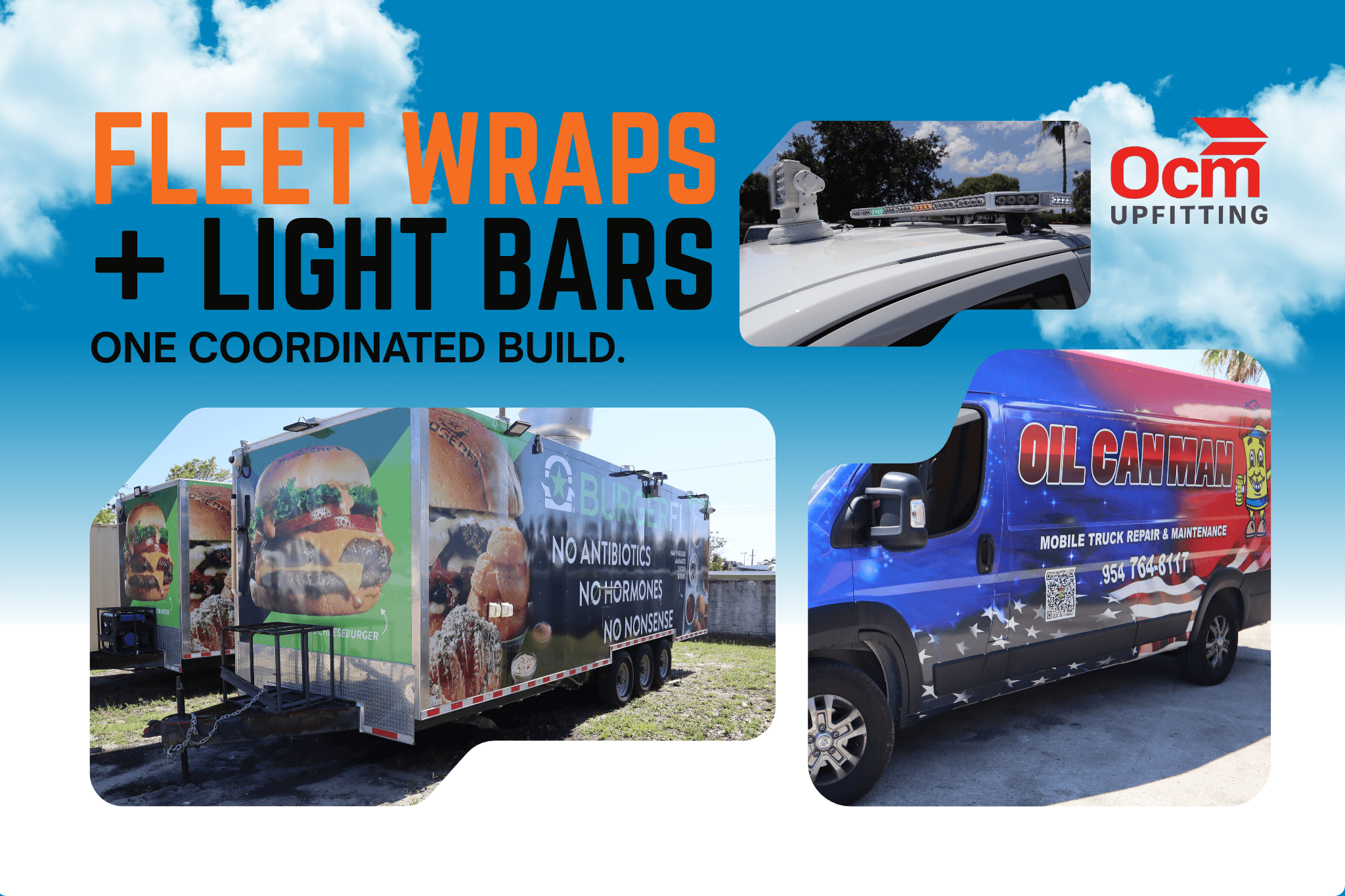
Why Fleet Wraps and Light Bars Should Be Planned Together
A professionally wrapped fleet vehicle can still require expensive rework if warning lights and exterior equipment were not included in the original installation plan.
Roof-mounted light bars, auxiliary lighting, antennas, exterior brackets, and wiring can affect graphic placement, installation access, and final vehicle appearance.
For fleet managers, fleet upfitting should coordinate these requirements before production begins. OCM Upfitting offers vehicle wraps and branding services alongside emergency lighting installations for commercial and public-safety fleets.
Planning fleet vehicle wraps and lighting together helps businesses and agencies approve equipment locations, graphic layouts, electrical requirements, and installation schedules under one specification.
The objective is straightforward: deliver a professionally branded vehicle with functional lighting, accessible equipment, and fewer avoidable installation conflicts.
Review Light Bar Mounting and Exterior Graphic Placement
A light bar and a vehicle wrap serve different purposes, but they must work with the same vehicle configuration.
Evaluate Mounting Locations First
Before approving an LED light bar installation for fleets, verify:
- Vehicle make, model, and roof configuration
- Approved light bar mounting locations
- Bracket and antenna clearances
- Existing roof accessories
- Exterior wiring requirements
- Maintenance access
Different vehicle models may require different mounting arrangements.
The GM Upfitter Body Builder Manuals provide vehicle-specific electrical and structural information to help evaluate proposed modifications.
Ford Pro’s upfitter publications also provide manufacturer resources for vehicle integration planning.
Position Graphics Around Equipment
Fleet graphics should not interfere with door operation, lighting equipment, sensors, or required vehicle markings.
A wrap layout should consider:
- Light bar brackets and roof accessories
- Exterior warning lights
- Doors and compartment openings
- Cameras and sensors
- Reflective markings
- Fleet unit numbers and identification
For commercial fleet graphics installation, designers should use accurate vehicle measurements and approved equipment locations before finalizing artwork.
The 3M fleet graphics guide also explains options such as full wraps, partial wraps, decals, and reflective accents.
Selecting appropriate coverage can help businesses maintain recognizable branding without interfering with vehicle functionality.
Coordinate Wiring, Equipment Access, and Vehicle Markings
Integrated fleet lighting and branding requires more than choosing matching colors.
Warning lights may need wiring routes, electrical connections, mounting hardware, and accessible controls. Graphic layouts must accommodate these installations without covering functional vehicle components.
Electrical Integration
Fleet managers should confirm:
- Available electrical capacity
- Power distribution and circuit protection
- Cable routing
- Controller placement
- Equipment service access
- Compatibility with existing vehicle systems
These requirements should be evaluated by qualified installers using vehicle and equipment manufacturer guidance.
The NTEA Vehicle Specification Process Guide emphasizes coordinating operational requirements, equipment specifications, and stakeholder approvals before vehicle modifications.
Required Markings and Warning Light Visibility
Commercial and public-safety vehicles may have identification, reflective markings, and warning light requirements based on their role and operating jurisdiction.
Before installation, confirm that approved graphics do not obstruct required lighting, reflectors, sensors, windows, or identification markings.
Emergency lighting colors and operating patterns must also meet applicable authorization and legal requirements.
A professional appearance should never come at the expense of required vehicle functions.
Planning a Combined Fleet Installation?
If your organization is ordering vehicles with both wraps and warning lights, OCM Upfitting can review proposed graphic layouts, equipment locations, and electrical requirements before production begins.
Plan Wrap Installation Around Vehicle Modifications
One of the most important parts of vehicle upfitting installation planning is deciding when each installation activity should occur.
There is no universal rule requiring wraps to be installed before or after every light bar or exterior accessory.
The appropriate sequence depends on the vehicle, mounting system, graphic coverage, material requirements, and equipment manufacturer’s instructions.
A Practical Installation Planning Process
Step 1: Finalize the equipment specification. Confirm light bar models, mounting locations, auxiliary lighting, antennas, and other exterior equipment.
Step 2: Approve the graphic layout. Use actual vehicle measurements and account for mounting hardware, access panels, lighting, and required markings.
Step 3: Determine the installation sequence. Coordinate mounting, cable routing, surface preparation, graphics application, and any required equipment removal or reinstallation.
Step 4: Complete system testing. Check warning light functions, controllers, electrical integration, and equipment accessibility.
Step 5: Inspect the final vehicle. Confirm the finished graphics and installed equipment match the approved specification.
Late changes to lighting or artwork should be reviewed through a documented process. OCM Upfitting’s fleet upfitting change-order guide explains how to evaluate specification revisions, pricing, scheduling, and acceptance requirements.
How Coordinated Planning Supports Multi-Vehicle Fleets
Consider a hypothetical service company preparing fifteen new vehicles with company branding, authorized warning lights, and communication equipment.
Some vehicles are cargo vans, while others are pickups.
If the graphics team and equipment installers work from different specifications, their plans may conflict.
For example, a proposed graphic may overlap an exterior lighting location, or a requested equipment change may affect completed artwork.
A coordinated approach could involve:
- Establishing a common branding standard
- Confirming equipment specifications for each vehicle model
- Approving lighting and graphic locations
- Validating the first completed vehicle
- Repeating the approved configuration across compatible vehicles
This approach does not guarantee lower costs or faster delivery, but it helps identify potential conflicts before installations are repeated.
What Affects the Cost of a Combined Fleet Upfit?
A combined project quote depends on the actual vehicle and installation requirements.
Important factors include:
- Vehicle type and fleet quantity
- Full wraps, partial wraps, or decals
- Graphic design and artwork preparation
- Light bar and auxiliary lighting specifications
- Electrical integration requirements
- Custom mounting or fabrication
- Existing equipment modifications
- Vehicle condition
- Installation complexity
- Project scheduling
Fleet managers should request a clearly defined scope identifying what is included, what requires separate approval, and how equipment changes will be handled.
For a multi-vehicle rollout, it is also useful to confirm which configurations can be standardized and which require vehicle-specific adjustments.
Fleet Wrap and Light Bar Installation Checklist
Before authorizing production, verify:
- Vehicle models and quantities are confirmed.
- Wrap designs and branding standards are approved.
- Light bar models and mounting locations are finalized.
- Auxiliary lighting and antennas are accounted for.
- Wiring and electrical requirements are reviewed.
- Sensors, doors, and equipment access remain functional.
- Required vehicle markings are preserved.
- Graphic materials and surface conditions are suitable.
- Installation sequencing is approved.
- Equipment changes require documented approval.
- Lighting functions and graphics are inspected.
- Final vehicle documentation is provided.
This checklist helps fleet teams compare proposals and approve a complete installation scope rather than treating wraps and lighting as unrelated purchases.
Plan Your Fleet Wrap and Lighting Project With OCM Upfitting
Your fleet graphics and lighting should work together from the first installation, not require adjustments after the vehicle is completed.
OCM Upfitting provides full-length emergency light bar installations, vehicle wraps, graphics, and custom vehicle upfitting services for commercial and public-safety applications.
If you are planning new service vans, fleet pickups, government vehicles, or authorized emergency units, prepare your vehicle models, fleet quantity, branding requirements, lighting specifications, and proposed installation schedule.
Call OCM Upfitting at (954) 764-8117 or use the fleet project inquiry page to request a custom fleet upfitting quote for vehicle wraps and LED light bar installations.
FAQs
Can vehicle wraps and LED light bars be installed during the same fleet upfitting project?
Yes. Both services can be coordinated through one approved project specification. The installation sequence should account for vehicle compatibility, equipment mounting, graphics, and electrical requirements.
Should vehicle wraps be installed before or after light bars?
It depends on the vehicle, mounting arrangement, film application requirements, and exterior modifications. The installation team should establish the appropriate sequence before work begins.
Can reflective vehicle graphics interfere with warning lights?
Poorly positioned graphics may obstruct required vehicle equipment or create conflicts with approved markings. Fleet managers should confirm placement, visibility, and applicable requirements before installation.
What information is needed for a combined fleet wrap and lighting quote?
Prepare vehicle makes and models, fleet quantity, approved branding files, wrap coverage, lighting specifications, existing equipment, and project scheduling requirements.