Take Down Lights vs. Alley Lights for Police Fleets
Not every light on a police vehicle performs the same job. Take down lights illuminate the area ahead of the vehicle, while alley lights direct illumination toward the sides. Both serve a different purpose from the flashing warning lights used to alert other road users.
For police fleet managers comparing light bar configurations, understanding these functions helps prevent incomplete equipment specifications. OCM Upfitting provides full-length roof light bar installation and offers Street Elite LED Light Bars with advertised take-down and alley-light options. The correct setup depends on the vehicle platform, available product configuration, and agency-approved operating requirements.
Comparing Police Light Bar Functions?
Need forward-facing take-down lights, side-facing alley lights, or both? Discuss your patrol vehicle requirements and available lighting configurations with OCM Upfitting.
What Are Take Down Lights on Police Vehicles?
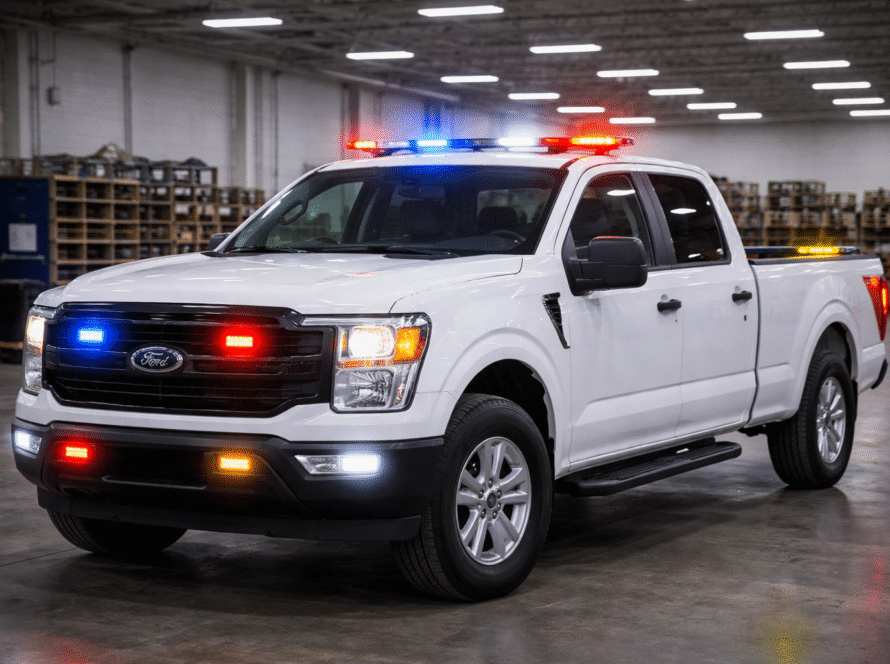
Police take-down lights are auxiliary illumination modules typically positioned toward the front of a roof-mounted light bar.
Their primary purpose is to project light forward, providing illumination beyond the vehicle’s standard lighting arrangement when authorized and appropriate.
Unlike colored warning modules, take-down lights generally use white light for illumination. Their actual beam pattern, output, and available operating modes depend on the product.
How Are They Different From Headlights?
Headlights provide the vehicle’s standard forward road illumination.
Take-down lights are additional equipment integrated into the police vehicle’s emergency lighting system. They may offer a different mounting position or beam pattern, but they are not a substitute for properly functioning headlights.
Before purchasing, departments should identify the forward illumination they actually require and confirm how the proposed light bar provides it.
How Are Take Down Lights Different From Alley Lights?
The main difference between take-down lights vs alley lights is the direction of illumination.
Take-down lights face forward. Alley lights typically face toward the driver’s side, passenger’s side, or both.
FeatureTake-Down LightsAlley LightsIllumination directionForwardLeft or right sideCommon placementFront of roof light barEnds or side-facing sectionsPrimary functionIlluminate the area aheadIlluminate areas beside the vehicleTypical light colorWhiteWhiteControlsProduct- and agency-dependentProduct- and agency-dependentMain purchasing questionIs forward illumination needed?Is side illumination needed?
Neither function should be confused with the primary warning modules that produce the authorized flashing signals.
What About Primary Emergency Warning Lights?
Warning lights communicate a vehicle’s presence and emergency status to other road users. They may use approved colors and flash patterns.
Take-down and alley lights primarily support illumination.
Some light bar designs combine illumination and warning capabilities within the broader assembly, but their functions must be identified separately in the purchasing specification.
For example, Whelen’s Liberty II product information lists distinct take-down and alley-light options. Availability depends on the specific model and selected equipment.
An agency should not assume that a light bar equipped with warning LEDs automatically includes both illumination functions.
When Should a Police Fleet Specify Both Lighting Functions?
A department may need forward and side illumination when its vehicle specification calls for both.
The decision should begin with documented operational requirements, not simply the availability of additional light modules.
Review the Vehicle’s Intended Role
A marked patrol SUV may have different illumination requirements from a specialized command vehicle or a patrol pickup.
Procurement teams should ask:
- Does the approved vehicle specification require dedicated forward illumination?
- Is illumination needed on the driver’s side, passenger’s side, or both?
- Are existing vehicle lights sufficient for the intended function?
- Do separate controls or operating modes need to be specified?
- Will the same requirements apply to every vehicle being purchased?
Avoid Assuming More Lights Means a Better Configuration
Additional lighting can increase equipment complexity and electrical demand.
The purchasing team should consider potential glare, beam direction, mounting limitations, and how auxiliary lighting interacts with other installed systems.
Roof height and vehicle accessories may also influence the selected configuration.
If the agency cannot identify a practical need for one of the functions, it should evaluate whether that option belongs in the specification.
Need Forward and Side Lighting on Your Patrol Vehicles?
The right combination depends on vehicle type, available light bar options, and agency-approved controls. Review your proposed police LED light bar configuration with OCM Upfitting before finalizing equipment specifications.
Compare Light Bar Integration and Control Requirements
Police LED light bar configurations involve more than choosing the direction of illumination.
The complete system must also be evaluated for vehicle compatibility, switching, electrical integration, mounting, and maintenance.
1. Confirm the Exact Product Options
Ask the supplier to identify the light bar model and the take-down or alley-light modules included in the quote.
Do not assume that an advertised option is standard equipment.
Also confirm whether the configuration provides driver’s-side, passenger’s-side, or dual-side alley illumination.
2. Document Control Requirements
The agency should specify the required operating controls and authorized modes.
Questions include whether the auxiliary functions need independent selection, how they interact with warning modes, and what operating restrictions apply.
These functions must be supported by the actual controller and product configuration.
3. Evaluate Vehicle and Electrical Compatibility
Different patrol vehicles may require different mounting hardware or integration planning.
A qualified installer should assess the vehicle’s electrical architecture, available power, control interfaces, roof equipment, and maintenance access.
Ford’s Police Interceptor upfitting information emphasizes vehicle-specific wiring solutions and the importance of reviewing modifications against the manufacturer’s guidance.
4. Keep Authorized Operation Separate From Equipment Capability
A product supporting a certain color or operating mode does not establish that every use is lawful.
For Florida fleets, Florida Statute § 316.2397 addresses restrictions and exceptions for certain vehicle lights.
Departments should confirm applicable laws, authorization, and agency policies before approving a configuration.
5. Consider Future Serviceability
Ask how the selected light bar will be inspected and serviced.
Review replacement-part availability, documentation, module accessibility, warranty terms, and procedures for maintaining the installed equipment.
OCM Upfitting’s police light bar fleet rollout guide provides additional guidance on standardizing installations across multiple vehicles.
Street Elite LED Light Bars: Confirm the Options
OCM Upfitting currently lists Street Elite LED Light Bars among its emergency lighting products.
The published Street Elite 4800 product information advertises take-down and alley-light options, along with a digital controller and modular maintenance features.
However, the listing does not establish that every purchasable configuration includes both illumination functions or provides a specific switching arrangement.
Before approving the purchase, request confirmation of the exact model, included modules, controller functions, vehicle mounting requirements, and supported service procedures.
This is especially important when several patrol vehicles must share a consistent lighting specification.
Example: Replacing Six Patrol SUVs
Consider a hypothetical police department replacing six marked patrol SUVs.
The department wants to standardize its roof light bars, but its current vehicles have different auxiliary lighting configurations.
Before requesting quotes, the purchasing team documents:
- Which vehicles require forward-facing illumination.
- Whether driver’s-side and passenger’s-side alley lights are needed.
- The authorized warning-light and auxiliary-light operating modes.
- The required controller functionality.
- Vehicle-specific mounting and electrical considerations.
- The maintenance and documentation requirements.
The department can then compare proposed light bars against one approved functional specification.
This example illustrates a purchasing process, not an actual OCM Upfitting project or a claim of improved performance.
Take Down and Alley Light Buying Checklist
Before approving a police light bar configuration, verify:
- Forward-facing take-down illumination is required.
- Driver’s-side and/or passenger’s-side alley illumination is required.
- All requested functions are available on the exact model.
- Warning-light and illumination functions are documented separately.
- Controller functions match agency requirements.
- Vehicle mounting compatibility has been reviewed.
- Roof accessories and potential glare have been evaluated.
- Electrical integration requirements are documented.
- Applicable laws and agency policies have been considered.
- Replacement parts and maintenance procedures are understood.
- The approved configuration can be repeated on compatible fleet vehicles.
- Final inspection and acceptance requirements are established.
A clear specification makes it easier to evaluate quotes based on actual lighting functions rather than equipment descriptions alone.
Frequently Asked Questions
Are take-down lights and alley lights the same thing?
No. Take-down lights provide forward-facing illumination, while alley lights typically illuminate areas to the sides of the vehicle. Both functions may be included in a properly configured roof light bar.
Do all police LED light bars include take-down and alley lights?
No. Availability depends on the product model and selected configuration. Departments should request written confirmation of the exact functions included.
Can take-down lights replace primary emergency warning lights?
No. Take-down lights primarily provide auxiliary illumination. Primary warning lights serve a separate alerting function and must satisfy applicable operating requirements.
What should police fleet managers provide when requesting a light bar quote?
Prepare the vehicle make, model, year, fleet quantity, desired forward and side illumination functions, control requirements, existing equipment, and approved agency specifications.
Plan Your Police Fleet Lighting With OCM Upfitting
Replacing patrol vehicles or reviewing emergency lighting equipment? Share your vehicle models, fleet quantity, required take-down and alley-light functions, and approved agency specifications with OCM Upfitting to discuss a suitable lighting project.
Request a Police Fleet Lighting Quote
Prefer to discuss your project?
Call (954) 764-8117
Visit OCM Upfitting in Fort Lauderdale
Planning an emergency lighting project for your police fleet? Contact OCM Upfitting to discuss vehicle requirements and arrange an appropriate visit.
OCM Upfitting
730 NW 7th St
Fort Lauderdale, FL 33311