Custom Does Not Automatically Mean Better
A custom bracket, storage system, or partition can solve a vehicle-specific problem. It can also add unnecessary complexity when a proven standard component already fits the vehicle, equipment, and workflow.
That is why custom fleet upfitting should start with the operational requirement rather than an assumption that every vehicle needs fabricated parts. Fleet managers should first determine what the vehicle must carry, how crews will use the space, what equipment must remain accessible, and whether the configuration needs to be repeated across additional units.
OCM Upfitting currently lists in-house custom fabrication, storage solutions, vehicle conversions, lighting, and graphics among its vehicle-upfitting capabilities. OCM Upfitting Fleets evaluating a new configuration can start by reviewing OCM Upfitting’s vehicle upfitting services.
The right decision is not “custom or standard” in isolation. It is the solution that meets the vehicle’s mission without creating avoidable installation, maintenance, payload, or replacement complications.
Start With the Vehicle Mission Before Choosing Components
Before comparing fabrication options, define the work.
NTEA’s Vehicle Specification Process Guide recommends identifying vehicle mission requirements, involving key stakeholders, evaluating chassis and equipment needs, and developing specifications around real operating requirements. NTEA Vehicle Specification Process Guide
For a fleet manager, useful questions include:
- What equipment must the vehicle carry?
- Which items are used most frequently?
- What equipment requires secure mounting?
- How much space is available?
- Where must employees stand, reach, load, or unload?
- What systems require electrical power?
- What areas must remain accessible for maintenance?
- Will the same configuration be repeated across multiple vehicles?
Those answers should determine whether an existing component is sufficient or whether fabrication solves a real constraint.
When Standard Upfit Components Make More Sense
Standard components can be the better choice when they already satisfy the operational requirement.
Examples may include standardized shelving, drawers, partitions, consoles, brackets, racks, or storage components designed for a particular vehicle class.
A standard solution may be appropriate when:
- It fits the intended vehicle correctly
- It provides the required capacity
- Equipment remains accessible
- Mounting does not interfere with other systems
- Payload remains within applicable vehicle limits
- Replacement parts or equivalent components can be identified
- The configuration can be repeated across similar vehicles
Using an existing component does not mean the overall build is generic. A fleet can combine standardized products in a carefully planned, vehicle-specific layout.
This can be especially valuable when a fleet wants repeatable specifications without fabricating every component from scratch.
When Custom Fabrication May Be Necessary
Custom fabrication becomes more useful when a standard product cannot satisfy an important vehicle or workflow requirement.
Potential reasons include:
- Equipment has unusual dimensions
- Factory or upfit mounting locations create conflicts
- Standard brackets place equipment where crews cannot use it efficiently
- Storage needs to fit around vehicle architecture
- A partition requires a specialized configuration
- Multiple pieces of equipment compete for limited mounting space
- Service access must remain available
- A specialized vehicle role requires a layout not addressed by standard products
OCM Upfitting already publishes content on its in-house fabrication workflow and practices, while the decision for a fleet buyer should remain focused on whether fabrication solves a genuine operational constraint.
Custom fabrication should solve a defined problem, not simply make the project appear more specialized.
Compare the Decision Before Approving the Build

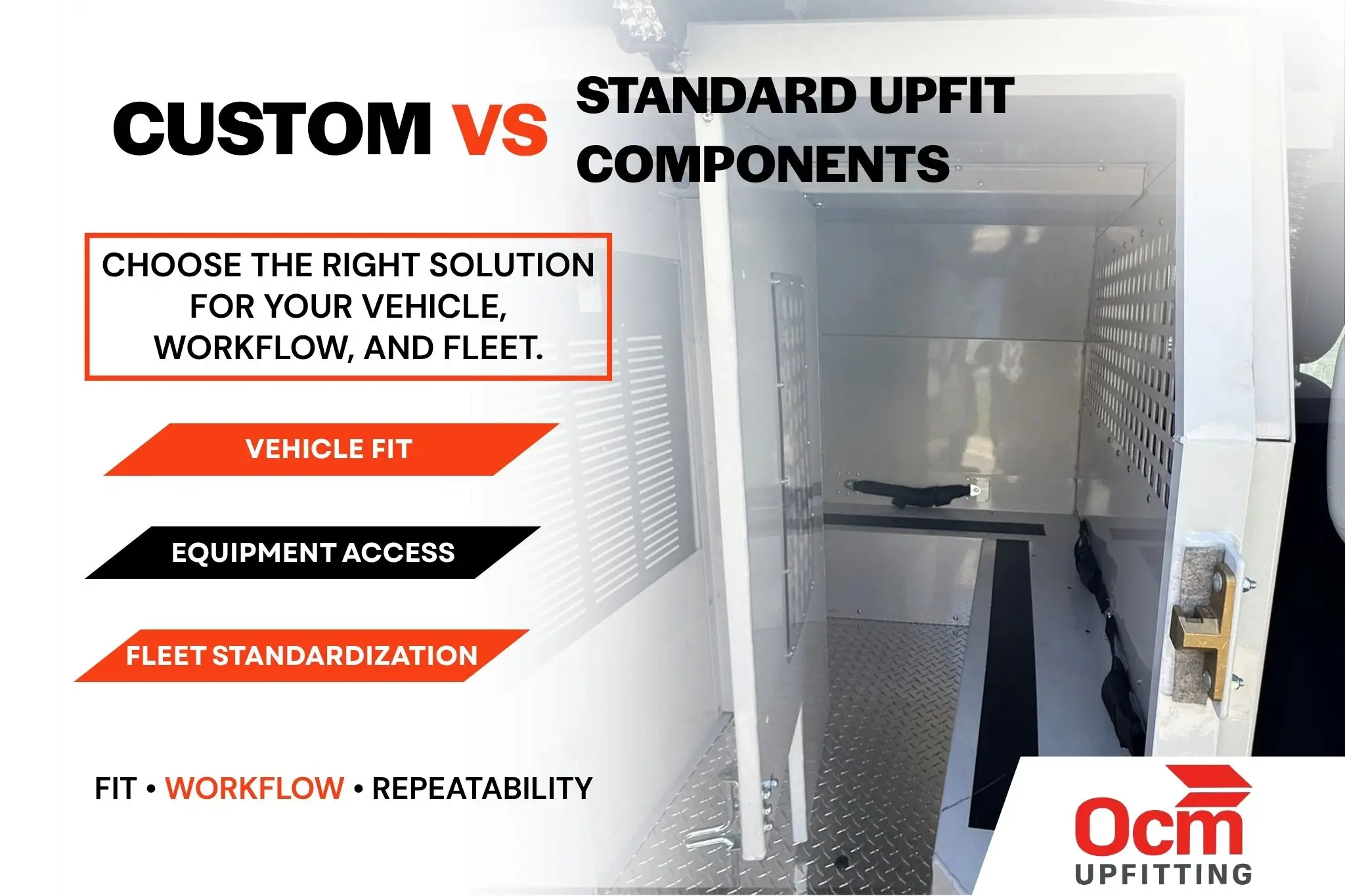
The purpose of the comparison is to connect the component decision to the vehicle’s actual mission.
Vehicle-Specific Mounting Still Matters
Whether the component is standard or custom, mounting should be evaluated against the exact vehicle platform.
GM’s current Body Builder Manuals provide vehicle-specific information including body and frame dimensions, electrical schematics, and modification guidance. GM Upfitter Body Builder Manuals
GM also publishes best-practice guidance covering areas such as body, chassis, electrical systems, paint, and sealing for vehicle conversions. GM Upfitter Best Practice Manuals
Ford Pro likewise maintains an upfitter publications resource for vehicle modifiers. Ford Pro Upfitter Publications
A bracket that works on one chassis or model year should not automatically be assumed to work the same way on another.
If your fleet has equipment that does not fit a standard layout, OCM Upfitting can review the vehicle platform, equipment dimensions, access requirements, fleet quantity, and intended vehicle role before a custom component is specified.
Consider Payload, Electrical Equipment, and Space Together
Fabrication cannot be evaluated only by whether something physically fits.
Fleet managers may also need to consider:
- Component weight
- Equipment weight
- Available payload
- Weight distribution
- Electrical equipment placement
- Wiring access
- Controls
- Driver visibility
- Door and compartment operation
- Airbag or restraint areas
- Future equipment
For example, moving a fabricated storage enclosure several inches may improve tool access but reduce space available for an electrical component or another required system.
The entire upfit should be reviewed as one integrated configuration.
Do Not Sacrifice Maintenance Access
One of the easiest problems to create during an upfit is installing equipment in a location that later blocks service access.
Before approving either a standard or fabricated component, ask:
- Can technicians access electrical distribution points?
- Can equipment be removed without dismantling unrelated components?
- Are factory service areas still accessible?
- Can wear items be inspected?
- Can replacement equipment be installed later?
- Is the finished configuration documented?
OCM Upfitting’s current vehicle upfit documentation guide recommends maintaining records that identify installed equipment, vehicle-specific changes, power distribution, wiring information where appropriate, and final build revisions.
That becomes especially important when fabricated parts differ from standard product documentation.
Can a Custom Design Still Be Standardized?
Yes, when the operational requirements are similar, and the fabricated design can be documented and reproduced appropriately.
A fleet does not have to choose between customization and standardization.
A specialized bracket, storage assembly, or interior configuration could become part of a repeatable fleet specification if future vehicles share the same relevant requirements.
OCM Upfitting’s fleet standardization guide discusses repeatable upfit packages while also recognizing that specialized vehicles may need controlled customization.
The important questions are:
- Can the design be reproduced?
- Are dimensions documented?
- Are mounting requirements documented?
- Does it work across the intended vehicle class?
- What happens if the vehicle platform changes?
- Can future technicians understand how it was built?
A Utility Fleet Example
Consider a utility fleet preparing 18 similar service trucks.
Most equipment fits commercially available drawers, cabinets, and mounting systems. One diagnostic unit, however, has unusual dimensions and must remain accessible without blocking a frequently used exterior compartment.
Fabricating every storage component would add complexity without solving an additional problem.
Instead, the fleet uses standard storage for most of the vehicle and a custom mounting solution only for the diagnostic equipment.
The final specification combines proven standard components with fabrication where the operational requirement justifies it.
That is often a better custom vehicle upfitting strategy than assuming an entire vehicle must be either fully standard or fully custom.
What to Give an Upfitter Before Discussing Custom Fabrication
Before requesting a project quote, prepare:
- Vehicle make and model
- Model year or planned replacement platform
- Fleet quantity
- Vehicle role
- Equipment list
- Equipment dimensions and weights where available
- Frequently accessed items
- Storage requirements
- Existing mounting problems
- Electrical equipment
- Driver and crew workflow
- Maintenance access requirements
- Existing fleet standards
- Future equipment plans
- Photos or drawings of the current layout where useful
The more clearly the fleet defines the constraint, the easier it is to determine whether a standard component is sufficient or fabrication is justified.
Build Around the Requirement, Not the Label
Effective custom fleet upfitting does not mean fabricating every bracket, cabinet, or partition. It means selecting the right combination of standard components and custom solutions for the vehicle, equipment, workflow, service requirements, and fleet strategy.
OCM Upfitting currently lists in-house custom fabrication as one of its core capabilities and positions its vehicle upfitting services for fleets across the United States. Its current website lists (954) 764-8117 as the primary contact number. OCM Upfitting
If your fleet is evaluating whether standard equipment will work or a custom solution is necessary, prepare your vehicle models, fleet quantity, equipment dimensions, intended vehicle roles, layout constraints, and standardization requirements. Call (954) 764-8117 or use the OCM Upfitting project contact page to discuss the proposed configuration before the build is finalized.
FAQs
Is custom fabrication always better for a fleet upfit?
No. A standard component may be the better choice when it fits the vehicle, supports the required equipment, preserves access, and meets the fleet’s operational needs. Fabrication is most useful when it solves a specific constraint that standard products do not address.
Can custom-fabricated components be standardized across a fleet?
They can be when similar vehicles have the same operational requirements and the design, dimensions, mounting, and installation requirements can be documented and reproduced appropriately.
What information is needed for custom vehicle equipment mounting?
Provide the vehicle platform, equipment type and dimensions, proposed location, crew workflow, service-access requirements, nearby vehicle systems, and whether the design must be repeated across additional vehicles.
Does custom fabrication automatically cost more than standard equipment?
Not necessarily, and a reliable universal comparison cannot be made without the project details. Vehicle type, component complexity, quantity, fabrication requirements, installation work, and equipment all influence the final quote.