The Cheapest Equipment to Reuse Can Become the Most Expensive to Transfer
If an older light bar, radio, camera, console, or partition still works, reusing it may seem like an obvious way to reduce the cost of replacing a fleet vehicle. But working today does not automatically mean it belongs in the next vehicle.
Fleet managers deciding whether to transfer upfit equipment to a new vehicle should evaluate more than the purchase price of replacement equipment. Age, condition, vehicle compatibility, removal labor, reinstallation, electrical architecture, remaining warranty, downtime, and future fleet standards can all change the economics.
OCM Upfitting works with public-safety, government, security, service, and other fleets on vehicle configurations that combine equipment, electronics, fabrication, storage, and operational requirements. The stronger fleet decision is to evaluate each component as part of the replacement vehicle specification rather than automatically transferring everything from the retiring unit.
Start With Three Categories: Reuse, Inspect, or Replace
A practical equipment-transfer review can place each component into one of three categories.
Reuse
Equipment may be a good reuse candidate when it is relatively current, in good condition, compatible with the replacement vehicle, supported by the manufacturer, and economical to remove and reinstall.
Examples might include certain radios, cameras, or removable equipment when compatibility has been verified.
Reuse After Inspection
Some equipment should not be approved for transfer until its condition, mounting hardware, wiring, connectors, programming requirements, and compatibility are inspected.
This is often the most useful category because equipment may still have value but require replacement cables, brackets, fasteners, connectors, or other supporting components.
Replace
Replacement may be more practical when equipment is obsolete, damaged, unsupported, incompatible with the new platform, expensive to remove and reinstall, or inconsistent with the fleet’s current specification.
The goal is not to maximize reuse. It is to make the most defensible lifecycle decision.
Evaluate the Equipment Before You Evaluate the Labor
Before asking what it costs to transfer a component, determine whether it should be transferred at all.
Fleet managers should review:
- Equipment age and operating condition
- Remaining manufacturer warranty
- Service history
- Corrosion, wear, or physical damage
- Availability of replacement parts
- Current software or programming support
- Mounting hardware condition
- Wiring and connector condition
- Whether the equipment still meets the fleet’s mission
- Whether newer fleet units use the same standard
This fits the broader decision process in OCM Upfitting’s fleet vehicle lifecycle planning guide, which recommends evaluating vehicle condition, equipment age, operational requirements, compatibility, downtime, and expected remaining life rather than making replacement decisions on age alone.
The New Vehicle Platform Can Change the Entire Decision
A component that fit the old vehicle may not fit the replacement model safely or efficiently.
Changes between vehicle generations can affect:
- Interior dimensions
- Console space
- Mounting locations
- Airbag deployment areas
- Factory wiring
- Power-distribution systems
- Electronic control architecture
- Roof or body structure
- Payload
- Camera sightlines
- Antenna placement
- Driver visibility
That is why fleet teams should consult current manufacturer information before assuming old hardware can be transferred.
GM’s current Body Builder Manuals include vehicle-specific electrical schematics, body and frame dimensions, and modification information. GM also states that alterations should not result in systems becoming nonconforming with applicable federal safety or emissions requirements.
Ford similarly provides upfitter publications and technical resources for current vehicle platforms. Its 2026 Police Interceptor documentation, for example, identifies dedicated console mounting provisions, wiring pathways, and power circuits intended for police equipment integration, illustrating why a new vehicle’s architecture should be reviewed rather than assuming the previous installation can simply be copied.
Do Not Automatically Reuse Wiring and Mounting Hardware
One of the biggest mistakes when trying to reuse fleet vehicle equipment is treating every part of the old installation as reusable.
The main device may remain suitable while its supporting installation components do not.
A radio, camera, light, or control module may need:
- New vehicle-specific brackets
- New wiring
- New connectors
- New circuit protection
- Different antenna placement
- Updated programming
- New cable routing
- Different mounting hardware
OCM Upfitting’s two-way radio installation guide explains that radio integration involves mounting, antenna placement, power routing, cable management, programming, interference considerations, and testing. Those requirements can change when the vehicle platform changes.
If your fleet is replacing vehicles and deciding which equipment should move forward, OCM Upfitting can review the retiring configuration alongside the new vehicle specification before removal work begins.
Compare Transfer Cost With Total Lifecycle Cost
“Already paid for” does not mean “free to reuse.”
A fleet equipment transfer may involve:
- Removing the equipment
- Diagnosing its condition
- Cleaning or refurbishing components
- Purchasing new brackets or wiring
- Reprogramming
- Installing it in the new vehicle
- Testing system interaction
- Managing additional vehicle downtime
If an older component has limited remaining service life, the fleet could pay to remove and reinstall it only to replace it shortly afterward.
NTEA’s Vehicle Specification Process Guide recommends evaluating vehicle requirements, current fleet performance, technology, equipment specifications, cost modeling, and lifecycle considerations as part of a structured specification process. That same logic applies when deciding whether equipment transfer creates real value or only reduces the initial purchase order.
Police and Emergency Vehicle Equipment Needs Extra Scrutiny
The decision to transfer police equipment to a new vehicle often involves multiple integrated systems.
Potential transfer candidates may include:
- Warning lights
- Radios
- Cameras
- Antennas
- Consoles
- Controls
- Storage systems
- Partitions
Each component should be evaluated individually and as part of the complete system.
For example, transferring a console may change equipment placement. Transferring lighting may require different mounting locations. Moving radios can require new antennas or cable paths. Cameras may need different fields of view.
Federal safety requirements also matter when a business modifies a vehicle. NHTSA explains that manufacturers, distributors, dealers, and motor-vehicle repair businesses generally may not knowingly make inoperative safety equipment installed to meet an applicable federal motor vehicle safety standard. NHTSA’s vehicle modification guidance provides additional context.
The exact requirements depend on the vehicle, equipment, timing of the modification, and applicable regulations.
Standardization May Be More Valuable Than Reuse
Equipment transfer decisions should also support the fleet’s future specification.
Suppose eight older patrol vehicles use three different light controllers, two camera generations, and several console layouts. Moving every functioning component into eight replacement vehicles preserves those differences for another replacement cycle.
That can create false savings.
OCM Upfitting’s guide to fleet standardization explains how repeatable vehicle specifications can simplify equipment placement, procurement, maintenance, training, and future replacement planning. Specialized units can still differ when their mission requires it.
When planning fleet equipment replacement, ask whether transferring an older component moves the fleet toward or away from the desired standard.
Replacing a Patrol SUV
Consider an agency replacing a patrol SUV equipped with a radio, console, camera system, warning lighting, antennas, and partition.
The radio may still be current and supported, making it a possible reuse candidate.
The camera may work but require inspection because the replacement SUV changes windshield geometry and cable routing.
The console may not match the new interior dimensions.
Older lighting may function, but removing it, replacing mounting hardware, rewiring it, and reinstalling it could approach the practical cost of moving to the fleet’s current standardized package.
The correct decision is therefore not “reuse everything that works.” It is to classify each component according to compatibility, remaining life, labor, support, and operational value.
Use a Transfer Worksheet Before the Old Vehicle Is Decommissioned
Before removing equipment, create a simple record for every major component:
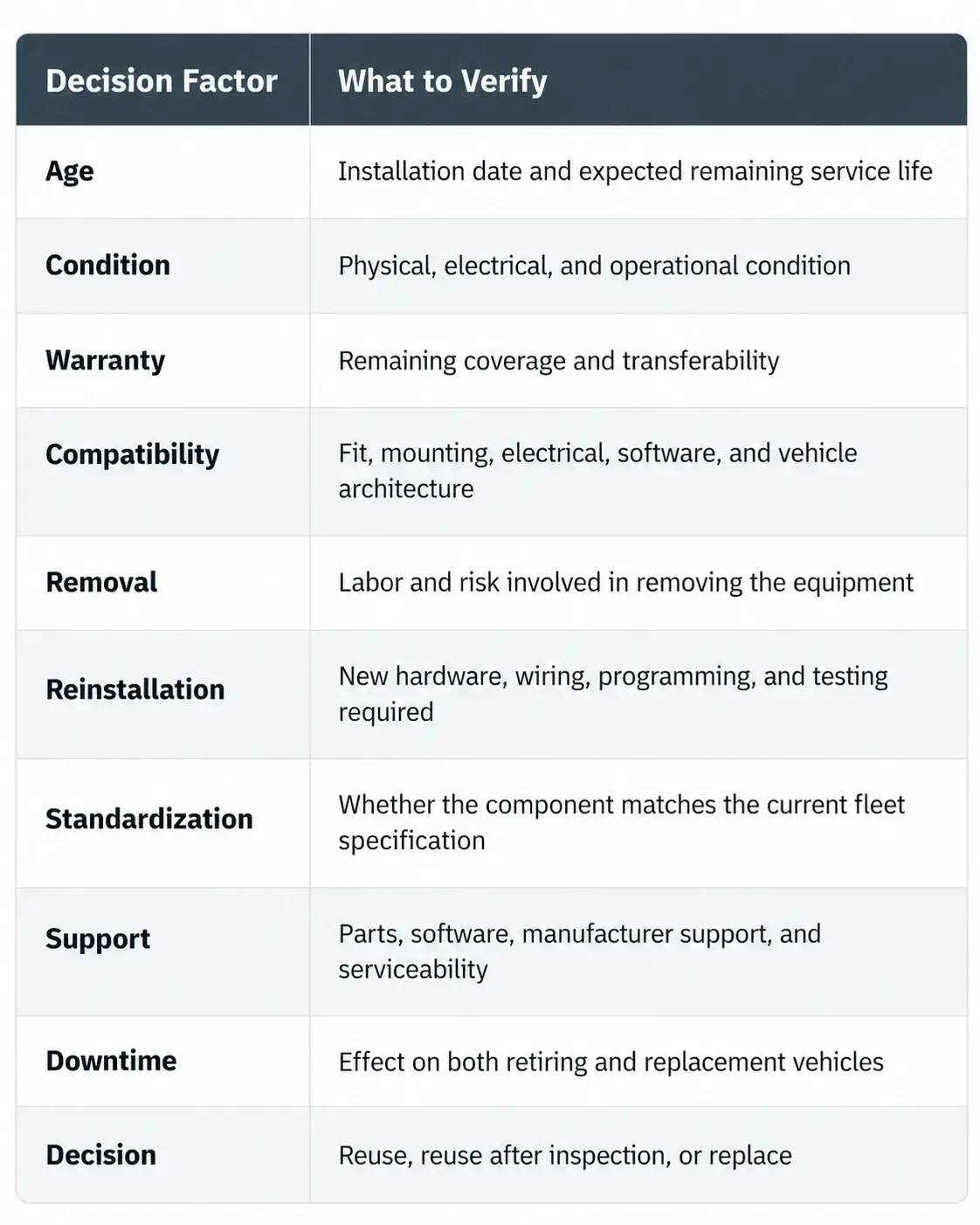
This process can also be incorporated into OCM Upfitting’s broader fleet vehicle upfitting timeline so transfer decisions occur during specification development rather than after the new vehicle arrives.
Decide What Moves Before the New Vehicle Arrives
Transferring equipment can be a smart lifecycle strategy, but only when the equipment still makes sense for the replacement vehicle.
OCM Upfitting helps fleets evaluate vehicle requirements, equipment integration, electrical needs, mounting, standardization, and replacement planning before new units enter service. Its current website lists (954) 764-8117 as the primary contact number.
Call (954) 764-8117 to discuss your replacement vehicles, existing equipment, fleet specifications, and which components should be reused, inspected, or replaced before the next upfit begins.
FAQs
Can you transfer upfit equipment to a new vehicle?
Often, but not automatically. Compatibility depends on the new vehicle’s dimensions, mounting locations, electrical architecture, equipment condition, wiring, software, and manufacturer requirements.
Is it cheaper to reuse emergency vehicle equipment?
It can be, but fleets should compare removal, inspection, new mounting hardware, wiring, programming, installation, testing, downtime, and remaining equipment life. Reuse is not always the lowest lifecycle-cost option.
What police vehicle equipment can be transferred?
Radios, cameras, lighting, antennas, controls, consoles, storage, and other components may potentially be transferred, but each item should be inspected and verified for compatibility with the replacement vehicle.
Should old wiring be reused when equipment is transferred?
Not automatically. Wiring condition, length, routing, connectors, circuit protection, and compatibility with the new vehicle should be evaluated. New wiring may be appropriate even when the primary equipment is reused.