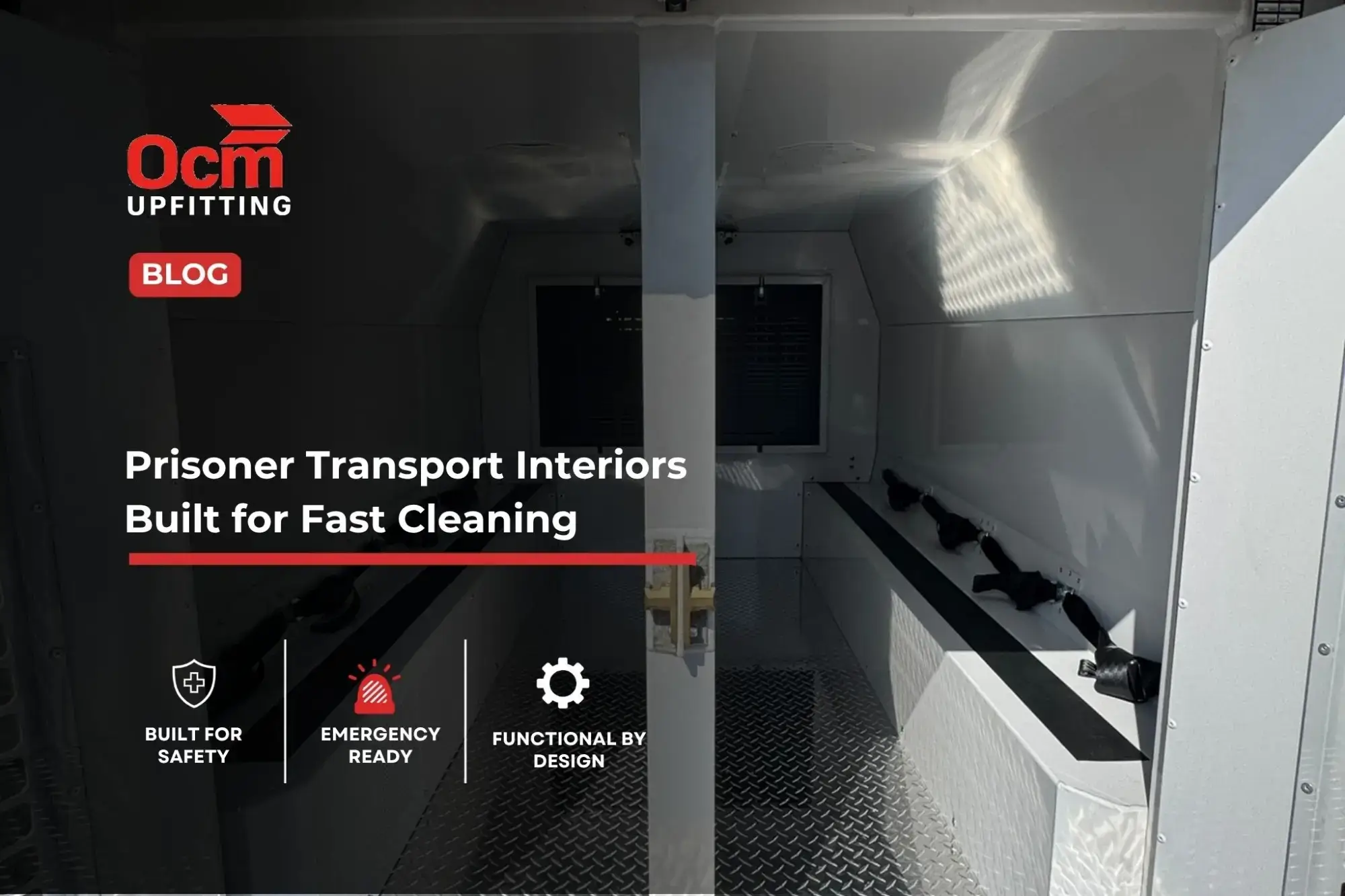
Cleaning Requirements Should Influence the Interior Before the Build
A prisoner transport van interior may be cleaned and inspected repeatedly throughout its service life. If surfaces trap debris, hardware is difficult to reach, or equipment creates unnecessary crevices, routine turnaround can become more complicated for corrections departments, law enforcement agencies, and private transport operators.
Cleaning should therefore be considered while the vehicle specification is still being developed. OCM Upfitting currently provides prisoner containment systems and vehicle conversions for corrections and law-enforcement fleets, including multi-compartment aluminum modules, partitions, reinforced door panels, ventilation-related configurations, cameras, and other integrated equipment.
Design the Prisoner Transport Van Interior Around Cleanable Surfaces
The first design question should be simple: where can dirt, moisture, and other contamination collect?
Smooth, durable surfaces generally give cleaning teams fewer complicated areas to work around than interiors filled with unnecessary joints, exposed cavities, or difficult transitions. For a high-use prisoner transport van, the specification should evaluate how walls, seating surfaces, partitions, flooring, doors, and hardware will be accessed during routine cleaning.
Useful design-review questions include:
- Are major surfaces nonporous and compatible with the agency’s approved cleaning products?
- Are seams minimized or sealed where the module design supports it?
- Can staff visually inspect corners and transitions?
- Are frequently cleaned surfaces resistant to normal cleaning-related wear?
- Can damaged or serviceable panels be accessed without dismantling unrelated equipment?
NIOSH recommends consistent cleaning and disinfection practices in correctional environments and specifically advises checking equipment-manufacturer instructions because some disinfectants can damage equipment or materials. The agency also recommends adequate ventilation when disinfectants are used in enclosed areas. Review NIOSH guidance for correctional facilities.
Choose Flooring for Cleaning, Traction, and Durability
Detainee transport flooring has to handle repeated entry and exit, footwear, moisture, cleaning products, and the normal wear associated with fleet operations.
OCM Upfitting’s existing prisoner transport guidance identifies anti-slip flooring and washable interior materials as common features in transport systems designed for heavy daily use.
When reviewing flooring, agencies should consider:
- Surface traction
- Resistance to routine cleaning
- Seams and transitions
- Edges around partitions and seating
- Inspection accessibility
- Material compatibility with approved disinfectants
- Repairability if a section becomes damaged
Drainage also requires project-specific planning. A design should not assume that water can simply be introduced into the compartment or drained through the vehicle. Any drainage feature needs to be intentionally engineered for the specific module and vehicle, with attention to the vehicle structure, corrosion protection, wiring, and manufacturer requirements.
Aluminum Modules Can Support a Durable Interior Strategy
OCM Upfitting currently lists multi-compartment aluminum modules with stainless steel security features as part of its prisoner transport vehicle-conversion services.
An aluminum prisoner transport module may be attractive to fleet planners because material selection affects durability, weight, corrosion considerations, fabrication, maintenance, and cleaning. However, the material alone does not determine whether an interior is easy to maintain.
Fleet managers should also examine:
- How panels join together
- How floor-to-wall transitions are finished
- Whether cleaning products are compatible with the surfaces
- Whether corrosion-prone interfaces are protected
- Whether damaged panels can be serviced
- How the module integrates with the underlying vehicle
The correct material and construction method should be evaluated for the particular vehicle, agency specification, expected duty cycle, and cleaning procedure.
Reduce Hidden Areas Without Compromising the Transport System
An easy-clean prisoner compartment should allow staff to see and reach the areas they are expected to inspect and clean.
Complex cavities, unnecessary recesses, poorly finished transitions, and difficult-to-access spaces can increase the work required after transport. At the same time, cleaning access cannot compromise containment, vehicle structure, wiring, or other safety systems.
This is where module design and maintenance planning have to work together. Protected hardware, appropriately finished transitions, and accessible service panels can support inspection without turning security components into exposed obstacles.
A tamper-resistant vehicle interior should still be maintainable by authorized personnel. The objective is not to expose security mechanisms. It is to ensure that designated maintenance and cleaning points can be accessed through the intended service procedure.
If your department is evaluating a new transport van or rebuilding an older unit, OCM Upfitting can review the vehicle, transport layout, material choices, equipment integration, and cleaning requirements as part of the overall vehicle conversion specification.
Treat Cleaning Products as Part of the Material Specification
A surface may look durable but still react poorly to the disinfectants an agency uses.
EPA states that registered disinfectants should be used according to their product labels, including the approved use site, application instructions, and required contact time. EPA’s registered disinfectant guidance is a useful reference when agencies develop cleaning procedures.
NIOSH similarly advises correctional facilities to confirm that disinfectants will not damage the equipment being cleaned.
That makes chemical compatibility a procurement question. Before approving flooring, coated panels, plastics, seals, camera housings, lighting, or other interior materials, fleet teams should compare the manufacturer’s cleaning instructions with the agency’s actual sanitation process.
Where employees have occupational exposure to blood or other potentially infectious materials, OSHA’s Bloodborne Pathogens Standard requires employers to determine an appropriate cleaning and decontamination schedule based on factors such as the surface, contamination, location, and tasks being performed. Review OSHA’s Bloodborne Pathogens requirements.
Keep Ventilation, Lighting, and Cameras Accessible
A transport compartment cannot be designed around surfaces alone.
Ventilation openings, interior lighting, cameras, and other equipment also need to remain accessible for inspection and maintenance without unnecessarily complicating the cleaning process. OCM Upfitting currently lists ventilation-related prisoner transport configurations and vehicle camera systems among its public-safety capabilities.
Fleet planners should consider whether:
- Ventilation openings can be inspected and maintained
- Lighting fixtures create unnecessary dirt-catching edges
- Camera placement maintains useful compartment visibility according to agency requirements
- Wiring and connectors are protected from routine cleaning
- Equipment can be serviced without removing major portions of the module
For retrofits, vehicle modifications also need to respect applicable vehicle safety requirements. NHTSA explains that covered businesses modifying a vehicle after first retail sale may not knowingly make inoperative a device or design element installed to comply with an applicable Federal Motor Vehicle Safety Standard. Review NHTSA’s vehicle modification guidance.
Standardize the Cleaning-Friendly Features Across the Fleet
Consider a hypothetical corrections department operating several transport vans acquired at different times.
One van has exposed transitions that take longer to inspect. Another uses different flooring and requires a different cleaning product. A third has cameras and ventilation components mounted differently. Staff now have to remember a different process for each vehicle.
Instead of making every vehicle identical regardless of mission, the department could standardize core requirements such as:
- Approved surface materials
- Flooring specifications
- Panel and hardware accessibility
- Ventilation inspection points
- Lighting and camera integration
- Cleaning-product compatibility
- Post-cleaning inspection procedures
- Documentation for serviceable components
This mirrors the broader fleet-standardization approach of establishing repeatable specifications while retaining controlled customization where specialized assignments require it. OCM Upfitting discusses this approach in its fleet standardization guide.
Use a Design-Review Checklist Before Approving the Module
Before ordering a new module or approving a retrofit, ask:
- Can staff reach the primary surfaces that require routine cleaning?
- Are materials appropriate for the agency’s approved cleaning products?
- Are floor and wall transitions easy to inspect?
- Is hardware protected without making maintenance unnecessarily difficult?
- Can authorized personnel access removable or service panels?
- Have ventilation and lighting access requirements been considered?
- Does the camera layout remain useful after the final interior is installed?
- Are wiring and electronics protected from routine cleaning activity?
- Does compartment separation support the agency’s operating requirements?
- Has the vehicle-specific installation been checked against OEM and applicable safety requirements?
- Can the same specification be repeated across similar fleet units?
- Is there a documented post-cleaning inspection process?
OCM Upfitting’s existing guide to custom prisoner transport modules provides broader guidance on containment, durability, flooring, ventilation, surveillance compatibility, and fleet operation. The cleaning-focused specification should complement those requirements rather than replace them.
Build Cleaning and Inspection Into the Transport Specification
A well-planned prisoner transport van interior should make routine cleaning, inspection, and maintenance part of the original design discussion.
That means looking beyond the obvious equipment and evaluating seams, surfaces, flooring, panel access, material compatibility, ventilation, lighting, cameras, compartment separation, and how authorized staff will inspect the vehicle after each cleaning cycle.
OCM Upfitting currently supports corrections and prisoner transport fleets with multi-compartment aluminum modules, partitions, reinforced door-panel modifications, vehicle technology, and other integrated upfitting services, with nationwide fleet positioning.
Call (954) 764-8117 to discuss your prisoner transport vehicles, cleaning and inspection requirements, module specifications, and plans for a new build or retrofit. OCM Upfitting’s current contact page verifies this phone number.
FAQs
What makes a prisoner transport van interior easier to clean?
A prisoner transport van interior is generally easier to maintain when the specification emphasizes durable nonporous surfaces, manageable seams and transitions, accessible inspection areas, appropriate flooring, protected equipment, and compatibility with the agency’s approved cleaning products.
What should agencies look for in detainee transport flooring?
Evaluate traction, durability, cleanability, seam construction, transitions around equipment, chemical compatibility, inspection access, and how the flooring integrates with the specific transport module and vehicle.
Is an aluminum prisoner transport module automatically easier to clean?
Not necessarily. Aluminum can be part of a durable transport design, but cleanability also depends on seams, coatings or finishes, transitions, hardware, panel construction, chemical compatibility, and access for inspection and maintenance.
Can an existing prisoner transport van be retrofitted for easier cleaning?
Potentially. The feasibility depends on the current vehicle, module condition, structure, flooring, partitions, electronics, ventilation, remaining service life, and the scope of the proposed changes. Retrofit decisions should be evaluated vehicle by vehicle rather than assuming every existing module can be modified economically or safely.