Build Utility Vehicles That Improve Productivity, Safety, and Efficiency
Utility service vehicles are more than transportation—they are mobile workspaces that directly affect technician productivity, jobsite safety, and operational efficiency. Every minute spent searching for tools, reorganizing equipment, or returning to the shop for forgotten materials increases labor costs and delays service. A well-designed utility fleet upfit eliminates these inefficiencies by creating organized, purpose-built vehicles that help crews complete jobs faster and more safely.
Whether your organization manages utility trucks, service vans, bucket trucks, municipal vehicles, or contractor fleets, investing in professional utility fleet upfitting helps maximize every vehicle’s value. The right combination of storage, power management, lighting, and safety equipment improves technician workflow while reducing equipment damage and unnecessary downtime.
OCM Upfitting partners with municipalities, utility providers, contractors, school districts, telecommunications companies, and public works departments to build customized service vehicles that meet real-world operational demands. Through professional Fleet Upfitting Solutions, organizations can standardize vehicle layouts, improve efficiency, and prepare their fleets for long-term growth.
What Is Utility Fleet Upfitting?
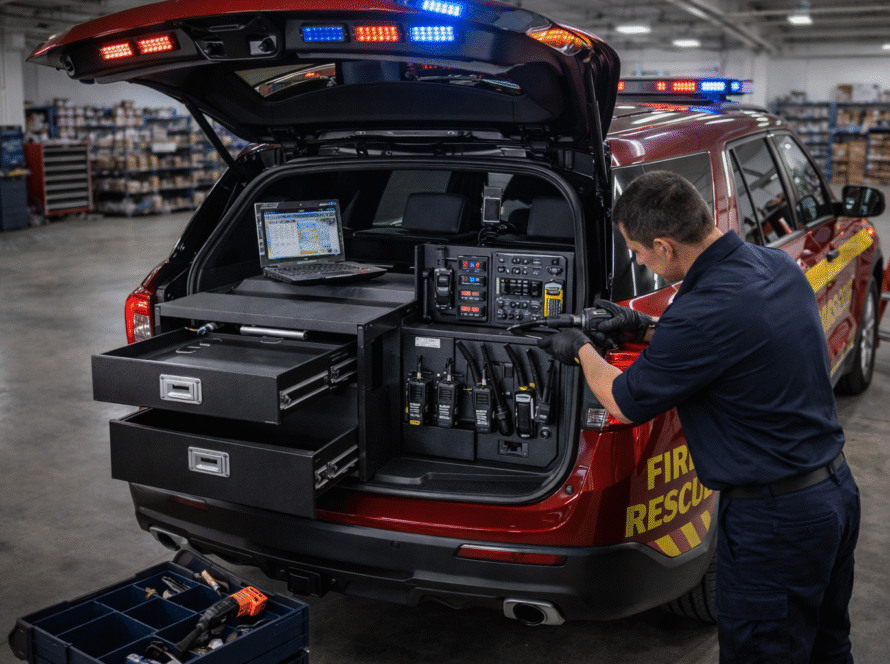
Utility fleet upfitting is the process of customizing commercial vehicles with equipment and accessories that support field operations. Rather than relying on factory cargo areas, upfitted vehicles are designed around the tools, materials, and workflow technicians use every day.
Common utility fleet upfitting components include:
- Heavy-duty shelving
- Drawer systems
- Ladder racks
- Service body compartments
- Bulkheads and partitions
- Interior and exterior work lighting
- Power inverters
- Auxiliary batteries
- Warning lights
- Secure cargo management
- Custom equipment storage
The goal is not simply to add accessories—it’s to create a safer, more organized mobile workspace that helps technicians perform efficiently while protecting valuable equipment.
Whether servicing electrical infrastructure, water systems, telecommunications networks, HVAC equipment, or municipal facilities, properly designed vehicles allow crews to spend more time completing work and less time managing equipment.
Organizations expanding multiple service vehicles can also benefit from professional Fleet Upfitting Solutions that create consistent layouts across locations, improving technician training, inventory management, and long-term fleet scalability.
Why Utility Fleet Upfitting Matters
Every service vehicle directly affects business performance.
Poorly organized cargo areas create unnecessary delays as technicians search for tools, move equipment, or return to the shop for forgotten materials. Over time, these small inefficiencies accumulate into lost productivity, increased labor costs, and reduced customer satisfaction.
Professionally designed service truck upfitting helps organizations:
- Improve technician efficiency
- Reduce time spent locating tools
- Protect expensive equipment
- Improve inventory organization
- Enhance jobsite safety
- Reduce vehicle clutter
- Improve fleet consistency
- Maximize return on fleet investments
For example, a municipal utility crew responding to an emergency water main repair needs immediate access to fittings, valves, hand tools, safety cones, and warning lights. With a properly organized service vehicle, crews can begin repairs almost immediately instead of spending valuable time searching through loose equipment.
OCM Upfitting designs customized layouts through its Vehicle Upfitting Services, helping organizations improve productivity while reducing unnecessary downtime.
Best Practice 1: Choose Storage Systems That Match Daily Workflow
Storage is the foundation of every successful utility vehicle upfit.
Utility technicians carry a wide variety of equipment, including hand tools, testing devices, replacement parts, cables, meters, hardware, and safety equipment. Without a structured storage system, cargo quickly becomes disorganized, making service calls slower and increasing the risk of damaged equipment.
Heavy-Duty Shelving and Drawer Systems
Well-designed shelving systems allow technicians to organize equipment according to how frequently it’s used.
Frequently accessed items should remain within easy reach, while specialized equipment can be stored in dedicated compartments.
Drawer systems are especially useful for:
- Electrical connectors
- Fasteners
- Diagnostic equipment
- Small repair components
- Testing instruments
- Safety supplies
Choosing shelving that matches equipment size, weight, and daily usage helps improve organization while extending the lifespan of both tools and storage systems.
Organizations looking to maximize technician productivity can also explore OCM Upfitting’s Vehicle Upfitting Productivity Solutions to learn how workflow-based layouts reduce wasted time and improve field efficiency.
Modular Bins and Compartments
Labeled bins, removable dividers, and modular storage compartments simplify inventory management while reducing misplaced materials.
Proper cargo organization helps technicians locate equipment quickly, minimizes replacement purchases caused by lost items, and improves accountability throughout the fleet.
Selecting the right utility vehicle equipment also helps prevent tools and materials from shifting during transport, improving both safety and equipment protection.
The Federal Motor Carrier Safety Administration (FMCSA) provides guidance on cargo securement requirements to help fleet managers ensure tools, equipment, and materials remain safely restrained during transport:
Ladder Racks and Exterior Storage
Many utility vehicles transport ladders, conduit, pipe, reels, and oversized materials that cannot be safely stored inside the cargo area.
Professionally installed ladder racks and exterior storage systems maximize interior cargo space while keeping large equipment secure during transit.
Fleet managers should select these systems based on:
- Vehicle type
- Payload capacity
- Technician accessibility
- Daily workflow
- Material length and weight
OCM Upfitting helps organizations select ladder rack systems and exterior storage solutions that improve accessibility while maintaining safe vehicle operation. Businesses planning long-term fleet consistency can also benefit from implementing Fleet Upfitting Standards that simplify maintenance, training, and future vehicle expansion.
Best Practice 2: Plan for Power Management Early
Storage is only one part of an efficient utility vehicle. Many field technicians also depend on reliable onboard power to keep tools, diagnostic equipment, and communication devices operating throughout the workday.
Electrical contractors, telecommunications providers, municipal crews, and utility technicians frequently rely on:
- Battery-powered tools
- Diagnostic equipment
- Laptops and tablets
- Mobile printers
- Two-way radios
- Charging stations
- Interior and exterior work lights
Planning these requirements before installation creates a cleaner, safer, and more reliable electrical system.
Inverters and Auxiliary Power
Power inverters, auxiliary batteries, and power distribution systems allow crews to operate equipment without placing unnecessary strain on the vehicle’s primary battery.
Professionally integrated electrical systems improve reliability while supporting future upgrades as fleet technology evolves.
Organizations evaluating electric fleet infrastructure can also review the U.S. Department of Energy’s Managed EV Charging for Fleets resource.
OCM Upfitting incorporates electrical integration into its Vehicle Upfitting Services, ensuring lighting, charging equipment, and onboard power systems work together efficiently.
Best Practice 3: Design Around Technician Workflow
A productive service vehicle should match the way technicians actually perform their work.
Instead of forcing employees to adapt to a poorly organized cargo area, every shelf, drawer, compartment, and storage location should support the natural workflow of daily service calls.
Well-designed layouts help technicians:
- Access tools faster
- Reduce unnecessary movement
- Minimize lifting and bending
- Improve inventory management
- Complete jobs more efficiently
Features such as pull-out trays, adjustable shelving, modular drawer systems, and dedicated equipment compartments reduce wasted time while improving overall productivity.
Organizations looking to improve operational efficiency can explore OCM Upfitting’s Vehicle Upfitting Productivity Solutions to see how workflow-focused vehicle layouts help technicians complete more work each day.
Standardize Fleet Layouts
As fleets grow, consistency becomes increasingly valuable.
Standardized vehicle layouts allow technicians to move between vehicles without searching for equipment, simplify employee training, improve inventory management, and make future vehicle purchases easier.
Fleet standardization also helps organizations:
- Simplify procurement
- Improve maintenance consistency
- Reduce inventory costs
- Improve technician onboarding
- Support long-term fleet expansion
Businesses planning long-term growth can implement Fleet Upfitting Standards and review Fleet Upfitting Specification Guidance to build repeatable vehicle designs across multiple locations.
Best Practice 4: Prioritize Safety
Every utility vehicle should be designed with technician safety in mind.
Proper equipment mounting, secure storage, visibility enhancements, and ergonomic access points help reduce workplace injuries while improving daily operations.
Important safety considerations include:
- Secure cargo restraints
- Locking drawer systems
- Bulkheads and partitions
- Non-slip access steps
- Grab handles
- Warning lights
- Scene lighting
- Backup cameras
- Reflective markings
Cargo should always be secured to prevent shifting during transportation.
Fleet managers can review the federal Cargo Securement Requirements for additional guidance:
Organizations should also review OSHA Motor Vehicle Safety Guidance to help reduce work-related transportation risks:
OCM Upfitting designs safety-focused vehicle layouts that protect technicians while improving visibility and equipment accessibility.
Best Practice 5: Plan for Long-Term Fleet Growth
The best utility vehicle upfits continue delivering value long after installation.
Fleet managers should select durable components capable of withstanding demanding work environments while allowing flexibility for future modifications.
Long-term planning should consider:
- Corrosion-resistant materials
- Heavy-duty shelving
- Replaceable components
- Easy maintenance access
- Future technology upgrades
- Fleet expansion
Choosing modular systems makes it easier to add storage, lighting, power equipment, or new technology without replacing the entire upfit.
Organizations preparing for future fleet growth benefit from scalable designs that maintain consistency while adapting to changing operational requirements.
Common Utility Fleet Upfitting Mistakes
Many organizations unintentionally increase costs by focusing only on initial pricing rather than long-term productivity.
Common mistakes include:
- Choosing generic vehicle layouts
- Ignoring technician workflow
- Overlooking payload capacity
- Installing poor-quality storage systems
- Failing to standardize fleet layouts
- Delaying safety upgrades
- Planning electrical systems after installation
Avoiding these mistakes helps improve technician efficiency while maximizing return on investment.
Build Smarter Utility Vehicles with OCM Upfitting
A professionally designed utility fleet upfit does far more than organize equipment. It transforms service vehicles into efficient mobile workspaces that improve technician productivity, strengthen safety, reduce downtime, and support long-term fleet performance.
Whether your organization operates utility trucks, municipal fleets, telecommunications vehicles, contractor service vans, or public works equipment, OCM Upfitting delivers customized solutions designed around your team’s daily workflow. Through professional Vehicle Upfitting Services and scalable Fleet Upfitting Solutions, we help organizations build safer, more organized, and more productive fleets.
Ready to improve your service vehicles? Visit our Contact Page to schedule a consultation and discover how a customized utility fleet upfit can improve efficiency, reduce downtime, and maximize the value of every vehicle in your fleet.
Frequently Asked Questions
What is utility fleet upfitting?
Utility fleet upfitting is the process of customizing service vehicles with shelving, storage systems, power equipment, lighting, safety features, and specialized accessories that improve technician productivity and vehicle functionality.
Why should utility fleets standardize vehicle layouts?
Standardized layouts improve technician efficiency, simplify training, streamline inventory management, reduce maintenance complexity, and make fleet expansion more consistent.
What are the biggest benefits of professional utility fleet upfitting?
Professional upfitting improves organization, increases technician productivity, enhances workplace safety, protects valuable equipment, reduces downtime, and delivers a stronger long-term return on fleet investments.