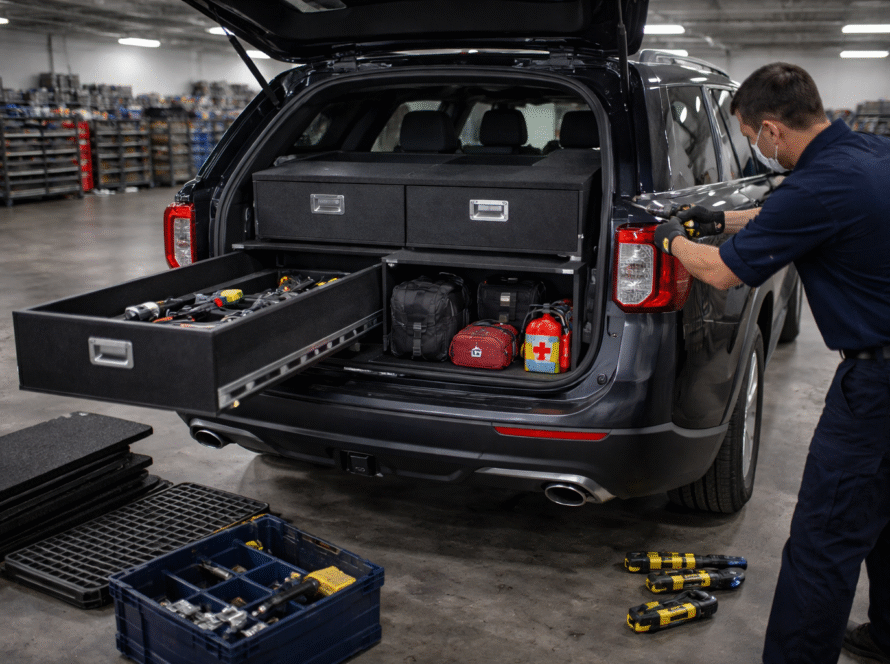
In-house fabrication in upfitting shops is the backbone of high-quality, reliable vehicle customization. Whether you’re building emergency response vehicles, law enforcement fleets, or commercial work trucks, a well-structured fabrication workflow ensures consistency, safety, and efficiency. Implementing strong best practices for fabrication not only enhances build quality but also reduces delays and costly rework key to maintaining customer satisfaction in a competitive upfitting industry.
When it comes to emergency vehicle upfitting, precision and reliability are everything. Every fabricated part from custom brackets and consoles to mounts and shelving must perform under demanding, mission-critical conditions. By keeping fabrication in-house, upfitting companies can maintain better control over materials, design, and turnaround time while delivering fully customized solutions that meet strict agency and fleet standards.
1. Establishing a Streamlined Fabrication Workflow
The first step in improving in-house fabrication is designing a workflow that minimizes bottlenecks. A good workflow moves projects smoothly through stages such as design, material preparation, cutting, assembly, finishing, and quality control.
Key elements of a streamlined workflow include:
-
Clear job documentation – Blueprint drawings, CAD models, and fabrication notes should be accessible to every team member.
-
Dedicated fabrication zones – Organize separate work areas for cutting, welding, assembly, and finishing to avoid cross-contamination and clutter.
-
Real-time communication tools – Digital project boards or fabrication management software help track job progress, timelines, and approvals.
A well-defined workflow not only boosts productivity but also ensures that each upfitted vehicle leaves the shop meeting exact specifications and performance expectations.
2. Investing in Skilled Technicians and Training
In-house fabrication quality heavily depends on skilled technicians. Investing in continuous training — from welding certifications to CAD software updates ensures your team stays current with evolving materials and safety standards.
Encourage cross-training among technicians to build flexibility within your team. A fabricator who understands both electrical systems and structural welding can prevent design conflicts early in the process, saving time and resources.
When your team has a deep understanding of upfitting standards like NFPA 1901 (fire apparatus), SAE J2498 (emergency lighting), or CALEA compliance, the results speak for themselves — safer, more durable vehicle builds.
3. Material Selection and Inventory Management
Selecting the right materials for fabrication directly impacts performance and longevity. Aluminum, stainless steel, and composite materials are common in modern vehicle upfits due to their strength-to-weight advantages.
Best practices include:
-
Use corrosion-resistant metals for long-term durability in high-demand applications.
-
Standardize materials to reduce waste and simplify procurement.
-
Implement an inventory control system that tracks raw materials and consumables, ensuring availability without overstocking.
By managing materials efficiently, upfitting shops can maintain consistent quality while reducing operational costs — a win-win for both shop owners and clients.
4. Quality Control and Safety Protocols
Safety and consistency must be integral to every fabrication process. Establishing clear quality control checkpoints throughout the workflow prevents errors from progressing downstream.
Effective quality control includes:
-
Visual inspections of welds, cuts, and finishes.
-
Functional testing of fabricated components before installation.
-
Compliance verification against OEM and industry standards.
Safety training is equally critical. Every technician should follow OSHA standards for welding, grinding, and lifting operations. Shops that prioritize safety not only protect their workforce but also gain trust from clients who depend on reliable, mission-ready vehicles.
5. Leveraging Technology for Precision Fabrication
Modern upfitting shops are adopting advanced technologies to optimize fabrication processes. CNC plasma cutters, laser engravers, and 3D printers allow for faster, more precise fabrication with minimal waste.
Digital tools such as CAD/CAM software streamline communication between design and production teams, ensuring every component fits seamlessly within a vehicle’s layout. Additionally, adopting digital measurement systems helps reduce human error a crucial factor in upfitting where millimeter accuracy can affect fit and function.
6. Collaboration Between Fabrication and Installation Teams
Strong coordination between fabrication and installation teams ensures that custom parts integrate seamlessly during vehicle assembly. Before final fabrication, the installation team should review prototype designs and provide feedback on ergonomics, accessibility, and wiring clearances.
Regular interdepartmental meetings keep everyone aligned and improve turnaround time for fleet deliveries. When fabrication and installation teams work as one, the result is smoother production and fewer last-minute adjustments.
7. Continuous Improvement and Documentation
An often-overlooked best practice in in-house fabrication is documentation. Tracking job performance, material usage, and time spent on each stage helps identify inefficiencies and training needs.
Implementing a continuous improvement program based on real-time shop data can reduce waste, improve build accuracy, and enhance team productivity. Even minor adjustments in workflow or tooling can deliver significant gains over time.
Conclusion
In-house fabrication is not just about cutting and welding — it’s about delivering precision-engineered solutions that meet the unique demands of every client. For upfitting shops, mastering workflow and fabrication best practices translates into better quality, faster delivery, and increased customer trust.
If your agency or company needs reliable, fully customized vehicle solutions, the experts at OCM Upfitting are here to help. From concept to completion, we specialize in advanced in-house fabrication and emergency vehicle upfitting tailored to your mission’s requirements.
? Ready to upgrade your fleet? Book your appointment today or contact our specialists to discuss your next project.